




New Cryogenic Shape Memory Alloy Designed for Outer Space
A new study analyzes the use of shape memory alloys in developing thermally driven actuators for spacecraft operating space exploration missions.
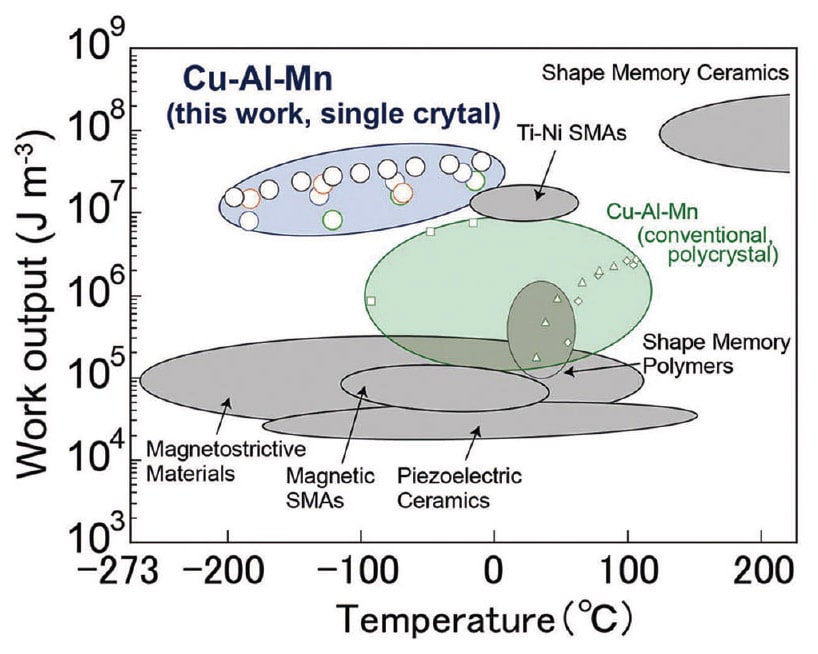
A study led by Tohoku University, Iwate University, The Japan Aerospace Exploration Agency (JAXA), National Astronomical Observation of Japan, Tokyo City University, and Kyoto University developed a novel copper-based alloy that exhibits a special shape memory effect at temperatures as low as -200 °C. Shape memory alloys can be deformed into different shapes when cold, but will revert back to their original shape when heated (as if “remembering” their default state, like memory foam). This exciting new alloy has the potential to be used for space equipment and hydrogen-related technologies, where challenging, cold environments below -100 °C are the norm.
Previously studied shape memory alloys using Ni-Ti could not maintain their shape memory ability below -20 °C, despite their otherwise practical characteristics. In contrast, the known existing shape memory alloys that can actually operate below -100 °C aren’t suitable for practical implementation. This study met the challenge of finding the first functional actuator material capable of large work output at temperatures below -100 °C. Actuators are components that turn some sort of input into mechanical energy (movement). They can be found not only in machines bound for outer space, but in everyday devices all around us.
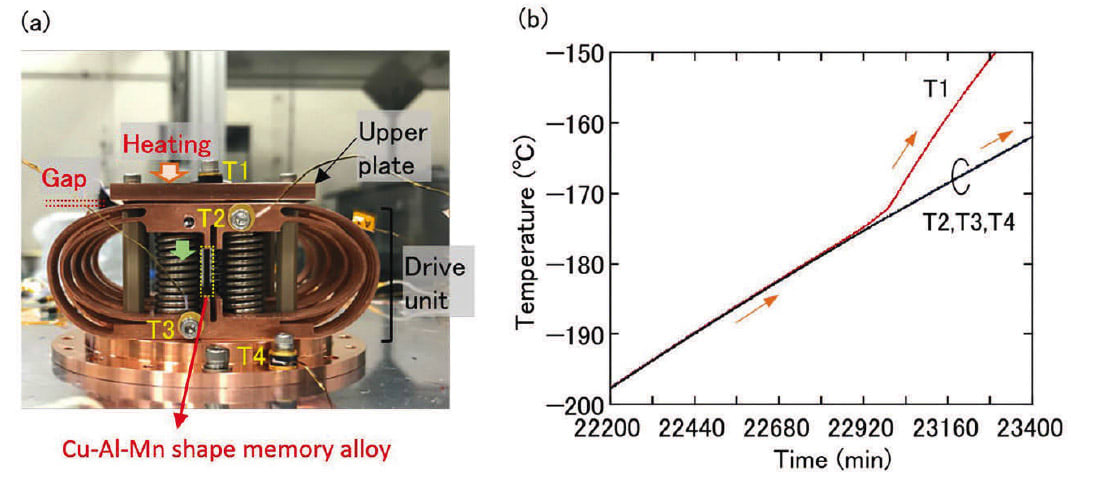
The team of researchers prototyped a mechanical heat switch using a new alloy (Cu-Al-Mn) as an actuator. This switch was shown to operate effectively at -170 °C, controlling heat transfer by switching between contact and non-contact states based on temperature changes. The operating temperature of the alloy can be adjusted by modifying its composition.
“We were very happy when we saw that it worked at -170 °C,” remarks Toshihiro Omori, from Tohoku University, “Other shape memory alloys simply can’t do this.”
The Cu-Al-Mn alloy is the first actuator material capable of large output at temperatures below -100°C. This development paves the way for the realization of high-performance actuators that can operate even under cryogenic conditions, which could not be realized before. Potential applications include a reliable mechanical heat switch for cooling system in space telescopes. The simplicity and compactness of such mechanical heat switches make them a crucial technology for future space missions and for advancing carbon-neutral initiatives like hydrogen transportation and storage.
This article was written by a team of researchers from Tohoku University. For more information, contact Toshihiro Omori,
More From SAE Media Group
Tech Briefs
Thin Film Sensor for Ultra High-Temp Measurement
Aerospace Manufacturing and Machining INSIDER
Can This Self-Healing Composite Make Airplane and Spacecraft Components Last for Centuries?
Aerospace INSIDER
Using Ultrabright X-Rays to Test Materials for Ultrafast Aircraft
Tech Briefs
Adaptive Thermal Management System
Aerospace & Defense Tech Briefs
Physics-Guided Neural Network for Regularization and Learning Unbalanced Data Sets
Aerospace & Defense Tech Briefs
Researchers Discover New Materials That Could Enhance Fighter Jet Efficiency
Aerospace INSIDER
Shaping Aviation: Metal with Memory
Automotive Engineering
Lyten Says 3D Graphene Could Disrupt Racing, Automotive and Space
Aerospace & Defense Tech Briefs
Zwick Roell Provides Flexible Materials Testing over a Wide Temperature Range
Aerospace & Defense Tech Briefs
European Researchers Leverage AI in Manufacturing Rocket Parts
Aerospace & Defense Tech Briefs
New Copper Alloy Could Provide Breakthrough in Durability for Military Systems
Aerospace INSIDER
A New Platform for Developing Advanced Aerospace Metals at Scale
Off-Highway Engineering
NASA Highlights Material and Coating Technology Ready for Commercial Applications
Aerospace INSIDER
Characterizing the Performance of Variable Emissivity Materials in Space
Tech Briefs
High-Temperature Ni-Based Superalloy Composition
Aerospace & Defense Tech Briefs
Acceleration Resistant HiK Heat Spreader

Tech Briefs
Products of Tomorrow

Aerospace INSIDER
Ceramic Matrix Composites Offer Lighter, More Durable Engine Parts
Aerospace & Defense Tech Briefs
Designing for Space and Other Extreme Environments
Aerospace & Defense Tech Briefs
SAE International Issues First Technical Standards for Aerospace Additive Manufacturing
Aerospace & Defense Tech Briefs
Shape-Shifting Antenna Poised to Transform Communications
Tech Briefs
Products of Tomorrow
Tech Briefs
Replacing Thick Insulation with Thin MXenes
NASA Spinoff
Aerogel Insulation Makes Thinner, Warmer Outerwear
Tech Briefs
Keeping Warmer in the Great Outdoors
Aerospace & Defense Tech Briefs
Unlocking the Potential of 3D-Printed Polymers in Aerospace and Defense
Aerospace & Defense Tech Briefs
FibreCoat’s New Radar-Absorbing ‘Stealth’ Fiber Reinforced Composites for Spacecraft, Aircraft and Tanks
Top Stories
INSIDERMaterials
 How Airbus is Using w-DED to 3D Print Larger Titanium Airplane Parts
INSIDERManned Systems
 FAA to Replace Aging Network of Ground-Based Radars
NewsAR/AI
 CES 2026: Bosch is Ready to Bring AI to Your (Likely ICE-powered) Vehicle
NewsAR/AI
 Accelerating Down the Road to Autonomy
INSIDERManufacturing & Prototyping
 Can This Self-Healing Composite Make Airplane and Spacecraft Components Last...
EditorialTransportation

Webcasts
Energy
 Hydrogen Engines Are Heating Up for Heavy Duty
Transportation
 Advantages of Smart Power Distribution Unit Design for Automotive...
Transportation
 Quiet, Please: NVH Improvement Opportunities in the Early Design...
Power
 A FREE Two-Day Event Dedicated to Connected Mobility
Connectivity
 E/E Architecture Redefined: Building Smarter, Safer, and Scalable Vehicles
Defense
 How Sift's Unified Observability Platform Accelerates Drone Innovation