




Imaging and Spectral Measurements of Explosions
A document describes experiments performed to investigate rates of delivery of energy onto targets from different explosive formulations. The experiments were designed to measure relative positions of blast fireballs and leading shock fronts; determine whether different explosive formulations exhibit unique spectral signatures; determine temperatures of gases and solids near fireball surfaces; and measure rates of heating as functions of time. In the experiments, unconfined explosions were observed using time-resolved laser shadowgraphy, spectrometry integrated over the first 50 ms following initiation, time-resolved three-wavelength pyrometry, and time-resolved heat-flux measurements.
Different explosives tested produced fireballs having different peak temperatures at ≈1 ms after initiation. For all explosives, fireball temperature varied relatively slowly from ≈5 to ≈55 ms after initiation. Pyrometer and heat-flux measurements were interpreted as suggesting that fireballs consist of collections of flamelets. Shadowgraphs were interpreted as suggesting that fireballs attain nearly full volume and then burn towards maximum heat flux. For aluminized explosives, spectral features at wavelengths near 394 nm and 396 nm from gas-phase aluminum and a band at 484 nm from gas-phase AlO were used as indications of burning of aluminum and as secondary sources of temperature information.
This work was done by Thuvan Piehler, Barrie Homan, Rachel Ehlers, Richard Lottero, and Kevin McNesby of the Army Research Laboratory. ARL-0040
This Brief includes a Technical Support Package (TSP).
Imaging and Spectral Measurements of Explosions
(reference ARL-0040) is currently available for download from the TSP library.
Don't have an account?
More From SAE Media Group
Photonics Tech Briefs
Hot Dielectrics as Light Sources for TPV Devices and Lasers
Aerospace & Defense Tech Briefs
Detecting Explosives by Use of LIBS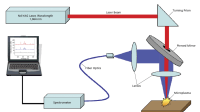
Photonics & Imaging Technology
Ultra-Narrowband Optical Filters Pushing Boundaries from the UV to the LWIR
Photonics & Imaging Technology
New Frequency Comb Can Identify Molecules in 20-Nanosecond Snapshots
Aerospace & Defense Tech Briefs
Detecting Trace Levels of Explosives Using Vibrational Sum Frequency Spectroscopy
Tech Briefs
Products of Tomorrow

Tech Briefs
Rare-Earth Optical Temperature Sensors


Aerospace & Defense Tech Briefs
This Laser Clock Could Transform Satellite Navigation Accuracy
Tech Briefs
Thermogravimetric Analysis With Laser Heating
Photonics Tech Briefs
Low-Resolution Raman-Spectroscopy Combustion Thermometry
Electronics Tech Briefs
Exploiting Ion/Atom Cold Collisions in Atomic Clocks
Tech Briefs
Tunable, Narrow Linewidth, Chip-Scale Lasers

Aerospace & Defense Tech Briefs
Uncooled Tunable LWIR Microbolometers


Tech Briefs
Levitating Objects with Light
Electronics & Sensors INSIDER
Two-Dimensional Hybrid Metal Halide Device Allows Control of Terahertz Emissions

Motion Design INSIDER
Friction That Cools
Electronics & Sensors INSIDER
New Atom-Based Thermometer Measures Temperature More Accurately
Aerospace & Defense Tech Briefs
Next-Generation Spectrometers for Rapid Analysis of Complex Mixtures
Tech Briefs
System for Thermal Imaging of Hot Moving Objects

Electronics & Sensors INSIDER
Ultra-Thin Terahertz Source Paves the the Way to Next Generation of Communication Tech
Overview
The document titled "High-Speed Laser Imaging, Emission and Temperature Measurements of Explosions" presents research conducted by Thuvan Piehler and colleagues, focusing on advanced measurement techniques for analyzing explosive events. This report, a reprint from the 2006 Insensitive Munitions & Energetic Materials Technology Symposium, details the methodologies and findings related to high-speed imaging, optical temperature measurements, and emission analysis of combustion products from explosives.
The study employs a high-speed camera synchronized with a Cu-vapor laser to capture high-brightness images of fireballs produced during explosive detonations. The imaging system operates at a wavelength of 510 nm and a frequency of 12 kHz, allowing for detailed temporal resolution of the explosive events. The report emphasizes the importance of capturing these images to understand the dynamics of explosions better.
In addition to imaging, the researchers utilized three-color pyrometry to measure the temperature of the fireballs generated by the explosions. This technique involves using multiple narrow bandpass filters and photodiode detectors to accurately assess the thermal characteristics of the fireball, providing insights into the heat generated during the detonation process.
The document also discusses the use of a grating-based modular spectrograph for emission measurements in the visible spectrum. This spectrograph is crucial for analyzing the light emitted during explosions, which can reveal information about the chemical composition and behavior of the combustion products.
The findings of this research contribute significantly to the field of explosive materials and safety, offering valuable data that can enhance the understanding of explosive behavior and improve safety protocols. The report is unclassified and approved for public release, ensuring that the knowledge gained can be disseminated widely for further research and application.
Overall, the document highlights the innovative approaches taken by the Army Research Laboratory in studying explosive phenomena, showcasing the integration of high-speed imaging and optical measurement techniques to advance the understanding of explosive dynamics. The research not only aids in the development of safer munitions but also enhances the scientific community's knowledge of energetic materials.
Top Stories
INSIDERManufacturing & Prototyping
 How Airbus is Using w-DED to 3D Print Larger Titanium Airplane Parts
INSIDERManned Systems
 FAA to Replace Aging Network of Ground-Based Radars
NewsTransportation
 CES 2026: Bosch is Ready to Bring AI to Your (Likely ICE-powered) Vehicle
NewsSoftware
 Accelerating Down the Road to Autonomy
EditorialDesign
 DarkSky One Wants to Make the World a Darker Place
INSIDERMaterials
 Can This Self-Healing Composite Make Airplane and Spacecraft Components Last...
Webcasts
Defense
 How Sift's Unified Observability Platform Accelerates Drone Innovation
Automotive
 E/E Architecture Redefined: Building Smarter, Safer, and Scalable...
Power
 Hydrogen Engines Are Heating Up for Heavy Duty
Electronics & Computers
 Advantages of Smart Power Distribution Unit Design for Automotive...
Unmanned Systems
 Quiet, Please: NVH Improvement Opportunities in the Early Design...
