




Charging Up Electrified Powertrains
Control technologies race forward while batteries improve and adopt standard sizes.

Battery-powered vehicles still represent a small niche in most vehicle markets, but concern over higher fuel prices and tighter emissions regulations continue to spark investments in electrified powertrains. Off-highway developers are looking at technologies and techniques that make electrification more viable.
Many of the advances in commercial and industrial vehicles follow the developments of high-volume passenger cars. But system designers note that in off-highway vehicle programs, design teams must consider the vehicle’s usage model and design all elements in a holistic fashion.
“The overall system — engine, electric motors, batteries, and drivetrain — needs to be optimized in the context of the overall vehicle, looking at machine productivity, functionalities, fuel consumption, cost, and other needs,” said Kiran Govindswamy, Powertrain Director at FEV North America. “The hybrid layout, component selection, thermal management, and controls strategy needs to be based on operating the powertrain components in their most efficient operating ranges while satisfying the propulsion and productivity demands of the vehicle.”
A battery of resolutions

Some key goals for system designers sound much like New Year’s resolutions. They want to trim the size and weight of battery packs and be able to accomplish more before running out of energy. Developers are taking two paths to address those challenges: improving battery chemistries and enhancing control functions.
Engineers have figured out how to get more energy from smaller battery packs. In the early days of electrified powertrains, developers typically built in a lot of headroom to ensure that batteries were recharged in ways that ensured that the batteries lasted several years.
Those additional batteries consumed valuable space and added cost. As engineers learned more about lithium-ion battery lifetimes, they figured out how to avoid adding lots of extra cells to level loads and extend lifetimes.
“There’s definitely been improvement in batteries, both in performance and in a better understanding of their lifetimes,” said Jason McConnell, Business Unit Director, Electrification & Hybrid, at IAV Automotive Engineering. “The thermal use case is much better understood. Feedback from the auto industry proved that lithium battery systems were way overdesigned for their use.”
Keeping batteries at the right temperature is a key aspect of extending their lifetimes. Improved sensors have helped improve thermal management, which helps increase lifetimes. Given the long use cycles of industrial vehicles, that’s a critical factor.
“Thermal behavior is of great importance during both charge and discharge cycles,” Govindswamy said. “Controlling a cell’s temperature within an allowable SOC range is important to ensure that a thermal runaway condition does not present itself. Battery management system software algorithms will have to be adapted to account for different duty cycles.”
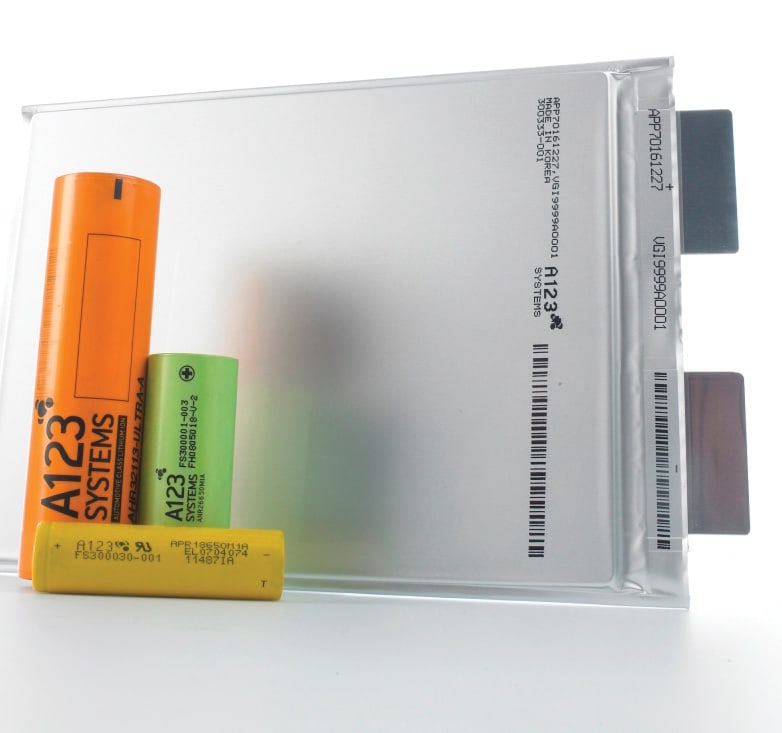
Prices drop when these batteries are better managed, since extra cells can be eliminated. Battery sizes have standardized, though there are still a number of form factors. Some applications use fairly small cells, which can be easier to cool.
“The basic building block, cells, come in form factors a bit like AA batteries to cans that are bigger, and there are more rectangular batteries,” McConnell said. “Everyone wants to use modules. In buses and commercial trucks, they want flexibility; they have different pockets of space for batteries. They want to put them where they fit.”
He added that many OEMs are using large, flat cells. They can be stacked together to provide more capacity than smaller cells.
“Instead of being the size of a deck of cards, many batteries tend to move toward something about the size of an 8.5 x 11 sheet of paper,” McConnell said. “Their thickness depends on their capacity — a 20 A·h cell is thinner than a 50 A·h cell.”
Many technologies
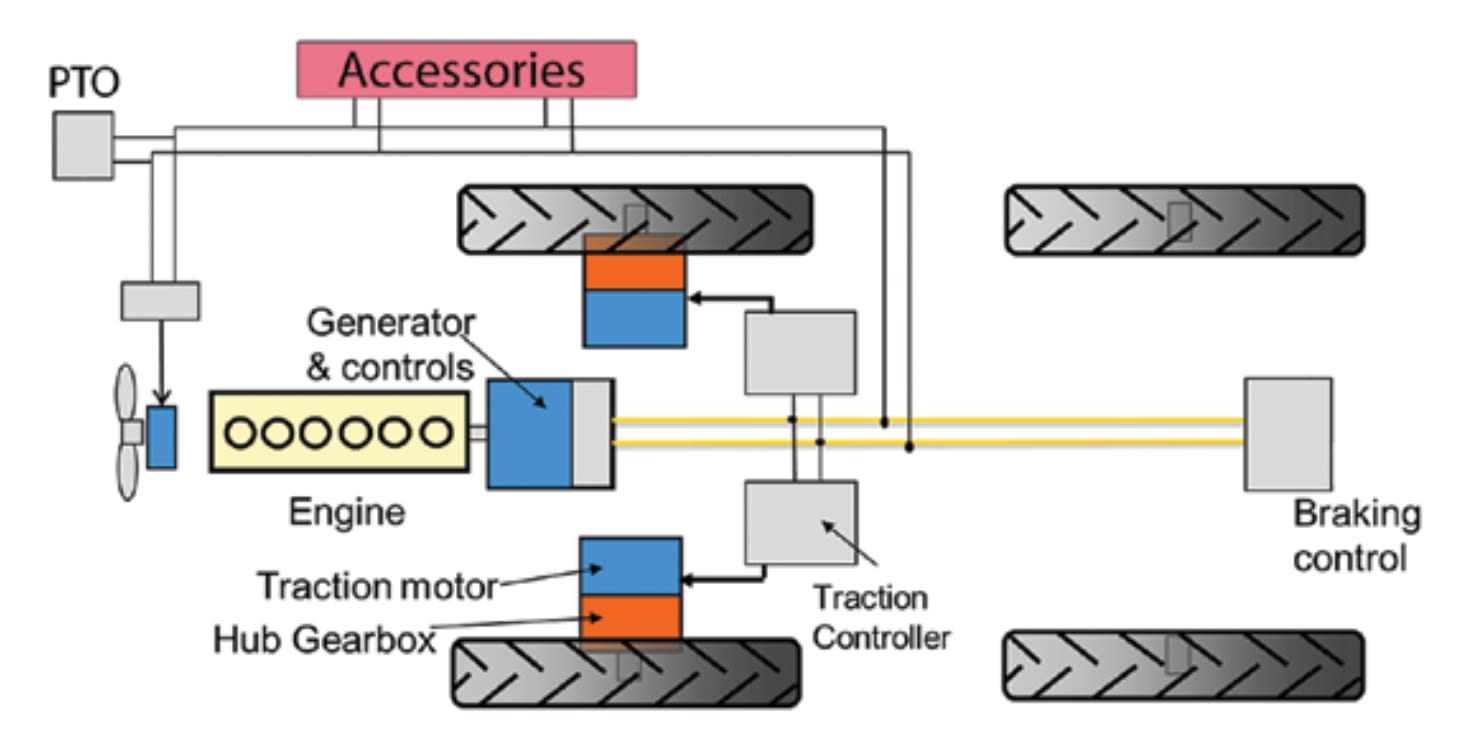
Component makers throughout the supply chain are introducing improvements that make electric power more viable. Vertically integrated companies are creating components that help them improve the efficiency of their hybrids. John Deere’s wheel loader line has included a pair of hybrids, the 644K and 944K, for some time.
Last year, John Deere Electronic Solutions unveiled its PD400 modular inverter for high voltage/high power applications. It eliminates multiple connector and cooling interfaces so designers at Deere and other companies can shorten development times. There can be several inverters in a hybrid system, so simplifying design and cutting costs can bring significant overall benefits.
High power devices haven’t seen the rapid advances of the digital world, but that’s changing. Technologists continue to improve efficiency by replacing technologies that have been in place for decades. For example, the long run of dominance for three-phase inverters is now being challenged.
“Inverters are becoming more efficient and using better packaging,” McConnell said. “Most machines now use three-phase devices, but they’re going to six and even nine phases to improve switching efficiency and reducing torque ripple.”
Electronic controls are letting engineers do more with motors. Helped by modeling and simulation tools, design teams are maximizing the effectiveness of mainstream electric motors.
“Motors are much more robust, largely because of how they are controlled,” McConnell said. “A lot of advances in motor control come from using advanced math and modeling to get better control and run the motors as efficiently as possible. Modeling helps to maintain peak torque and peak efficiency.”
The mechanical interfaces between motors and actuators are also improving. Developers are finding new ways to reduce loss and simplify gear designs.
“There have been improvements on the gearbox side,” McConnell said. “In off-highway, you want to go to a multi-speed gearbox, not the single-speed gearboxes used by Tesla and some other electric vehicles.”
More From SAE Media Group
Battery & Electrification Technology
Ultracapacitor Solutions to Address Energy-Storage Needs of Vehicles
Automotive Engineering
GM: Ultium Heat-Pump System Boosts EV Range, Reduces Charge Times
Off-Highway Engineering
Nikola Producing Battery-Electric Trucks, Fuel-Cell EVs Coming
Off-Highway Engineering
Overcoming EV Drivetrain Testing Challenges
Off-Highway Engineering
CES 2025: Cat Debuts Hybrid-Electric Retrofit on 972 Wheel Loader
Automotive Engineering
FEV and the Art of EV Testing
Automotive Engineering
The Path to Better, Smarter Vehicle Charging
Off-Highway Engineering
Rexroth Takes Aim at Electrification for Off-Highway Vehicles
Automotive Engineering
The Bi-Directional Bonus for EVs
Battery Technology
Advancing Battery Technology: THE 2021 BATTERY SHOW Preview
Off-Highway Engineering
Commercial-Vehicle Battery Producer Sets up in U.S. as Electrification Takes Hold
Power Electronics INSIDER
An Electrifying Collaboration: From the Lab to the Marketplace
Off-Highway Engineering
Electric Mobile Machines Won’t Abandon Hydraulics
Off-Highway Engineering
FEV Simplifies Off-Highway Electrification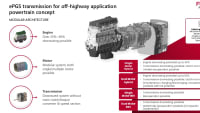
Off-Highway Engineering
ABS Ramps up Commercial-Vehicle Battery-Pack Assembly
Off-Highway Engineering
Challenges and Opportunities of Electrifying Off-Highway Machines
Off-Highway Engineering
How Battery Technology Will Drive Truck Electrification
Off-Highway Engineering
Electric Machines Find Their Niche
Automotive Engineering
BP’s Nexcel Sealed-Cell Oil System an Alternative for Controlling GHG Emissions
Automotive Engineering
The ONE for Battery Innovation
Off-Highway Engineering
Unique Hybrids Required
Off-Highway Engineering
Vanguard Swappable and Fixed Batteries Aim to Electrify the Jobsite
Automotive Engineering
ZF Introduces Complete E-Drive System for Passenger, Commercial Vehicles
Automotive Engineering
Developing High-Energy-Density Batteries for EVs
Automotive Engineering
Engineering Flexibility into EV Powertrains
Automotive Engineering
Elevate: Hyundai’s New Four-Wheel Drive, Four-Legged Off-Road Vehicle
Off-Highway Engineering
Case Launches ‘Industry First’ Electric Backhoe Loader
Tech Briefs
Top 10 Most-Read Tech Briefs Stories of 2022
Off-Highway Engineering
Yanmar, ELEO Announce Electrification Strategy for Off-Highway Sector
Top Stories
INSIDERManufacturing & Prototyping
 How Airbus is Using w-DED to 3D Print Larger Titanium Airplane Parts
INSIDERManned Systems
 FAA to Replace Aging Network of Ground-Based Radars
NewsTransportation
 CES 2026: Bosch is Ready to Bring AI to Your (Likely ICE-powered) Vehicle
NewsSoftware
 Accelerating Down the Road to Autonomy
EditorialDesign
 DarkSky One Wants to Make the World a Darker Place
INSIDERMaterials
 Can This Self-Healing Composite Make Airplane and Spacecraft Components Last...
Webcasts
Defense
 How Sift's Unified Observability Platform Accelerates Drone Innovation
Automotive
 E/E Architecture Redefined: Building Smarter, Safer, and Scalable...
Power
 Hydrogen Engines Are Heating Up for Heavy Duty
Electronics & Computers
 Advantages of Smart Power Distribution Unit Design for Automotive...
Unmanned Systems
 Quiet, Please: NVH Improvement Opportunities in the Early Design...
