




Commercial-Vehicle Battery Producer Sets up in U.S. as Electrification Takes Hold
With commercial-vehicle electrification advancing, a longstanding battery specialist Akasol packs industry-leading energy density into a new battery design.

Projecting the market for full-electric and hybrid-electric commercial vehicles will continue to expand, Germany-based lithium-ion battery specialist Akasol recently announced production-readiness of a newly-developed battery pack that sets an energy-density benchmark. The company’s president also confirmed Akasol will build a manufacturing facility in the Detroit area targeted to begin production in mid-2020.
Akasol has a 30-year history of producing battery systems for buses and other commercial vehicles, as well as railway and marine applications. President Roy Schulde (left) says the new American plant is being constructed primarily to build battery packs for buses constructed by European-brand customers doing business in the U.S. The company already claims Europe’s largest commercial-vehicle lithium-ion battery production facility.

But as regulatory and environmental interests dictate electrification alternatives to traditional internal-combustion powertrains for all manner of commercial vehicles, Schulde said Akasol sees the off-highway sector growing. He said smaller-sized construction equipment intended for use in urban and indoor areas is increasingly targeted for 48-volt electric systems, as well as higher-voltage applications of 600V or 660V for larger machines.
New standard for energy density
At the recent Battery Show North America, Akasol showcased its new AKASystem AKM CYC battery, a nickel-manganese cobalt (NMC) lithium-ion chemistry that the company said achieves an industry-leading 221 Wh/kg. Designed as a modular and scalable battery for high-power/long-range in vehicles such as city buses, the system is liquid cooled and capable of accepting high fast-charging rates required for many commercial-vehicle applications.
Schulde noted the desire for higher energy density is coming from customer feedback. Fully electric buses currently are fitted with anywhere from 600 kWh battery packs up to 1,000 kWh. The AKASystem AKM CYC battery is designed in two standard module sizes – AKAModule 64 CYC and AKAModule 150 CYC – with the larger offering integrating liquid cooling to help manage cell temperatures.
The new battery is based on specially designed 21700-format cylindrical cells that rival current solid-state battery technology. Schulde told SAE that Akasol is keeping an eye on solid-state battery developments and is trying to be “cell-agnostic,” but for now, NMC chemistry is the company’s focus.
“With this technology, AKASOL is able to outperform today’s solid-state technology in terms of price competitiveness and availability, while increasing energy density by approximately 30-40%,” Schulde said. “The solution also can be used for fast charging, which is particularly important for increasing the uptime of commercial vehicles. AKASOL plans to bring the solution to serial production in 2021 and already has customers starting sample operation by the end of this year.”
More From SAE Media Group
Off-Highway Engineering
Volvo Trucks’ Battery Chemistry of Choice: NCA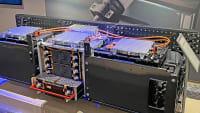
Off-Highway Engineering
How Battery Technology Will Drive Truck Electrification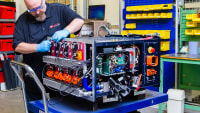
Off-Highway Engineering
Yanmar, ELEO Announce Electrification Strategy for Off-Highway Sector
Off-Highway Engineering
Batteries Not the Only Route to EV Efficiency
Off-Highway Engineering
Battery Innovation Key for Commercial and Off-Highway EVs
Tech Briefs
Factorial’s Solid-State B-Samples Send a Message
Off-Highway Engineering
Next Steps Toward Battery-Electric Class 8 Trucks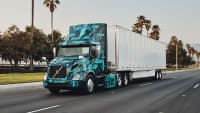
Off-Highway Engineering
Brownout for Commercial-Vehicle Electrification?
Off-Highway Engineering
ABS Ramps up Commercial-Vehicle Battery-Pack Assembly
Off-Highway Engineering
Vanguard Swappable and Fixed Batteries Aim to Electrify the Jobsite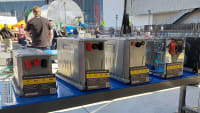
Off-Highway Engineering
Nikola Producing Battery-Electric Trucks, Fuel-Cell EVs Coming
Off-Highway Engineering
Quantron Launches 12-M Battery-Electric Bus; Fuel-Cell Variant to Follow
Off-Highway Engineering
Bigger Barrier to CBEVs: Batteries or Infrastructure?
Off-Highway Engineering
Mega Push for Heavy-Duty EV Charging
Off-Highway Engineering
Hydrogen ‘Inevitable’ for Commercial Vehicles
Off-Highway Engineering
Making the Case for Battery-Electric Fleet Power
Automotive Engineering
BEV Heat Pumps Recovering Cost Investments
Off-Highway Engineering
Narrower Focus, Bigger Payoff for Commercial EVs
Automotive Engineering
Tariff Challenges, EV Advances at Mobility 360
Off-Highway Engineering
Caterpillar Ventures Invests in Fisker for Electric Future
Automotive Engineering
Wireless Road Charging for EVs to Debut in 2023
Automotive Engineering
BMW Plans Move to Structural Battery Packs and ‘46120’ Cells
Off-Highway Engineering
Lightning EMotors Adapts to Changing Electrification Market
Off-Highway Engineering
Freudenberg to Deliver Batteries, Fuel-Cell Stacks
Off-Highway Engineering
FPT’s Battery Pack Dives into Marine Market
Off-Highway Engineering
Deere Pursues Electric Construction Machines and Charging Infrastructure
Automotive Engineering
Nissan's Innovative Solid-State Gambit
Automotive Engineering
Brunswick Launches All-Electric Marine Outboard
Automotive Engineering
Battery Show 2022: Wireless EV Charging, Scaling Gigafactories

Top Stories
NewsRF & Microwave Electronics
 Microvision Aquires Luminar, Plans Relationship Restoration, Multi-industry Push
INSIDERAerospace
 A Next Generation Helmet System for Navy Pilots
INSIDERDesign
 New Raytheon and Lockheed Martin Agreements Expand Missile Defense Production
INSIDERMaterials
 How Airbus is Using w-DED to 3D Print Larger Titanium Airplane Parts
NewsPower
 Ford Announces 48-Volt Architecture for Future Electric Truck
ArticlesAR/AI

Webcasts
Electronics & Computers
 Cooling a New Generation of Aerospace and Defense Embedded...
Automotive
 Battery Abuse Testing: Pushing to Failure
Power
 A FREE Two-Day Event Dedicated to Connected Mobility
Unmanned Systems
 Quiet, Please: NVH Improvement Opportunities in the Early Design Cycle
Automotive
 Advantages of Smart Power Distribution Unit Design for Automotive &...
Energy
 Sesame Solar's Nanogrid Tech Promises Major Gains in Drone Endurance