




Mazda Motorsports Keeps the MX-5 Cool with a New Differential Plate
Mazda has developed an ingenious solution to help late model MX-5 differentials stay frosty on track.

Mazda Motorsports, the company’s North American-based racing program, serves as a support network for thousands of professional and amateur racers at road courses around the United States. In addition to contingency programs, discounted OEM parts and a ladder system into the professional ranks, the program also maintains a catalog of competition parts designed specifically for the rigors of racing.

One of the recent additions to Mazda’s competition parts catalog is a differential cooling plate. The unit is intended for racers piloting the third generation MX-5 roadster (known by its model code, NC). The unit reportedly provides a significant upgrade in the cooling performance and improves longevity of the vehicle’s rear differential.
According to Mazda, the oil temperatures in a stock NC differential can become very hot during competition use. Mazda states that they have data showing operating temperatures of over 325 Fahrenheit (163 Celsius) on multiple occasions, which is too high for the fluid to work effectively.
To mitigate this issue, Mazda Motorsports has developed a plate that sits between the factory differential housing and cover.
It features strategically positioned ports for fluid circulation, including in/out oil lines and a dedicated temperature sensor port. The plate has fins on all sides serving as heat sinks. Dowel pins are included to ensure correct alignment during installation and a reusable steel/rubber-coated gasket simplifies rear cover plate removal for routine maintenance.

“The plate by itself is all most sprint racers are going to need,” said Josh Smith, business development manager, Mazda Motorsports, in an interview with SAE Media. “But if you’re running an NC in an endurance environment, it’s set up to attach additional coolers. We made sure (the plate) was spraying fluid on parts that need cooling by directing it where you want it to be on the gear stack.”

Smith explained the development process of the plate and how Mazda determined that this was a weak point for this chassis. “We had an Achilles heel in the NC differential from the OE standpoint and wanted to fix that,” he explained. “Our sprint racers did not want to justify the cost of an entire differential cooling system with fans and other components. So, we were trying to find an elegant solution that added minimal cost to the car, but reduced the operating temperature of the fluid and allowed an upgrade path for the future.”
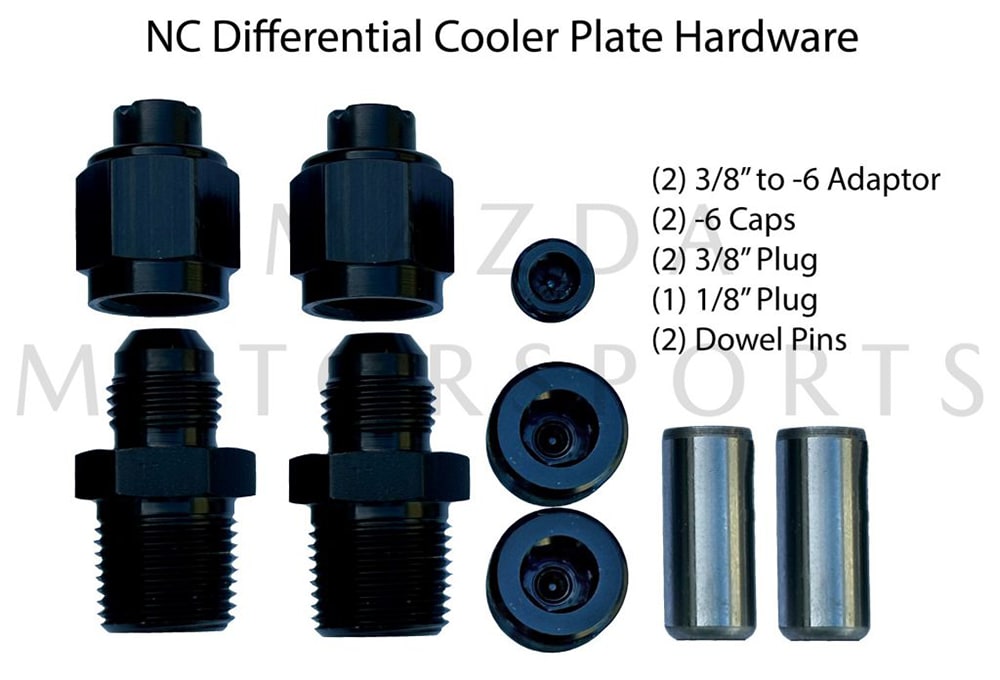
Smith continued, “There’s no expensive fluid you can use to fix the issue because there’s no airflow and the exhaust is also located right next to the unit. So additional capacity and a heat sink was the logical solution.” Smith said that during testing of the unit, vehicles using just the just the plate saw max operating temperatures of 300 degrees versus the factory configuration.
“With just the plate, it took two hours of constant use to reach that temperature. That’s a 30–50-degree delta from the factory setup, which would reach those temperatures in just 20 minutes,” he said. “If you’re sprint racing for an hour or less, the spacer is all you need. If you’re running for over an hour, you’ll want the spacer with a pump and other components because it will eventually heat soak out.”
Smith estimates that there are between 25-30 examples of the plates currently in circulation. Mazda Motorsports is currently developing a comprehensive kit featuring a cooler, pump and filter. The system will be designed for ease of installation and maintenance and will mount on a removable plate in the trunk. In the meantime, if you’re a Mazda racer looking for a way to keep your rear differential cooler, look for part number 0000-02-5580 in Mazda’s catalog.
More From SAE Media Group
Automotive Engineering
Tariff Challenges, EV Advances at Mobility 360
Automotive Engineering
2020 Supra: Toyota's Japanese Spin on German Engineering
Automotive Engineering
2018 Porsche 718 Boxster
Automotive Engineering
Driving the New Nissan Leaf Prototype
Automotive Engineering
BMW Previews an HMI Future Without Dashboard Screens
Automotive Engineering
Heavy Capability for Chevy’s 2020 Silverado Heavy-Duty Pickups
Automotive Engineering
2019 Dodge Challenger: Deceased Demon Seeds Stronger and Wider Muscle-Car Lineup
Automotive Engineering
Balancing the ‘Dominos’ in EV Thermal Management
Automotive Engineering
A Consumer’s View: Perry Parts 3D-Printed Bump Stops


Automotive Engineering
Toward an Electric Two-Wheeled Triumph
Automotive Engineering
Raptor 4-Door-Only for 2021; R Version Coming Next Year
Aerospace & Defense Tech Briefs
Thermal Management Techniques in Avionics Cooling
Automotive Engineering
Balancing the Scales in Dakar
Automotive Engineering
Ford’s Latest Mustang Improves the Breed
Automotive Engineering
2025 BMW M5 First Drive: Stuffed like Schnitzel with PHEV Tech
Automotive Engineering
Honda Motocompacto Folding Scooter Is an Accessory with Pep
Aerospace & Defense Tech Briefs
Thermostatic Solutions for Temperature Control Applications
Automotive Engineering
Q&A: What It Takes to Add an E-Axle
Automotive Engineering
Rotax Keeps EV Development In-House
Automotive Engineering
2020 Jeep Gladiator Mojave
Off-Highway Engineering
Leak Testing of Commercial-Vehicle AC Systems Critical as Move to HFO Refrigerants Looms
Off-Highway Engineering
New Generation Orbital X Motors
Automotive Engineering
NAIAS 2019: Shelby GT500 Most Powerful and Advanced Mustang in Ford History
Automotive Engineering
2018 Los Angeles Auto Show: Hyundai Unveils the 2020 Palisade Midsize SUV as Its Flagship
Motion Design
Avoiding Electrical Damage with Conductive Lubrication
Automotive Engineering
Civic Type R Is Honda’s Technology Showcase
Tech Briefs
Cryogenic Cam Butterfly Valve
Top Stories
INSIDERManufacturing & Prototyping
 How Airbus is Using w-DED to 3D Print Larger Titanium Airplane Parts
INSIDERManned Systems
 FAA to Replace Aging Network of Ground-Based Radars
NewsTransportation
 CES 2026: Bosch is Ready to Bring AI to Your (Likely ICE-powered) Vehicle
NewsSoftware
 Accelerating Down the Road to Autonomy
EditorialDesign
 DarkSky One Wants to Make the World a Darker Place
INSIDERMaterials
 Can This Self-Healing Composite Make Airplane and Spacecraft Components Last...
Webcasts
Defense
 How Sift's Unified Observability Platform Accelerates Drone Innovation
Automotive
 E/E Architecture Redefined: Building Smarter, Safer, and Scalable...
Power
 Hydrogen Engines Are Heating Up for Heavy Duty
Electronics & Computers
 Advantages of Smart Power Distribution Unit Design for Automotive...
Unmanned Systems
 Quiet, Please: NVH Improvement Opportunities in the Early Design...
