




Engineers at Cape Optimize Test-rig Performance for Roof-crush Testing
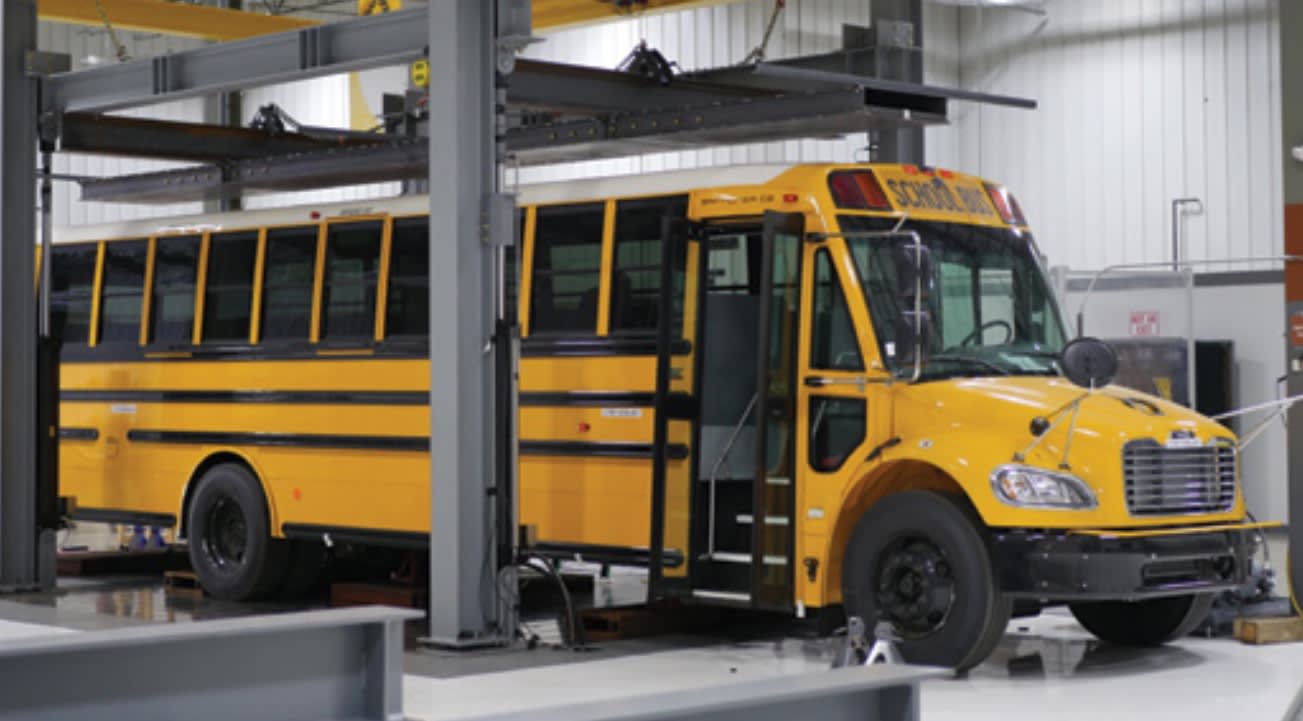
Evaluating how school buses and other commercial vehicles perform in crash-test scenarios is regular practice at the Center for Advanced Product Evaluation (CAPE) in Westfield, Indiana. The center, a unit of advanced vehicular safety systems manufacturer IMMI, designs and builds test rigs that help engineers determine whether there is survivable space inside the vehicle, and whether the vehicle’s body-to-frame mounting system is sufficiently strong to withstand a rollover incident.
The tests performed at CAPE are typically designed to prove that vehicle manufacturing processes comply with standards set by organizations such as SAE International and the National Fire Protection Association (NFPA).
CAPE’s engineering team recently completed development of a test rig that can provide vehicle OEMs with roof-crush testing up to 100 tons (890 kN). The unit can also be used to test off-road vehicle roll cages and racecar chassis. The rig uses four hydraulic actuators (cylinders), mounted at the four corners of a heavy-gauge pressure plate and controlled as four separate motion axes.
At the core of the new test system is an eight-axis RMC150 electro-hydraulic motion controller manufactured by Delta Computer Systems. CAPE engineers had previously integrated Delta motion controllers into two other test rigs before the new roof crush system was developed. According to the facility’s Technical Director, Ryan Hoover, the RMCs exhibit superior stability for test applications. He described the Delta software as “very professionally developed and finished,” noting that CAPE had previously experienced control software that was often “buggy.”
“Virtual Gearing”
CAPE engineers used a special function of the RMC151 motion controller called “Virtual Gearing” to cause all four axes to move in precise synchrony, to ensure that the pressure plate is kept completely level during a compression operation. The four “slave” axes follow a virtual “master” axis, which is set up to control the position of the pressure plate and the cumulative force being applied.
The motion controller tracks the position of each corner cylinder using in- puts from a linear variable displacement transducer (LVDT) attached to the cylinder. It controls the compression force using a load cell mounted on each cylinder rod end.
Besides the motion axes, the Delta controller gathers information on the deflection of the vehicle under test by tracking four “reference axis” inputs which are connected to string potentiometers mounted to the body and test frame. In this way, the RMC functions as a multi-channel data acquisition de- vice in addition to a motion controller.
The typical compression cycle starts as follows. The hydraulic pump is turned on and the transducers are initialized to zero values. Then the four compression cylinders are set up to be geared together, and the system is given a command to move the steel pressure plate up and out of the way. The vehicle cab/body is placed in the rig, and the pressure plate is lowered until it reaches a position that is just above the cab but not touching it. The command is then given to pre-load the rig to 500 lb (227 kg), followed by the command to apply the full load, a process that takes between one and five minutes.
The system is allowed to rest under load for 30 seconds and then it is unloaded to zero pounds on the load cells. Finally, the press plate is moved completely off the cab, and the test data is downloaded from the motion controller to the network drive over the RMC’s Ethernet interface.
Programming the motion steps was done using RMCTools software, provided free with Delta’s motion controllers. It enables programming the controllers using high-level commands, such as the Virtual Gearing arrangement. As the accompanying screen shot shows, programming the operation of the four corner cylinders is done by filling in boxes and selecting options from pull-down menus. Velocity, acceleration and deceleration rates can be set to cause the axes to start, stop and move smoothly.
The RMC hydraulic systems use proportional servo valves to enable precise control over the closed-loop motion parameters.
Following programming, the system needed to be tuned. “Initially, the test rig was shaking,” said Hoover. “Then we used Delta’s Tuning Wizard, another part of RMCTools, to get the system pretty close to where we wanted it to be.” After that, the CAPE team did fine-tuning, operating the press plate up and down at various speeds.
“We validated the tuning process by testing different cabs with different amounts of crushing force,” Hoover explained.
A test operator interface
During testing operations, the Delta motion controller in the CAPE test rig performs the data acquisition and maintains all the test data internally. Not just for motion program development; the RMCTools software can handle test system operator interface functions and data transfer to an attached PC. The package is capable of developing and running an array of tests, Hoover said.
An accompanying graph shows how the various test parameters can be tracked and displayed in real time. The black plot line is the total force being applied, and the upper magenta line shows that some roof crushing has occurred. The relationship between crushing force and amount of crush at all points in time is clear, and the plot serves as documentation of the complete test cycle.
Serving as “a powerful core of a flexible electrohydraulic test system, Delta controllers are easy to program and tune for engineers,” Hoover noted.
Bruce Coons, a ceramics engineer, is Regional Applications Specialist at Delta Computer Systems Inc. Coons wrote this article for Truck & Off-Highway Engineering. For more information, visit here .
More From SAE Media Group
Automotive Engineering
A Secret Weapon for Roof-crush Testing
Motion Design
Multi-Axis Motion Controller Accelerates Gear Testing
Off-Highway Engineering
Reshaping the Mobile-hydraulic Ecosystem
Off-Highway Engineering
Knapheide Saves Costs, Time by Moving Vehicle Life Testing In-House
Motion Design
Making the Jump to Electric
Sensor Technology
New Products
Automotive Engineering
Sharper Testing Delivers Better AV Performance
Battery Technology
Venting for EV Battery Packs

NASA Spinoff
Shuttle Tire Sensors Warn Drivers of Flat Tires

Motion Design INSIDER
Autonomous Bus Sounds: It’s All About When, Not How
Battery Technology
An Immersive Solution for Thermally Safer EV Batteries
Sensor Technology
A Better Way to Measure Acceleration
Aerospace & Defense Tech Briefs
The Future of Aircraft Electrification
Battery Technology
Greater Precision for EV Battery Leak Testing
Test & Measurement Tech Briefs
Automating Roadbed Testing Before Paving
Tech Briefs
High-Reliability Radio Frequency MEMS Switch
Sensor Technology
Direct-Current Detector for Emergency Responder Safety
Tech Briefs
Autonomous Vehicles and the Burden of Testing
Automotive Engineering
The Future of “Core” Vehicle Systems
Off-Highway Engineering
Yanmar CE Adds to Growing Compact Track Loader Segment
Automotive Engineering
MAGNA Say Some Hurdles of Seat-reconfiguration System to Be Addressed by OEMs
Automotive Engineering
Seeking Ways to Make Better Computer Crashes
Automotive Engineering
A Proactive Approach to Hydraulic Health in Class 8 Trucks
Motion Design
Automated X-Ray Inspection

Top Stories
INSIDERManufacturing & Prototyping
 How Airbus is Using w-DED to 3D Print Larger Titanium Airplane Parts
INSIDERManned Systems
 FAA to Replace Aging Network of Ground-Based Radars
NewsTransportation
 CES 2026: Bosch is Ready to Bring AI to Your (Likely ICE-powered) Vehicle
NewsSoftware
 Accelerating Down the Road to Autonomy
EditorialDesign
 DarkSky One Wants to Make the World a Darker Place
INSIDERMaterials
 Can This Self-Healing Composite Make Airplane and Spacecraft Components Last...
Webcasts
Defense
 How Sift's Unified Observability Platform Accelerates Drone Innovation
Automotive
 E/E Architecture Redefined: Building Smarter, Safer, and Scalable...
Power
 Hydrogen Engines Are Heating Up for Heavy Duty
Electronics & Computers
 Advantages of Smart Power Distribution Unit Design for Automotive...
Unmanned Systems
 Quiet, Please: NVH Improvement Opportunities in the Early Design...
