




High-Voltage, High-Temperature Power Electronics Capacitor
These capacitors can be used in containers or housings of almost any geometric form and material of construction.
A novel high-temperature, high-voltage power electronics capacitor incorporates materials of construction and electrical components that have been initially designed as a segment of an integral electronics component, package, or system to be subjected to harsh or high-temperature environments. The capacitor can withstand operating temperatures in excess of 300°C, while maintaining a capacitance between a fraction of 1 to several μFs.
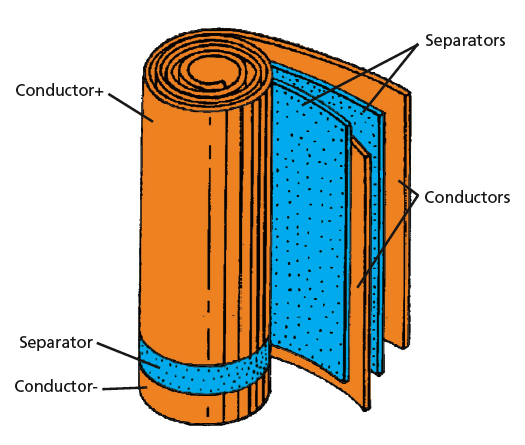
Capacitor-grade reconstituted mica papers are used as the dielectric material for the insulator/separator. The mica papers are self-supporting sheets comprised of thin, overlapping flakes or platelets of inorganic native muscovite. The separator sheets range in thickness from 0.0005" to 0.002" and are free of adhesives, binders, and coloring agents.
A high operating voltage of 1-3 kVDC required that a suitable impregnant/operating environment be developed to insulate the electrode edges and fill and insulate the critical regions or microscopic voids between the mica platelets. Such voids normally constitute about 30% of the total volume of the separator material. The majority of the work was performed within a pressurized environment of CO2 gas (maintained at near ambient to about 405.2 kPa of pressure).
The capacitor-grade materials are arranged to provide a single wound capacitor element (WCE). A standard winding machine, with a take-up means of about 1" diameter, is used to collect a feed of two conductor layers, separated and insulated from each other and the take-up means, by positioning at least one layer of an insulator material between them. The thickness of the insulator and conductor can range from 10-50 μm and 5-10 μm, respectively. The insulator is also used as a support or foundation for the conductor layers.
A mica paper separator is positioned over the take-up means that comprises two layers of about 0.0009" mica paper and a single layer of about 0.0007" mica paper. A conductor layer of aluminum foil of about 0.0002" is applied over the separator layer and take-up means. A second separator is then positioned over the first conductor layer, which is comprised of two and one 0.0007" thickness of mica paper. Finally, a second conductor layer of 0.0002" foil is placed directly over the second insulator layer.
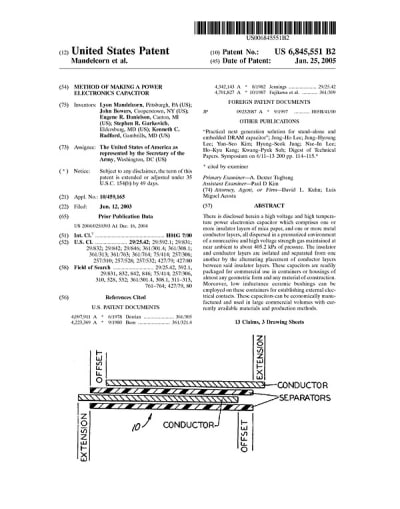
For this WCE, the separator layers are overlaid, in registration, on top of each other with the first conductor layer separating them. When the second conductor is positioned over the second separator layer, the first conductor is longitudinally overlapped by about 6.9 cm at the center. This staggered placement causes the edges or outer peripheries of the conductors to alternatingly extend about 0.38 cm beyond the edges of the corresponding separator layers on which they are positioned. The opposing edges or peripheries of these conductors lie buried between the separator layers. Thus, the first conductor layer will extend above and slightly beyond the left edge of the first separator layer, and the second conductor will extend above and beyond the right edge of the second separator layer. This procedure is repeated in multiple windings until all separators and conductors fed are consumed, and a final WCE is obtained.
This work was done by Lynn Mandelcorn, John Bowers, Eugene R. Danielson, Stephen R. Gurovich, and Kenneth C. Radford for the US Army RDECOM-TARDEC.
ARL-0050
This Brief includes a Technical Support Package (TSP).
High-Voltage, High-Temperature Power Electronics Capacitor
(reference ARL-0050) is currently available for download from the TSP library.
Don't have an account?
More From SAE Media Group


Aerospace & Defense Tech Briefs
Life Tests of a Microwave MEMS Capacitive Switch

Tech Briefs
High-Power/Pulsed-Power Electrical Switch
Tech Briefs
Supercapacitors for Wearable Devices
Tech Briefs
New on the Market
Tech Briefs
Low-Inductance DC Power Bus
Tech Briefs
Ultrahigh-Energy-Density Capacitor
Automotive Engineering
Clarios to Build Supercapacitor Plant in U.S.
Tech Briefs
Ultracapacitor-Powered Cordless Drill


Aerospace & Defense Tech Briefs
High-Cycle Life Testing of RF MEMS Switches
Tech Briefs
High-Voltage Droplet Dispenser
Tech Briefs
Pyroelectric Sandwich Thermal Energy Harvester

Aerospace & Defense Tech Briefs
Rolls-Royce and Superdielectrics Explore Supercapacitor Technology
Battery Technology
Charge Control Methods for Supercapacitors

Tech Briefs
High-Reliability Radio Frequency MEMS Switch
Tech Briefs
Improved Q-Switch Drivers
Electronics Tech Briefs
Interdigital Overlay Capacitors for Integrated Circuits
Electronics Tech Briefs
Supercapacitors With C and Nanostructured Mn0₂ Electrodes
Power Management INSIDER
New Wearable Device Turns the Body Into a Battery
Aerospace & Defense Tech Briefs
Development of High Quality 4H-SiC Thick Epitaxy for Reliable High Power Electronics Using Halogenated Precursors
Air Force Research Laboratory Technology Horizons
Textile Capacitor
Power Electronics INSIDER
Highly Conductive Aluminum Can Equal Copper
Aerospace & Defense Tech Briefs
DC Power Converter for 200°C Containing SiC Transistors
Overview
The document is a report dated January 25, 2005, detailing a method for making a power electronics capacitor. Authored by Lynn Mandelcorn, John Bowers, Eugene R. Danielson, Stephen R. Gurovich, and Kenneth C. Radford, the report is associated with the US Army RDECOM-TARDEC, located in Warren, Michigan. It is identified by the report number 18733 and is approved for public release with unlimited distribution.
The report likely discusses the technical aspects and innovations related to the manufacturing process of power electronics capacitors, which are critical components in various electronic systems, particularly in military and defense applications. Capacitors play a vital role in energy storage, power conditioning, and signal processing, making advancements in their design and production significant for enhancing the performance and reliability of electronic devices.
While the specific details of the capacitor-making method are not provided in the excerpt, the report may include information on materials used, fabrication techniques, and potential applications of the capacitors developed through this method. The mention of a United States Patent (No. US 6,845,551 B2) suggests that the method may involve proprietary technology or innovative approaches that could offer advantages over existing capacitor manufacturing processes.
Additionally, the report includes a section on public reporting burden, indicating that the collection of information related to the report is estimated to take an average of one hour per response. This section emphasizes the importance of compliance with information collection regulations and the assurance that respondents will not face penalties for non-compliance if the information does not display a valid OMB control number.
Overall, the document serves as a technical report that contributes to the field of power electronics by presenting a novel method for capacitor production, which could have implications for various applications in both military and civilian sectors. The report underscores the ongoing efforts to improve electronic components, thereby enhancing the functionality and efficiency of electronic systems.
Top Stories
INSIDERManufacturing & Prototyping
 How Airbus is Using w-DED to 3D Print Larger Titanium Airplane Parts
INSIDERManned Systems
 FAA to Replace Aging Network of Ground-Based Radars
NewsTransportation
 CES 2026: Bosch is Ready to Bring AI to Your (Likely ICE-powered) Vehicle
NewsSoftware
 Accelerating Down the Road to Autonomy
EditorialDesign
 DarkSky One Wants to Make the World a Darker Place
INSIDERMaterials
 Can This Self-Healing Composite Make Airplane and Spacecraft Components Last...
Webcasts
Defense
 How Sift's Unified Observability Platform Accelerates Drone Innovation
Automotive
 E/E Architecture Redefined: Building Smarter, Safer, and Scalable...
Power
 Hydrogen Engines Are Heating Up for Heavy Duty
Electronics & Computers
 Advantages of Smart Power Distribution Unit Design for Automotive...
Unmanned Systems
 Quiet, Please: NVH Improvement Opportunities in the Early Design...
