




Study: Information Desert Leaves Many Suppliers in EV Dust Bowl
The 23rd annual OEM-supplier Working Relations Index (WRI) study finds that suppliers aren’t getting enough insight into automakers’ EV transition plans.
Inadequate information about domestic and Japanese automakers’ product timelines and strategic plans relating to the transition from ICE-powered vehicles to EVs has emerged as a major issue for suppliers, according to an annual study focused on the OEM-supplier working relationship. “The most significant risk of not having a clear roadmap is that it can freeze the supplier,” Dave Andrea, principal in Plante Moran’s Strategy and Automotive & Mobility Consulting Practice, said about his firm’s 2023 North American Automotive OEM-Tier 1 Supplier Working Relations Index (WRI) study.
For many suppliers, it isn’t feasible to simultaneously invest in ICE-related technologies and EV programs. “If they don’t know what to invest in, or when, or how much, they won’t invest in EV programs, as no company wants stranded assets, like a plant standing idle just waiting for an EV program to come to fruition,” Andrea told SAE Media. The most likely outcome from an EV information ‘desert:’ suppliers will continue to focus on existing ICE production orders and investments — as that’s the known revenue source.
“OEMs and suppliers must focus on defining the long-term EV strategy,” said Andrea. In the meantime, suppliers are dealing with many financial headaches, including supply-chain disruptions, soaring raw-material prices and inflationary costs. “Unanticipated inflation has spilled over to labor, transportation, energy and other inputs, and this industry isn’t strong at managing these issues,” Andrea said.
Navigating the ICE-EV transition
While the legacy automakers are supporting their march to electrification with ICE-powered vehicle sales, suppliers essentially are left in a state of flux. “Private-equity firms are looking to consolidate some sectors to keep volumes and scales up in traditional ICE sectors,” said Andrea. Many large suppliers are carving out their pure ICE products and divisions to focus their investments on EVs. Other suppliers are making minimal EV-related investments and/or re-shuffling their product mix.
The number of component providers is expected to decline as the EV transition unfolds. “There will be mergers and acquisitions as companies, particularly in the ICE powertrain area, are de-sourced and revenues go down, making consolidation attractive,” Andrea concluded. For companies producing EV components, the firms unable to grow resources fast enough are likely to acquire technologies as well as add workers and production capacity via mergers or acquisitions.
The WRI study, based on online responses collected from mid-February to mid-April 2023, reflects input from 715 salespeople at 459 Tier 1 companies. The survey addresses suppliers’ perceptions of their relationships with Ford, General Motors, Honda, Nissan, Stellantis, and Toyota. Respondent firms, accounting for approximately 50% of the six OEM’s annual purchases, represent 38 of the Top 50 North American suppliers. Now in its 23rd year, the WRI study was founded in 2001 by Dr. John Henke of Planning Perspectives, Inc. and acquired by Plante Moran in 2019.
Value of communications

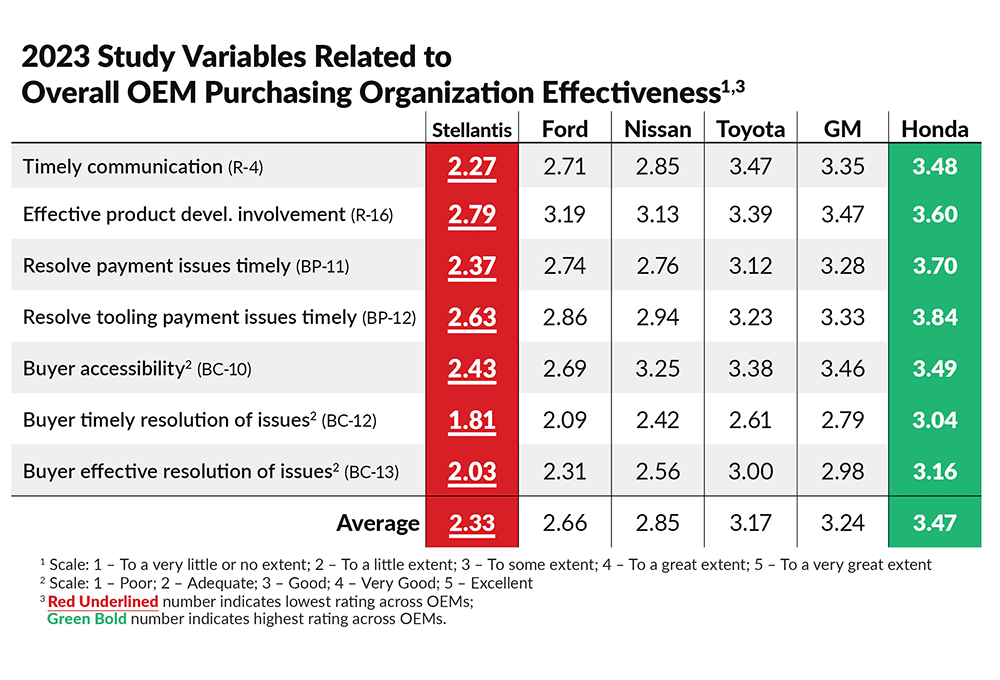
The respected WRI study has repeatedly shown that timely communication and effective product-development involvement are cornerstones to good working relations. “When we ask suppliers which OEMs engage the suppliers most effectively in the product development process, the best-to-last order is Honda, GM, Toyota, Ford, Nissan and Stellantis. “The challenge for automakers is balancing cost competitiveness with strong supplier partnerships by identifying lead suppliers on platforms early,” Andrea said.
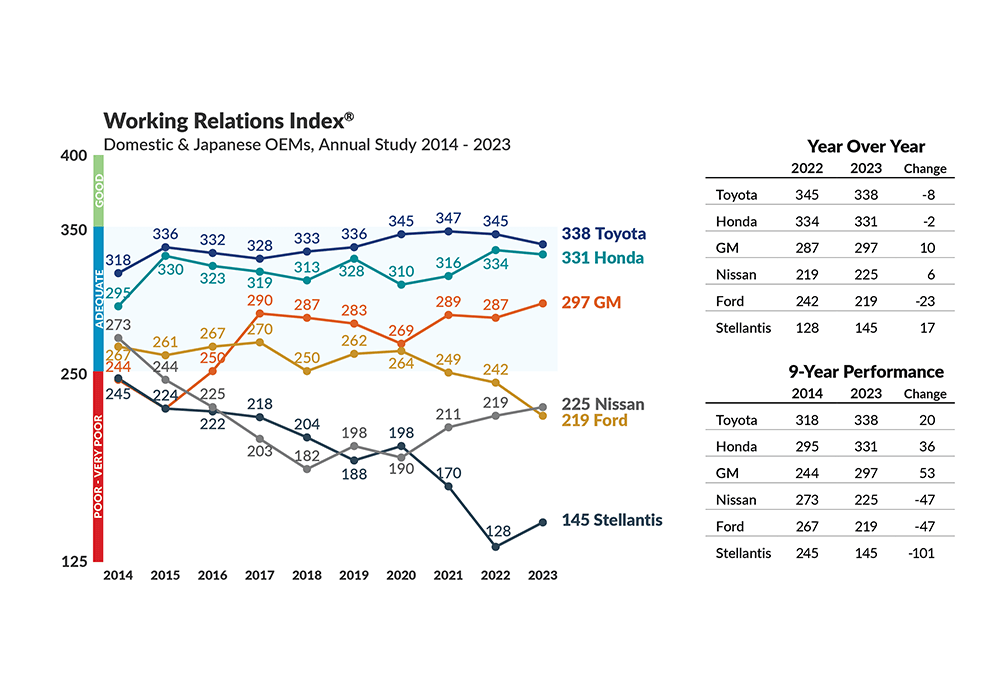
For a record 13th time, Toyota ranked tops in the annual study, followed in order by Honda, GM, Nissan, Ford, and Stellantis. WRI scores dropped slightly for Toyota and Honda. Ford’s scores dipped significantly, while GM, Nissan, and Stellantis improved.
Stellantis had the biggest gain year-over-year, going from 128 to 145 points. “Stellantis’ 17-point increase was driven by a leadership change that reoriented their practices toward building partnerships,” noted Andrea. The 23-point decline for Ford is attributed to organizational moves. “The changes were done to deliver more EV nameplates and production volume, but the transition left suppliers concerned about their long-term future with Ford,” Andrea said.
The biggest surprise of this year’s WRI study was Toyota. “This automaker is known for its continuous-improvement mantra, yet Toyota has been flat for the past three years,” said Andrea. Toyota has been trending downward in the study on certain attributes, including technical and commercial knowledge. One underlying reason for the flatlining is the addition of new manufacturing plants. “It’s a growth churn,” Andrea said.
More From SAE Media Group
Automotive Engineering
Toyota Tops 2021 OEM-Supplier Relations Study
Automotive Engineering
Toyota Scores the Top Spot Again in 2024 OEM-Supplier Survey
Automotive Engineering
WCX 2023: Software-Defined Vehicle Development an Ongoing Headache for Industry
Automotive Engineering
Japanese OEMs Tops at Involving Suppliers Early in Development Process, Says 2014 Study
Automotive Engineering
Preparing for the New, Faster EV Product Cadence
Automotive Engineering
Tenured Production CEO Leading VW’s U.S. Electrified Manufacturing Push
Automotive Engineering
Innovative ‘Afreecar’ Wins SAE’s 2021 Create the Future Design Award
Automotive Engineering
Toyota Tops 2020 OEM-Supplier Relations Study
Automotive Engineering
GM CEO Barra Promises $30K EV SUV by Fall 2023; Automated Driving by Mid-Decade
Automotive Engineering
Honda and Nissan Merger Plans Could Accelerate EV R&D
Automotive Engineering
All-Electric Nissan Ariya Handles Ultra-Cold Temps on Pole to Pole Trek
Automotive Engineering
Corvette Hybrid Development Defies GM’s All-Electric Mantra
Automotive Engineering
Engineering ‘Electron Guzzlers’
Off-Highway Engineering
A Bevy of Battery and Fuel-Cell Electric Truck Reveals
Automotive Engineering
Engineering a Marvel of a Maverick Hybrid Transmission
Automotive Engineering
Seeking More Traction in Budding EV Market, VW Adds AWD to ID.4
Off-Highway Engineering
Allison Builds a Testing Powerhouse
Automotive Engineering
Preparing for a Lumpy EV Transition
Automotive Engineering
GM Unveils 2024 Chevrolet Silverado EV
Automotive Engineering
2022 Hyundai Santa Cruz: A Truck by Any Other Name
Autonomous Vehicle Engineering
Amending the Automated-Driving ‘Constitution’
Automotive Engineering
2022 Toyota Tundra: V8 Out, Twin-Turbo Hybrid Takes Over
Automotive Engineering
Preview: SAE 2021 WCX
Automotive Engineering
WCX 2024: The Technologies That Will Define Future Mobility
Automotive Engineering
Bringing Back the Hot Hatch: 2023 Toyota GR Corolla
Automotive Engineering
Personnel Moves at Denso
Automotive Engineering
The Battle over EV Value-Add Has Begun
Off-Highway Engineering
Western Star Adds ‘Weight Sensitive’ 47X to Vocational Lineup
Automotive Engineering
Schaeffler Builds an E-Motor Powerhouse
Automotive Engineering
Acura TLX Is Honda’s New Body-Build Benchmark
Top Stories
NewsSensors/Data Acquisition
 Microvision Aquires Luminar, Plans Relationship Restoration, Multi-industry Push
INSIDERRF & Microwave Electronics
 A Next Generation Helmet System for Navy Pilots
INSIDERWeapons Systems
 New Raytheon and Lockheed Martin Agreements Expand Missile Defense Production
NewsAutomotive
 Ford Announces 48-Volt Architecture for Future Electric Truck
INSIDERAerospace
 Active Strake System Cuts Cruise Drag, Boosts Flight Efficiency
ArticlesTransportation

Webcasts
Aerospace
 Cooling a New Generation of Aerospace and Defense Embedded...
Energy
 Battery Abuse Testing: Pushing to Failure
Power
 A FREE Two-Day Event Dedicated to Connected Mobility
Automotive
 Quiet, Please: NVH Improvement Opportunities in the Early Design Cycle
Electronics & Computers
 Advantages of Smart Power Distribution Unit Design for Automotive &...
Unmanned Systems
 Sesame Solar's Nanogrid Tech Promises Major Gains in Drone Endurance