




Alloys for Nozzles of Hypersonic Wind Tunnels
At least one alloy withstands stresses of 600 MPa at temperatures to 1,700 K.
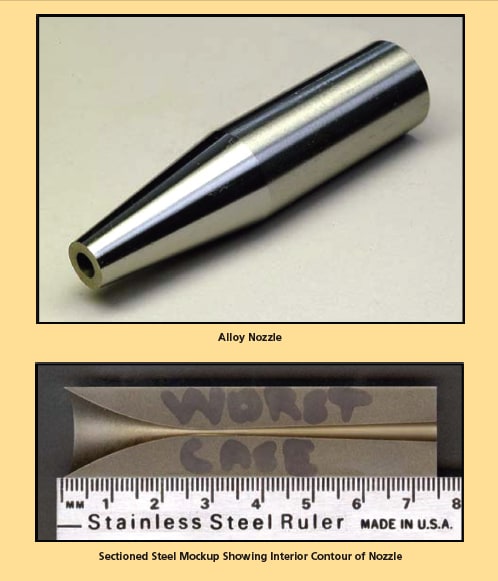
Alloys are being developed for nozzles of hypersonic wind tunnels to be used in testing components of future hypersonic missiles, aircraft, and space transportation systems. The nozzle components made from these alloys will be required to retain sufficient strength to withstand stresses of as much as 600 MPa at throat surface gas temperatures as high as 1,700 K while resisting erosion and oxidation by impinging hypersonic flows of air and possibly other gases. In some applications, back-side cooling or film/transpiration cooling may be used to reduce the temperature rises in nozzles. Alternatively, in some applications, nozzles may be used, without active cooling, in either of two heat-sink modes. In one mode, exposure time would be limited in order to limit the maximum temperature rise. In the other mode, denoted the self-limiting heat-sink mode, a nozzle throat would be exposed long enough to come into thermal equilibrium with the gas, and, hence, the nozzle throat material must be chosen to withstand the maximum surface gas temperature (e.g., 1,700 K) for an indefinite time.
The alloys investigated thus far are of three types: one based on Ir; one based on various proportions of Mo, Si, and B; and one comprising a baseline Mo-Re alloy modified by incorporation of small amounts of other metals:
- Prior Ir-based alloys have proven high resistance to oxidation but limited strength at temperatures above 1,200 ºC. Therefore, the approach taken in the present development of Ir-based alloys has involved increasing strength by means of both solid-solution hardening and particle strengthening through alloy additions, while ensuring that any increase in strength is not accompanied by loss of oxidation resistance or reduction in melting temperature.
- Prior Mo-Si-B alloys have exhibited potential for retention of high strength at elevated temperatures as long as thermal shock is minimized. They do not resist oxidation as well as do prior Ir-based alloys. The Mo-Si-B portion of the present development has been oriented toward choosing process conditions and proportions of Mo, Si, and B to increase fracture toughness (to increase resistance to thermal shock).
- Prior Mo-Re alloys are known to be more ductile (and, hence, less vulnerable to thermal shock) than are prior Mo-Si-alloys. The Mo-Re portion of the present development has been oriented toward strengthening through addition of other alloying elements.
This work was done by E. J. Felderman and D. T. Akers of Aerospace Testing Alliance and C. T. Liu and J. Schneibel of Oak Ridge National Laboratories for the Air Force Research Laboratory.
This Brief includes a Technical Support Package (TSP).
Alloys for Nozzles of Hypersonic Wind Tunnels
(reference AFRL-0032) is currently available for download from the TSP library.
Don't have an account?
More From SAE Media Group

Tech Briefs
Nanoprecipitates Toughen Structural Alloys
Aerospace & Defense Tech Briefs
Evaluation of Additively Manufactured Ultrahard Steels
Tech Briefs
Using 3D Printing to Strengthen Jet Engines
Photonics & Imaging Technology
Deformation Fingerprints Will Help Researchers Identify, Design Better Metallic Materials
Aerospace & Defense Tech Briefs
Plasma Electrolytic Oxidation: The Future of Lightweight Designs in Aerospace and Defense
Tech Briefs
Nanocomposite Strain Gauges Having Small TCRs
Air Force Research Laboratory Technology Horizons
Strain-Induced Porosity Model
Tech Briefs
Rapid 3D Printing of Biomedical Parts
Tech Briefs
Engineers Develop New Shape-Memory Material
Tech Briefs
Self-Healing Aluminum Metal Matrix Composite


Medical Design Briefs
Scientists Develop Elastic Metal Rods to Treat Scoliosis
Tech Briefs
Low-Alloy, High-Impact-Toughness Steel


Tech Briefs
Liquid Metal Lattice

Aerospace & Defense Tech Briefs
Novel Chromium–Molybdenum Metal Alloy Withstands Extreme Conditions
Tech Briefs
High-Temperature Ni-Based Superalloy Composition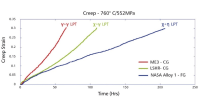
Tech Briefs
Wear-Resistant Platinum Gold Alloy

Aerospace & Defense Tech Briefs
More Bang for the Buck: A New Design and Manufacturing Method for Deep Penetrating Bomb Cases
Tech Briefs
Fine-Tuning Alloys for High-Temperature Use
Aerospace & Defense Tech Briefs
Low Distortion Titanium in Laser Powder Bed Fusion Systems
Automotive Engineering
Lightweight Steel on a (Cold) Roll

Overview
The document titled "Hypersonic Wind Tunnel Nozzle Survivability for T&E" is a final report detailing a technology development effort conducted by the Arnold Engineering Development Center (AEDC) and Oak Ridge National Laboratories (ORNL) from October 1, 2002, to September 30, 2006. The report, identified as AEDC-TR-06-17, is approved for public release and aims to address the challenges associated with hypersonic testing and evaluation (T&E).
The report begins with an introduction to hypersonic simulation requirements, emphasizing the need for advanced testing facilities to support the development of hypersonic technologies. It outlines the specific requirements for nozzles used in various hypersonic facilities, highlighting the critical role that nozzle design and materials play in ensuring the survivability and effectiveness of these testing environments.
A significant portion of the report is dedicated to nozzle materials development, which includes the exploration of several advanced materials. Key developments discussed include:
-
Iridium Alloy Development: This section focuses on the properties and potential applications of iridium alloys in hypersonic nozzles, emphasizing their high-temperature resistance and durability.
-
MoSiB Alloy Development: The report details the characteristics of molybdenum-silicon-boron (MoSiB) alloys, which are being investigated for their ability to withstand extreme conditions encountered during hypersonic testing.
-
MoReX Alloy Development: This section covers the development of molybdenum-rhenium alloys, which are noted for their strength and thermal stability at high temperatures.
-
Ni-Coated Cu - Back-Side-Cooled Arc-Heater Nozzles: The report discusses innovative designs that incorporate nickel-coated copper with back-side cooling to enhance nozzle performance and longevity.
The document concludes with a summary of findings and recommendations for future research and development in hypersonic testing technologies. It emphasizes the importance of continued innovation in materials and designs to meet the evolving demands of hypersonic flight testing.
Overall, the report serves as a comprehensive resource for understanding the advancements in hypersonic wind tunnel nozzle technology, providing insights into material science, engineering challenges, and the future of hypersonic research. It is a valuable contribution to the field of aerospace testing and evaluation, supporting the U.S. Air Force's objectives in hypersonic capabilities.
Top Stories
INSIDERManufacturing & Prototyping
 How Airbus is Using w-DED to 3D Print Larger Titanium Airplane Parts
INSIDERManned Systems
 FAA to Replace Aging Network of Ground-Based Radars
NewsTransportation
 CES 2026: Bosch is Ready to Bring AI to Your (Likely ICE-powered) Vehicle
NewsSoftware
 Accelerating Down the Road to Autonomy
EditorialDesign
 DarkSky One Wants to Make the World a Darker Place
INSIDERMaterials
 Can This Self-Healing Composite Make Airplane and Spacecraft Components Last...
Webcasts
Defense
 How Sift's Unified Observability Platform Accelerates Drone Innovation
Automotive
 E/E Architecture Redefined: Building Smarter, Safer, and Scalable...
Power
 Hydrogen Engines Are Heating Up for Heavy Duty
Electronics & Computers
 Advantages of Smart Power Distribution Unit Design for Automotive...
Unmanned Systems
 Quiet, Please: NVH Improvement Opportunities in the Early Design...
