




Remote-Controlled Aerial Vehicle for Application of Pesticides
AFRL researchers demonstrate an aerial spray platform for preventing insect-borne illness in hostile environments.
AFRL demonstrated its Remotely Controlled Aerial Vehicle for Application of Pesticides (RCAVAP) at the Force Protection Equipment Demonstration (FPED) conducted at Quantico Marine Corps Base, Virginia. During times of war, disease has historically caused more deaths than bullets, far outnumbering any other cause. Consider, for example, the Mexican-American war. Over 1,000 soldiers were killed in action, 529 died of wounds sustained on the battlefield, 362 suffered accidental death, and 11,155 perished from disease— mostly yellow fever, a viral illness transmitted by the Aedes aegypti mosquito. During World War II, malaria ravaged the troops. Spread by the female anopheline mosquito, the disease affected thousands of American soldiers. More recently, a single 2-week period in Baqubah, Iraq, saw 250 cases of cutaneous leishmaniasis, a disfiguring parasitic disease spread by the female sandfly.
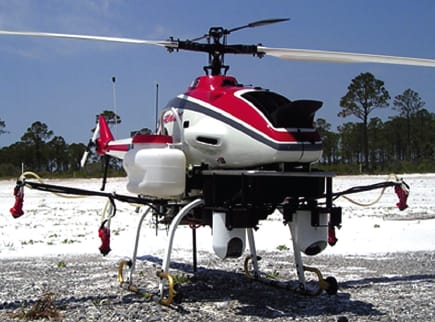
"Military public health officers often remind us that disease has killed more people during warfare than bullets. The RCAVAP is an important tool for preventing insect-borne illness," remarks Major Mark Breidenbaugh, command entomologist for the Air Force Reserve Command in Youngstown, Ohio.
At the FPED, the RCAVAP performed two demonstration flights consisting of automatic takeoff, waypoint-navigated flight, automatic payload delivery, and automatic landing. The flight path for each demonstration flight ranged from 0 to 100 ft in altitude and spanned an area approximating 1,000 sq ft.
The Department of Defense (DoD), Joint Staff, Department of Energy, National Institute of Justice, and Technical Support Working Group all sponsor the FPED, which serves the purpose of demonstrating available equipment capable of providing protection against both terrorist forces and hostile conditions having the potential to harm US personnel. AFRL, in coordination with the Armed Forces Pest Management Board, Naval Disease Vector Ecology Control Center, and 757th Aerial Spray Flight (Youngstown, Ohio), developed the prototype aerial spray platform under a Force Protection Battlelab initiative. Since the vehicle provided an opportunity for technology transfer, the lab delivered it to the 757th Aerial Spray Flight (the DoD's only full-time aerial spray operation) for user assessment.
Lt Jeffrey Miller and Ms. Mindy Cooper (General Dynamics), of the Air Force Research Laborator y's Materials and Manufacturing Directorate, wrote this article. For more information, visit http://www.afrl.af.mil/techconn_index.asp . Reference document ML-H-05-52.
More From SAE Media Group

Aerospace & Defense Tech Briefs
Deceiving the Enemy: These Are the Drones You Are Looking For
Tech Briefs
UCF’s Hypersonic Technology Advances
Aerospace & Defense Tech Briefs
MUSHER Demonstrates Manned-Unmanned Aircraft Teaming Applications
Tech Briefs
Insect-Sized Agile Drones
Tech Briefs
Magazine Archives
Tech Briefs
Products of Tomorrow
Air Force Research Laboratory Technology Horizons
Unmanned SkyTote Demonstrates Capabilities
Aerospace & Defense Tech Briefs
A New Approach to Counter-UAS Technology
Tech Briefs
Flying Robot Mimics Rapid Insect Flight
Tech Briefs
Facility Focus: Battelle Memorial Institute
Tech Briefs
Hinge Design Helps Quadrotors Climb
Aerospace & Defense Tech Briefs
Connectors Lighten the SWaP Burden in UAV/MUMT Aircraft Electronics
Aerospace & Defense Tech Briefs
SAE International Extends Call for Abstracts, Seeks Submissions for AeroTech Conference
Aerospace & Defense Tech Briefs
Advancing Metrology at Mach Speed
Aerospace INSIDER
Can Microvanes Improve Fuel Efficiency for Legacy Air Force Aircraft?

Aerospace & Defense Tech Briefs
Investigation of Flight Dynamics and Controls for a Solar-Tracker-Mounted UAV
Medical Design Briefs
Guest Editorial: Expanding the Scope of Mobility
Aerospace & Defense Tech Briefs
Advanced Assembly Solutions for the Airbus RACER Joined-Wing Configuration
Tech Briefs
Anti-Phase Noise Suppression Rotor Technologies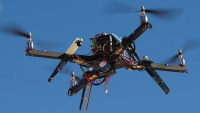
Tech Briefs
New Printing Process Advances 3D Capabilities
Tech Briefs
Implantable Stimulator Speeds Tendon Healing
Aerospace & Defense Tech Briefs
Industry Invited to Participate in AeroTech Aerospace and Defense Technical Program
Medical Design Briefs
Deciphering Medical Risk with High-Performance Computing
Tech Briefs
Multirotor Aircraft Noise Reduction
Aerospace & Defense Tech Briefs
Rebar Tying Robot
Motion Design
Insect-Inspired Motion Sensing
Tech Briefs
Small But Mighty: Stratospheric Microballooons
Aerospace & Defense Tech Briefs
Hybrid Ultra-Low VOC and Non-HAP Rain Erosion Coatings
Top Stories
INSIDERManufacturing & Prototyping
 How Airbus is Using w-DED to 3D Print Larger Titanium Airplane Parts
NewsAutomotive
 Microvision Aquires Luminar, Plans Relationship Restoration, Multi-industry Push
INSIDERAerospace
 A Next Generation Helmet System for Navy Pilots
INSIDERDesign
 New Raytheon and Lockheed Martin Agreements Expand Missile Defense Production
ArticlesAR/AI
 CES 2026: Bosch is Ready to Bring AI to Your (Likely ICE-powered) Vehicle
Road ReadyDesign

Webcasts
Semiconductors & ICs
 Advantages of Smart Power Distribution Unit Design for Automotive...
Unmanned Systems
 Quiet, Please: NVH Improvement Opportunities in the Early Design...
Electronics & Computers
 Cooling a New Generation of Aerospace and Defense Embedded...
Power
 Battery Abuse Testing: Pushing to Failure
AR/AI
 A FREE Two-Day Event Dedicated to Connected Mobility
