




Rocket Factory In-A-Box Missile Propulsion Anytime, Anywhere
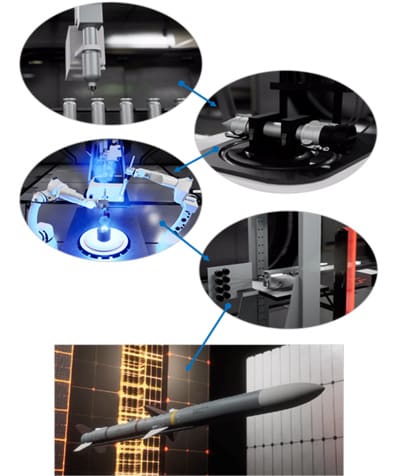
AFRL’s Rocket Factory In-a-Box (RFIB) program is developing a mobile, containerized Solid Rocket Motor (SRM) production capability by aggregating revolutionary design and component manufacturing techniques, thus enabling rapid SRM manufacture in a small footprint with the flexibility to tailor performance to specific missions. This approach contrasts with current industry practices requiring significant infrastructure and resources (time and money), which often results in design constraints.
Key aspects of the program include:
- Ingredient Synthesis: Precision generation of propellant ingredients with continuous microfluidic reactors leads to unprecedented property control.
- Resonant Acoustic Mixing: Vibrational propellant ingredient homogenization reduces processing time up to 20X with lower property variance.
- Additive Manufacturing: 3D printing of fuel grains enables compositional gradients, integration of performance-enhancing features, and in-situ curing.
- Case-on-Propellant Processing: Direct installation of rocket structural case onto propellant accelerates production and eliminates manufacturing tooling.
- Automation: Robotic staffing of factory eliminates need for human labor, improves process control, and enhances operational safety.
- Non-Destructive Evaluation: The use of comprehensive imaging tools aids in construction of digital twins for manufactured rockets.
- Digital Engineering: Computational design of requisite rocket aids in prediction of as-built system and provides governance over automated fabrication.
Among the benefits expected to be derived from the program are:
- Agile, resilient, and persistent logistics for solid rocket propulsion that support requirements for 21st century competition and conflict.
- Rapid design, development, and fielding of new systems that will help the U.S. meet emerging threats.
- Flexible manufacturing will expand the design space and performance of solid rocket propulsion.
Current rocket propulsion systems of air-launched missiles can take years to enter full rate production due to iterative design, build, and test methods practiced by industry. Furthermore, the U.S. industrial base has consolidated into just a few manufacturing centers for bombs and missiles. Meanwhile, the capabilities of adversaries have significantly improved in the last decade.
Mobile, small, and clandestine manufacturing centers for SRMs and weapons ensure continuity of necessary force application capabilities for warfighters by augmenting the resilience of logistics chains during conflict, answering raw material obsolescence, increasing survivability, mitigating unpredictability, and improving lethality depth within enemy threat rings. It is expected that RFIB will prove beneficial to several key major commands including Air Combat Command, Air Mobility Command, Air Force Special Operations Command and Pacific Air Forces.
More From SAE Media Group
Aerospace Manufacturing and Machining INSIDER
Sentinel Missile Design and Manufacturing Processes Validated
Defense INSIDER
Anduril Becomes Third US Supplier of Solid Rocket Motors

Aerospace Manufacturing and Machining INSIDER
Advanced Manufactured Solid Rocket Motor Completes Latest Flight Test


Aerospace Manufacturing and Machining INSIDER
New Defense Department Contract to Expand Domestic Rocket Motor Manufacturing
Tech Briefs
2025 Award Finalists
Aerospace INSIDER
Ursa Major Performs First Successful Hotfire of Hypersonic Draper Engine
Aerospace & Defense Tech Briefs
Prototype Hypersonic Defense Engine



Aerospace Manufacturing and Machining INSIDER
Airbus Inaugurates New A320 Structure Assembly Line in Hamburg
Aerospace & Defense Tech Briefs
Reclaiming Readiness: Advancing US Defense Through Scalable Additive Manufacturing
Aerospace Manufacturing and Machining INSIDER
Meeting the Demands of Defense Production and Sustainment Through Additive Manufacturing
Motion Design INSIDER
MIT Engineers Develop a Fully 3D-Printed Electrospray Engine
Aerospace Manufacturing and Machining INSIDER
RAMFIRE Project Develops, Tests 3D-Printed Aluminum Rocket Engine Nozzle
Aerospace Manufacturing and Machining INSIDER
How AR, Robotics are Increasing Speed of Space Payload Manufacturing at Northrop
Aerospace Manufacturing and Machining INSIDER
Army Launches $50 Million Advanced Manufacturing Initiative for Aviation and Weapon Systems
Aerospace & Defense Tech Briefs
Factory-as-a-Service for Missile Production
Defense INSIDER
Adranos Secures Government Contracts for Hypersonic Research
Aerospace Manufacturing and Machining INSIDER
GE Concludes Phase 1 Testing on XA100 Adaptive Cycle Engine
Aerospace Manufacturing and Machining INSIDER
Supernova to 3D Print Military Grade Energetic Materials
Tech Briefs
2025 Rising Star Awards Winners

Aerospace & Defense Tech Briefs
Industry Invited to Participate in AeroTech Aerospace and Defense Technical Program
Aerospace Manufacturing and Machining INSIDER
US Navy Taps Hunt Valve for First 3D-Printed Submarine Assemblies
Tech Briefs
3 Power and Energy Advances
Top Stories
NewsRF & Microwave Electronics
 Microvision Aquires Luminar, Plans Relationship Restoration, Multi-industry Push
INSIDERAerospace
 A Next Generation Helmet System for Navy Pilots
INSIDERDesign
 New Raytheon and Lockheed Martin Agreements Expand Missile Defense Production
INSIDERMaterials
 How Airbus is Using w-DED to 3D Print Larger Titanium Airplane Parts
NewsPower
 Ford Announces 48-Volt Architecture for Future Electric Truck
ArticlesAR/AI

Webcasts
Electronics & Computers
 Cooling a New Generation of Aerospace and Defense Embedded...
Automotive
 Battery Abuse Testing: Pushing to Failure
Power
 A FREE Two-Day Event Dedicated to Connected Mobility
Unmanned Systems
 Quiet, Please: NVH Improvement Opportunities in the Early Design Cycle
Automotive
 Advantages of Smart Power Distribution Unit Design for Automotive &...
Energy
 Sesame Solar's Nanogrid Tech Promises Major Gains in Drone Endurance