




Imaging System for Characterizing Materials and Processes
Three complementary camera systems are combined to obtain a high-performance system.
Ahigh-performance digital imaging system has been assembled to provide enhanced capabilities for characterizing materials and processes. Highspeed imaging is needed for observation and analysis of such fast dynamic processes as impact fracture (including ballistically induced fracture) in advanced composite materials, dynamic deformation of materials, and hydrodynamic instabilities in jets. Because these dynamic processes occur at diverse temporal and spatial scales, there is a need for an imaging system that can operate at correspondingly diverse frame rates, spatial resolutions, and magnifications, and that is capable of recording various numbers of image frames.
A thorough market search led to the conclusion that no single commercially available electronic camera can satisfy all of the diverse requirements. Therefore, it was decided to satisfy the requirements by building the present high-performance digital imaging system as a combination of three commercially available electronic camera systems that have overlapping resolution, recording-rate, record-length, sensitivity, and other performance characteristics. The resulting assembly is a unique, state-of-the-art, ultrahighresolution/ speed imaging system for quantitative observation and analysis of dynamic processes.
High-spatial-resolution digital imaging at a rate of a million or more frames per second is needed for the analysis of many dynamic processes. Market research revealed that only rotating-mirror charge-coupled-device (CCD) camera systems can satisfy these requirements. The specific commercially available system chosen to satisfy these requirements was a Cordin Model 550 24 high-resolution rotatingmirror CCD camera system, which contains 24 cameras synchronized for imaging at a rate as high as 1.5 million frames per second. The rotating mirror and associated optics distribute incoming light to the cameras in sequence, and the exposure time and recording rate are electronically controlled in accordance with the rotation. Pictures having resolution and dynamic range superior to those recorded by use of a multichannel-plate image intensifier and having exposure times as short as hundreds of nanoseconds can be taken by use of this system.
A capability of imaging at 10 million or more frames per second is needed for ballistic impact experiments. The commercial system chosen to satisfy this requirement was a Cordin Model 214-8 image-intensified gated CCD camera system. In a camera system of this type, an optical subsystem divides the image across multiple channels, thus yielding temporal resolution, at some loss in spatial resolution and sensitivity. Individual channels are activated in sequence to record a series of images separated by very short time intervals. The Model 214-8 system records 8 frames at a minimum interframe and exposure time of 25 nanoseconds.
A digital camera system capable of making 1,000-frame or longer movies of moving objects at rates greater than 1,000 frames per second and spatial resolutions of at least 1,000 pixels along each axis is needed for visualization and analysis of electrospinning processes. Also needed are software that supports making of video recordings and software for performing two- and threedimensional particle-velocity and -trajectory analyses. The Redlake MotionXtra HG 100K high- speed color complementary metal oxide semiconductor (CMOS) camera system was found to satisfy these requirements and, accordingly, was incorporated into the present system. A control computer for this camera was acquired separately.
This work was done by Y. Dzenis and R. Feng of the University of Nebraska for the Air Force Research Laboratory. For more information, download the Technical Support Package (free white paper) at www.defensetechbriefs.com/tsp under the Physical Sciences category. AFRL-0029
This Brief includes a Technical Support Package (TSP).
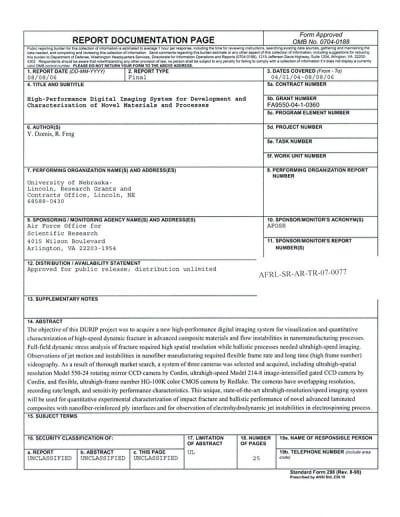
Imaging System for Characterizing Materials and Processes
(reference AFRL-0029) is currently available for download from the TSP library.
Don't have an account?
More From SAE Media Group
Aerospace & Defense Tech Briefs
Computational Cameras
Photonics & Imaging Technology
Researchers Use Inkjet Printing to Make a Portable Multispectral 3D Camera

Imaging Technology
Improved Scanners for Microscopic Hyperspectral Imaging


Photonics Tech Briefs
Making Three-Dimensional Holograms Visible From All Sides
Photonics & Imaging Technology
New Products
Tech Briefs
Solar-Powered Airplane With Cameras and WLAN

Photonics & Imaging Technology
The Latest Advancements in Optics

Software Tech Briefs
Water Detection Based on Sky Reflections
Photonics Tech Briefs
Target-Tracking Camera for a Metrology System

Photonics Tech Briefs
Wide-Field Optic for Autonomous Acquisition of Laser Link

Tech Briefs
Model of Image Artifacts From Dust Particles
Tech Briefs
Global Shutter Imaging
Aerospace & Defense Tech Briefs
Miniature Snapshot Multispectral Imager
Photonics Tech Briefs
Instruments for Imaging From Far to Near
Photonics Tech Briefs
Miniature Wide-Angle Lens for Small-Pixel Electronic Camera


Tech Briefs
A Broad-Band Phase-Contrast Wave-Front Sensor
Overview
The document outlines a project aimed at acquiring a high-performance digital imaging system to enhance the observation and analysis of fast dynamic processes, particularly in advanced composite materials and nanomanufacturing. The need for high-speed imaging arises from the necessity to study phenomena such as impact fracture, ballistic performance, dynamic deformation, and hydrodynamic instabilities, which occur at varying time scales and require different imaging capabilities.
The project, funded by the Defense University Research Instrumentation Program (DURIP), identified that no single camera could meet the diverse requirements for spatial resolution, frame rates, and recording capabilities. Consequently, a system comprising three specialized cameras was selected: an ultrahigh-spatial resolution rotating mirror CCD camera (Model 550-24) by Cordin, an ultrahigh-speed image-intensified gated CCD camera (Model 214-8) by Cordin, and a flexible, ultra-high-frame number color CMOS camera (HG-100K) by Redlake. This combination allows for overlapping performance characteristics, enabling comprehensive analysis of dynamic processes.
The imaging system is intended for quantitative experimental characterization of impact fracture and ballistic performance in advanced laminated composites, particularly those with nanofiber-reinforced ply interfaces. Additionally, it will facilitate the observation of electrohydrodynamic jet instabilities during the electrospinning process, which is crucial for nanofiber manufacturing.
The document emphasizes the importance of high-speed imaging in advancing research in material science and engineering, particularly in understanding the behavior of materials under dynamic conditions. The selected imaging system represents a state-of-the-art solution that addresses the conflicting requirements of high spatial resolution and ultrahigh-speed imaging, making it a valuable tool for researchers in the field.
Overall, the project aims to significantly enhance the capabilities for studying complex dynamic processes, contributing to advancements in material development and manufacturing techniques. The successful implementation of this imaging system is expected to lead to new insights and innovations in the characterization of advanced materials and processes.
Top Stories
INSIDERAerospace
 How Airbus is Using w-DED to 3D Print Larger Titanium Airplane Parts
NewsAutomotive
 Microvision Aquires Luminar, Plans Relationship Restoration, Multi-industry Push
INSIDERManufacturing & Prototyping
 A Next Generation Helmet System for Navy Pilots
INSIDERDefense
 New Raytheon and Lockheed Martin Agreements Expand Missile Defense Production
ArticlesAR/AI
 Accelerating Down the Road to Autonomy
Road ReadyDesign

Webcasts
Automotive
 Advantages of Smart Power Distribution Unit Design for Automotive...
Unmanned Systems
 Quiet, Please: NVH Improvement Opportunities in the Early Design...
Defense
 Cooling a New Generation of Aerospace and Defense Embedded...
Power
 Battery Abuse Testing: Pushing to Failure
Power
 A FREE Two-Day Event Dedicated to Connected Mobility
