




Accomplishments of the Microwave Power Research Initiative
Reported research pertains to an L-band and a W-band signal source.
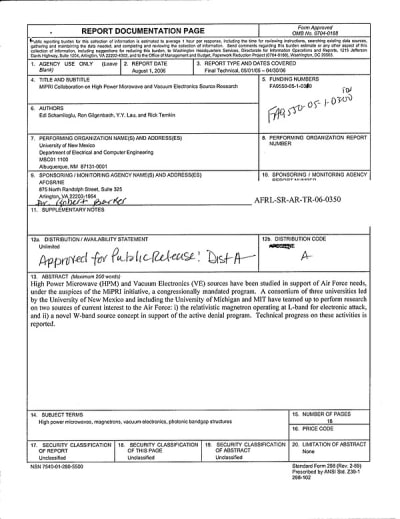
Research performed under the auspices of the Microwave Power Research Initiative (MiPRI) between May 1, 2005 and April 30, 2006 has been reported. [The MiPRI is a congressionally mandated Air Force program to advance the science of high-power electron- beam-driven microwave and millimeter- wave signal sources.] The reported research was performed by a consortium of three universities led by the University of New Mexico and including the University of Michigan and the Massachusetts Institute of Technology (MIT). The research pertains to two signal sources of current interest to the Air Force: a relativistic Lband magnetron and a W-band source.
The topics addressed in this research at each of the three locations is summarized as follows:
University of New Mexico — A transparent cathode C, essentially a longitudinally slit cylindrical cathode comprising multiple strip electron emitters arranged in a circle C, was proposed as a means of improving the output characteristics of a relativistic magnetron or a free-electron laser. The behavior of a coaxial-diode relativistic magnetron containing a transparent cathode operating with applied crossed electrostatic and magnetostatic fields was simulated by use of a relativisticparticle- in-cell computer code called "MAGIC." The results of the simulations and preliminary results of experiments were interpreted as signifying that, as expected, the transparent cathode offers advantages over a conventional solid cathode.
University of Michigan — Progress has been made in one experimental, one engineering, and four theoretical research projects. The experimental project included fabrication and testing of a three-section cathode intended to implement a combination of cathode-priming and transparent-cathode concepts. The engineering project consisted mainly of design studies to determine what modifications must be made in the University of Michigan laboratory equipment to enable testing of the transparent cathode developed at the University of New Mexico. One of the theoretical projects, performed in collaboration with the University of New Mexico, explored the feasibility of using surface plasmons as sources of coherent terahertz radiation. Another continuing theoretical project in collaboration with the University of New Mexico examines models of cathode priming and transparent cathodes, and includes optimization studies. Yet another of the theoretical projects, which also continues, addresses the effects of manufacturing errors on the performances of microwave tubes. The remaining project, about to begin at the time of reporting, is to involve theoretical analyses of the effects of a nonuniform work function on the emission from a cathode.
Massachusetts Institute of Technology — A design study of an overmoded interaction circuit for a W-Band (94-GHz) slow-wave traveling-wave-tube capable of 100 kW of power in short pulses was performed. The goals of the study included investigation of various kinds of interaction structures to obtain high interaction impedance and bandwidth. Also investigated were interaction circuits made of photonic-bandgap structures that would accommodate overmoded operation, thereby enabling increases in average power by at least an order of magnitude over power levels achievable using interaction circuits of prior design. These structures should also enable progression to higher frequencies, including terahertz frequencies.
This work was done by Edl Schamiloglu, John Gaudet, Mikhail Fuks, Herman Bosman, Sarita Prasad, and Andrey Andreev of the University of New Mexico; Ronald Gilgenbach, Y. Y. Lau, and Ryan Edgar of the University of Michigan; and Richard J. Temkin of Massachusetts Institute of Technology for the Air Force Research Laboratory. For further information, download the free white paper at www.defensetechbriefs.com under the Electronics/Computers category. AFRL-0004
This Brief includes a Technical Support Package (TSP).
Accomplishments of the Microwave Power Research Initiative
(reference AFRL-0004) is currently available for download from the TSP library.
Don't have an account?
More From SAE Media Group
Photonics & Imaging Technology
Sussex Researchers Combine Lasers, Computers & THz Waves to Build Camera That Sees ‘Unseen’ Details


Aerospace & Defense Tech Briefs
To 6G and Beyond: Penn Engineers Unlock the Next Generation of Wireless Communications


RF & Microwave Technology
Design Study of a C-Band Crestatron

Aerospace & Defense Tech Briefs
Microcomb Chips Could Improve Accuracy of GPS Systems


Tech Briefs
Wireless, Wearable Transmitter
Aerospace & Defense Tech Briefs
RAD-HARD Microelectronics for Space Applications
Aerospace & Defense Tech Briefs
New, Portable Antenna Could Help Restore Communication After Disasters

Aerospace & Defense Tech Briefs
From DC to Daylight — How Innovations in Microwave Absorbers Shield the Warfighter
Tech Briefs
New Wireless System for Greater 5G Access
Aerospace & Defense Tech Briefs
Microwave Sources Utilizing Linear Induction Accelerators
Electronics & Sensors INSIDER
New Tech May Lead to Smaller, More Powerful Wireless Devices
Tech Briefs
Atom-Based Radio Communications
Aerospace & Defense Tech Briefs
Radiation Effects on Electronics in Aligned Carbon Nanotube Technology (RadCNT)
Electronics & Sensors INSIDER
Blocking Electromagnetic Radiation with the Flip of a Switch
Aerospace & Defense Tech Briefs
New Products
Tech Briefs
High-Sensitivity Microwave Radiation Sensor
Electronics & Sensors INSIDER
Two-Dimensional Hybrid Metal Halide Device Allows Control of Terahertz Emissions
Aerospace & Defense Tech Briefs
Fundamentals of Metamaterials for High-Power RF Applications
Tech Briefs
Submillimeter-Wave Image Sensor
Tech Briefs
Scanning Terahertz Heterodyne Imaging Systems
Overview
The document is a Final Technical Report detailing research activities conducted under the MiPRI (Microwave and Photonic Research Initiative) program, which is a congressionally mandated initiative aimed at advancing High Power Microwave (HPM) and Vacuum Electronics (VE) technologies to support the needs of the U.S. Air Force. The research was a collaborative effort led by the University of New Mexico, with participation from the University of Michigan and the Massachusetts Institute of Technology (MIT).
The report outlines the focus on two primary areas of research: the development of a relativistic magnetron operating at L-band frequencies for electronic attack applications, and the exploration of a novel W-band source concept intended for use in active denial systems. The relativistic magnetron is a type of microwave generator that utilizes relativistic electron beams to produce high-power microwave signals, which can be used for various military applications, including electronic warfare.
Additionally, the report discusses the theoretical and experimental research conducted on high power magnetrons, as well as the potential for developing terahertz (THz) sources based on the Smith-Purcell effect. This effect involves the interaction of charged particles with a periodic structure, which can be harnessed to generate THz radiation, a frequency range that has numerous applications in imaging and communications.
The document also highlights the use of novel photonic bandgap structures in the development of W-band sources, which are critical for enhancing the performance and efficiency of microwave systems. The research findings are supported by several publications that have emerged from this initiative, showcasing the collaborative efforts and technical progress made by the participating universities.
Overall, the report emphasizes the importance of advancing microwave and vacuum electronics technologies for military applications, detailing the innovative approaches taken by the research teams and the potential implications of their findings for future defense capabilities. The work conducted under the MiPRI program represents a significant step forward in the field of high power microwave technology, with the potential to enhance the effectiveness of electronic warfare and active denial systems.
Top Stories
INSIDERManufacturing & Prototyping
 How Airbus is Using w-DED to 3D Print Larger Titanium Airplane Parts
NewsAutomotive
 Microvision Aquires Luminar, Plans Relationship Restoration, Multi-industry Push
INSIDERAerospace
 A Next Generation Helmet System for Navy Pilots
INSIDERDesign
 New Raytheon and Lockheed Martin Agreements Expand Missile Defense Production
ArticlesAR/AI
 CES 2026: Bosch is Ready to Bring AI to Your (Likely ICE-powered) Vehicle
Road ReadyDesign

Webcasts
Semiconductors & ICs
 Advantages of Smart Power Distribution Unit Design for Automotive...
Unmanned Systems
 Quiet, Please: NVH Improvement Opportunities in the Early Design...
Electronics & Computers
 Cooling a New Generation of Aerospace and Defense Embedded...
Power
 Battery Abuse Testing: Pushing to Failure
AR/AI
 A FREE Two-Day Event Dedicated to Connected Mobility
