




Design Study of a C-Band Crestatron
Crestatrons could be substituted for TWTs to reduce sizes and weights.
A design study of a crestatron that would operate in the frequency range from 3 to 6 GHz (which overlaps with the C band) has been performed. The basic crestatron concept was developed during the 1950s. The present interest in crestatrons is spurred by the prospect of realizing compact, efficient, high-power, high-gain microwave transmitters in which crestatrons would be combined with low-noise, solid-state drivers into microwave power modules (MPMs). Such transmitters and MPMs could be attractive for applications in which there are severe constraints on volume and weight.
A crestatron is a variant of a conventional helix travelling-wave tube (TWT). Whereas a conventional helix TWT operates in an exponentially-growing-wave regime, a crestatron operates in a beating-wave regime, in which three constant-amplitude waves travelling at different phase velocities along its helix beat together to produce power gain. A crestatron potentially offers advantages over a conventional TWT of comparable power:
- The circuit structure needed to support the beating-wave interaction of a crestatron can be considerably shorter than that needed to support adequate exponential growth in a conventional TWT. Thus, a crestatron is a higher-power-density device and thus, further, it may be useful in applications in which volume and weight must be limited.
- The geometric shortness of a crestatron circuit makes it possible to reduce the mass of the magnet and pole pieces needed to apply the magnetic field to guide electrons along the axis of the helix. The shortness also raises the prospect of capability of operation without an applied magnetic field, potentially leading to further reductions of weight and volume.
- A crestatron can put out a signal of usefully high power over a surprisingly broad frequency range with high efficiency.
- Although the gain of a crestatron is inherently lower than that of a conventional TWT of comparable power, low gain can be viewed as an advantage, in-as-much as it reduces circuit complexity, minimizes the need for high circuit attenuation to suppress instabilities, and eliminates the need for severs. [As used here "severs" is a noun denoting electrically conductive deposits on dielectric rods that support the helix (which is conductive). Severs serve as filters, helping to smooth out fluctuations in gain.] Low crestatron gain is compatible with a distributed-gain approach to design of an MPM in which a total system gain > 30 dB can be achieved by combining a crestatron with a high-power solid-state preamplifier. In this distributed-gain approach, the overall system noise performance benefits from the low-noise performance of the solid-state preamplifier while the overall system output-power performance benefits from the efficiency and high power capability of the crestatron vacuum electronic output stage.
- As in a conventional TWT, overall efficiency can be further enhanced with the introduction of a multi-stage depressed collector to recover energy from the spent beam electrons.
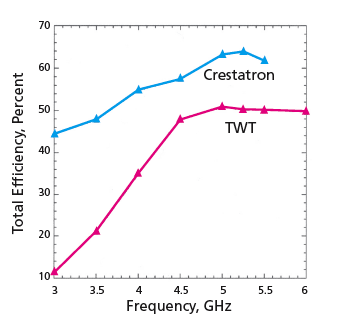
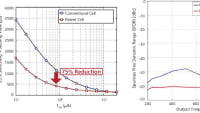
The degrees to which these advantages could be achieved were investigated in the design study, which was performed by use of CHRISTINE 1-D — a computer code developed previously for simulating the operation of a helix TWT in a large-signal regime. For example, large-signal simulations of a C-band crestatron operating at a potential of 5.850 kV and a current of 196 mA showed that this device could produce >250 W of power over a frequency span of 3 to 5.5 GHz. It was further shown that if the crestatron were to be combined with a two-stage depressed collector, the peak efficiency, reached at a frequency of about 5.2 GHZ, would be 64 percent. In contrast, a conventional TWT of similar power equipped with a two-stage depressed collector would exhibit efficiency of about 50 percent at this frequency (see figure). The crestatron as designed would also be a higher-power-density device, 40 percent shorter and 25 percent less massive, in comparison with the conventional TWT.
This work was done by DaviD K. Abe and Baruch Levush of the Naval Research Laboratory and David P. Chernin of Science Applications International Corp.
NRL-0029
This Brief includes a Technical Support Package (TSP).
Design Study of a C-Band Crestatron
(reference NRL-0029) is currently available for download from the TSP library.
Don't have an account?
More From SAE Media Group
Aerospace & Defense Tech Briefs
To 6G and Beyond: Penn Engineers Unlock the Next Generation of Wireless Communications
Tech Briefs
Wireless, Wearable Transmitter


Aerospace & Defense Tech Briefs
From DC to Daylight — How Innovations in Microwave Absorbers Shield the Warfighter
Aerospace & Defense Tech Briefs
Development of a 94 GHz Radar System for Dedicated Bird Detection at Airports and Airfields
Tech Briefs
New Wireless System for Greater 5G Access
Tech Briefs
Radio Signals Image Hidden and Speeding Objects
Aerospace & Defense Tech Briefs
New, Portable Antenna Could Help Restore Communication After Disasters

Tech Briefs
“One-Way” Electronic Devices
Aerospace & Defense Tech Briefs
Merging Antenna and Electronics Boosts Energy and Spectrum Efficiency
Tech Briefs
Atom-Based Radio Communications
Aerospace & Defense Tech Briefs
Benefits and Challenges of Direct-RF Sampling for Avionic Platforms
Electronics & Sensors INSIDER
New Transmitter Could Make Wireless Devices More Energy-Efficient
Aerospace & Defense Tech Briefs
Microcomb Chips Could Improve Accuracy of GPS Systems

Aerospace & Defense Tech Briefs
Software-Defined Analog Filters: A Paradigm Shift in Radio Filter Performance and Capability
Aerospace & Defense Tech Briefs
What is Pulse Shaping?
Tech Briefs
New on the Market

Photonics & Imaging Technology
Photonics-Based Wireless Link Breaks Speed Records for Data Transmission
Sensor Technology
RF Wireless Power Unleashes the Ubiquity of Sensor Networks
Tech Briefs
Conformal, Lightweight, Aerogel-Based Antenna
Tech Briefs
Wireless Transceiver Quadruples Speed of 5G
Aerospace & Defense Tech Briefs
Shape-Shifting Origami Could Help Antenna Systems Adapt On-the-Fly
Aerospace & Defense Tech Briefs
Understanding the “Black Art” of RF and Microwave Switching
Overview
The document presents a design study of a high-power C-band Crestatron amplifier, a type of vacuum electronic device. Unlike conventional helix traveling-wave tubes (TWTs) that operate in an exponentially growing-wave mode, the Crestatron utilizes a "beating-wave" regime. This involves three constant-amplitude voltage waves traveling at different phase velocities along the helix, which combine to produce power gain. Although the Crestatron has inherently lower gain than a TWT, it can deliver high RF power across a broad frequency range with impressive efficiency.
In the study, simulations indicated that a Crestatron operating at 5850 volts and 196 mA could generate over 250 watts of RF power within a frequency span of 3 to 5.5 GHz. When paired with a two-stage depressed collector, the Crestatron achieves a peak efficiency of approximately 64%, significantly higher than the 50% efficiency typical of a TWT of similar power output. Additionally, the Crestatron is noted for its higher power density, with a 40% reduction in length and a 25% reduction in mass compared to TWTs, making it a more compact and efficient option.
The document emphasizes the potential applications of the Crestatron in environments where volume and weight constraints are critical, such as airborne pods and unmanned vehicles. By integrating the Crestatron with a low-noise solid-state driver in a microwave power module (MPM) configuration, the study suggests that it is possible to create high-power, high-gain transmitters that are both efficient and compact.
The report also discusses the performance characteristics of the Crestatron compared to TWTs, particularly in terms of output power and intermodulation distortion (IMD). For output powers below 46 dBm, the Crestatron exhibits better C3IM and C5IM performance than TWTs, although it requires a reduction in output power to achieve certain linearity metrics.
Overall, the study highlights the Crestatron's advantages in efficiency, power density, and potential for high-performance applications, positioning it as a promising alternative to traditional TWTs in various technological fields.
Top Stories
NewsRF & Microwave Electronics
 Microvision Aquires Luminar, Plans Relationship Restoration, Multi-industry Push
INSIDERAerospace
 A Next Generation Helmet System for Navy Pilots
INSIDERDesign
 New Raytheon and Lockheed Martin Agreements Expand Missile Defense Production
INSIDERMaterials
 How Airbus is Using w-DED to 3D Print Larger Titanium Airplane Parts
NewsPower
 Ford Announces 48-Volt Architecture for Future Electric Truck
ArticlesAR/AI

Webcasts
Electronics & Computers
 Cooling a New Generation of Aerospace and Defense Embedded...
Automotive
 Battery Abuse Testing: Pushing to Failure
Power
 A FREE Two-Day Event Dedicated to Connected Mobility
Unmanned Systems
 Quiet, Please: NVH Improvement Opportunities in the Early Design Cycle
Automotive
 Advantages of Smart Power Distribution Unit Design for Automotive &...
Energy
 Sesame Solar's Nanogrid Tech Promises Major Gains in Drone Endurance