




Dassault Falcon 8X Breaks U.S. Coast-To-Coast Record
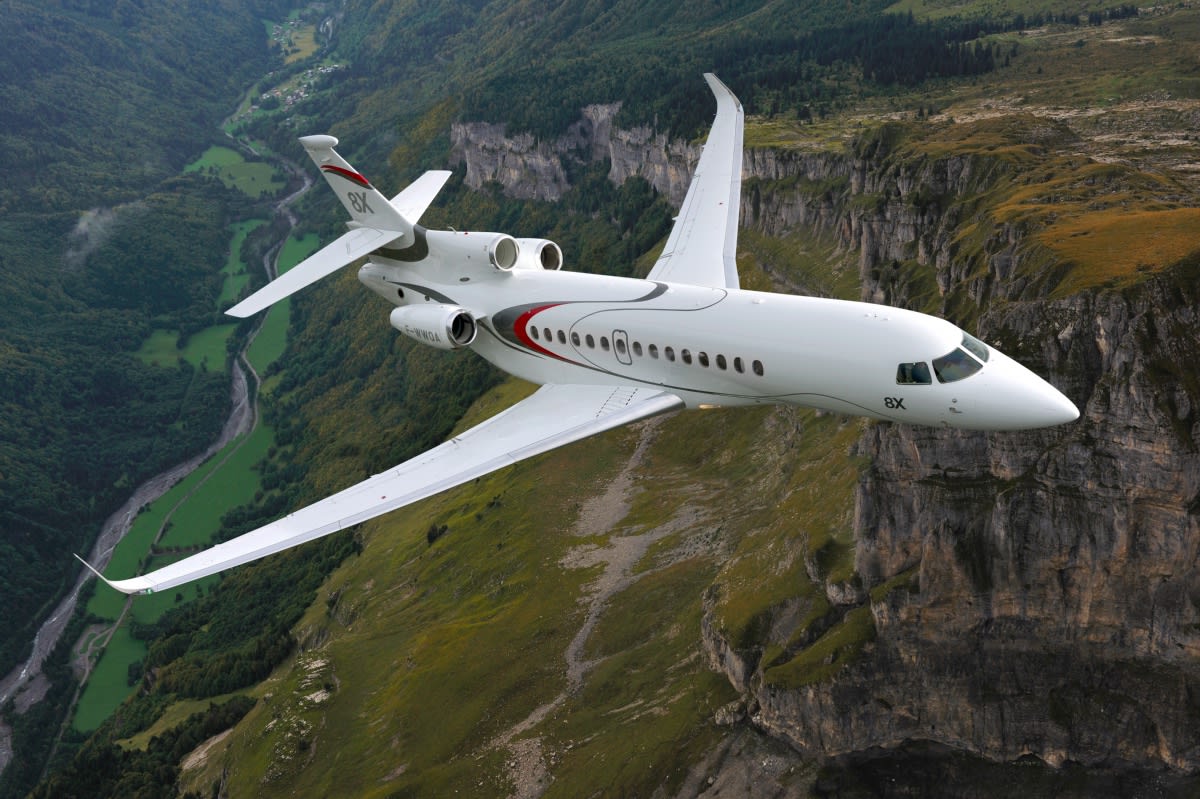
Paris-based Dassault Aviation SA (Dassault) just broke the coast-to-coast speed record with the company’s new ultra-long range, trijet Dassault Falcon 8X business jet. The flagship aircraft flew from Santa Monica Municipal Airport (SMO) outside of Los Angeles to Teterboro Airport in New Jersey in four hours and 28 minutes, beating a previous record by 24 minutes.
“Business aviation is about flying precisely where you need to be. Today’s flight on the Falcon 8X embodies everything that advanced design can accomplish: unparalleled airport performance, a quiet noise footprint, and extended capability, all in a large cabin business jet,” says Eric Trappier, chairman and CEO of Dassault Aviation. “This is not possible in any other business jet in the ultra-long range class.”
The record, pending official ratification by the National Aeronautic Association (NAA), was made after taking off from SMO’s notoriously short 3,500-foot runway, complying with strict noise abatement departure procedures, and flying with “overall poor tailwinds, averaging just five knots”. The previous record was made when SMO’s runway measured 5,000 feet.
Read more: Collins Aerospace taps Wind River Helix virtualization platform to future-proof avionics
The aircraft needed less than 2,000 feet of runway upon landing at Teterboro at 3:36 p.m. local time and a balanced field length only of 3,200 feet when it departed at 8:08 a.m. local time. Throughout the departure procedure and climb-out, laden with four passengers and 200 pounds of cargo, the Falcon 8X – a larger variant of the Dassault 7X – registered significantly below the 95 dBA SEL sound limit.

The new speed record follows a series of records set in 2018, including a challenging mission from London City Airport (LCY) that crossed the Atlantic Ocean to Beverly Regional Airport outside of Boston, Massachusetts in 6 hours and 44 minutes. LCY’s stringent noise rules, short runway, and steep glide scope limit the airport to very few aircraft types, but all production Falcon aircraft meet those requirements and are certified to operate at LCY.
Since its entry into service in late 2016, the Falcon 8X has been widely recognized not only for its superior performance, including its ability to land at airports like Aspen/Pitkin County Airport in Colorado and Lugano Airport and Gstaad Saanen Airport in Switzerland with challenging approaches that typically limit access to very few ultra-long range business jets.
The Falcon 8X, powered by three Pratt & Whitney Canada PW307D turbofan engines, has maximum takeoff with of 73,000 pounds and a range of 6,450 nautical miles.
William Kucinski is content editor at SAE International, Aerospace Products Group in Warrendale, Pa. Previously, he worked as a writer at the NASA Safety Center in Cleveland, Ohio and was responsible for writing the agency’s System Failure Case Studies. His interests include literally anything that has to do with space, past and present military aircraft, and propulsion technology.
Contact him regarding any article or collaboration ideas by e-mail at
More From SAE Media Group
Aerospace & Defense Tech Briefs
Gulfstream G500 Earns FAA Type and Production Certificates

Aerospace & Defense Tech Briefs
Aerion and Honeywell Collaborate on Revolutionary Flight Deck for Supersonic Bizjet
Aerospace & Defense Tech Briefs
HondaJet Is the Most Delivered Very Light Business Jet in 2019
Aerospace & Defense Tech Briefs
Rockford Xellerix to Support Pilatus PC-24 Electrification
Aerospace & Defense Tech Briefs
Sonex Aircraft Is Developing the World's Most Afforadable Jet Trainer
Aerospace & Defense Tech Briefs
Stratos Aircraft Evolves Carbon-Fiber Very Light Jet, Offers Limited Number of Kit Aircraft
Aerospace & Defense Tech Briefs
Air Force Begins 3D Printing Nonstructural Aircraft Parts
Aerospace & Defense Tech Briefs
Ahead of USAF T-X Decision, Leonardo Finds Market for T-100’s Little Brother – the Single-Engine Aermacchi M-345
Aerospace & Defense Tech Briefs
Embraer’s New Praetor 500 Is Awarded Type Certification in São Paulo During LABACE
Aerospace & Defense Tech Briefs
Mitsubishi Heavy Industries Will Acquire Bombardier’s Regional Jet Program
Aerospace & Defense Tech Briefs
Boeing's Latest Contract Secures New Wings for Remaining A-10 Fleet
Aerospace & Defense Tech Briefs
BendixKing and Airwork Are Developing Cockpit Upgrades for the Often Overlooked Small- and Medium-Sized Helicopter Market
Aerospace & Defense Tech Briefs
First F-35 Crash; Pilot Safe
Aerospace & Defense Tech Briefs
Old Bird Learns New Tricks
Aerospace & Defense Tech Briefs
Jet Aviation Basel Gains DGCA Approval from India for Dassault Aircraft
Aerospace & Defense Tech Briefs
Honeywell Acquires TruTrak and Expands General Aviation Avionics Portfolio
Aerospace & Defense Tech Briefs
Maintainers Design a $400 Maintenance Fixture to save the U.S. Air Force $500k per Year
Aerospace & Defense Tech Briefs
AVIC Subsidiary Continental Aerospace Will Power the Upcoming Diamond DA50, Expands into Electric Propulsion
Aerospace & Defense Tech Briefs
FAA Certifies AeroVonics' Economical Avionics Upgrade for Light General Aviation Aircraft
Aerospace & Defense Tech Briefs
Curtiss-Wright and Honeywell Team to Develop Cloud-Enabled Flight Recorders of the Future
Aerospace & Defense Tech Briefs
NATS Will Test AI at Heathrow to Reduce Weather-Related Flight Delays
Aerospace & Defense Tech Briefs
UTC’s Project 804 Hybrid-Electric Demonstrator May Increase Regional Jet Efficiency by 30 Percent
Aerospace & Defense Tech Briefs
Collins Aerospace Cabin Solutions Maintain Passenger Experience While Reducing Aircraft Weight
Aerospace & Defense Tech Briefs
Collins Aerospace Provides Avionics for C-130H Modernization Program
Aerospace & Defense Tech Briefs
Lockheed Martin Flies FireHerc Firefighting Variant of C-130J Turboprop in Farnborough
Aerospace & Defense Tech Briefs
OA-X Phase Two Kicks Off
Aerospace & Defense Tech Briefs
Japan Signs on for Second Boeing KC-46 Military Tanker and Transport Aircraft
Aerospace & Defense Tech Briefs
Boeing Wins $2.9B for 18 KC-46A Military Tanker Aircraft Based on 767 Jet Airliner
Aerospace & Defense Tech Briefs
Rolls-Royce to Work with Airframe Manufacturers, Seek Partners for EVTOL Project
Top Stories
INSIDERManufacturing & Prototyping
 How Airbus is Using w-DED to 3D Print Larger Titanium Airplane Parts
INSIDERManned Systems
 FAA to Replace Aging Network of Ground-Based Radars
NewsTransportation
 CES 2026: Bosch is Ready to Bring AI to Your (Likely ICE-powered) Vehicle
NewsSoftware
 Accelerating Down the Road to Autonomy
EditorialDesign
 DarkSky One Wants to Make the World a Darker Place
INSIDERMaterials
 Can This Self-Healing Composite Make Airplane and Spacecraft Components Last...
Webcasts
Defense
 How Sift's Unified Observability Platform Accelerates Drone Innovation
Automotive
 E/E Architecture Redefined: Building Smarter, Safer, and Scalable...
Power
 Hydrogen Engines Are Heating Up for Heavy Duty
Electronics & Computers
 Advantages of Smart Power Distribution Unit Design for Automotive...
Unmanned Systems
 Quiet, Please: NVH Improvement Opportunities in the Early Design...
Power

Similar Stories
NewsManned Systems
 Jet Aviation Basel Gains DGCA Approval from India for Dassault Aircraft
NewsAerospace
 Sonex Aircraft Is Developing the World's Most Afforadable Jet Trainer
NewsAerospace
 HondaJet Is the Most Delivered Very Light Business Jet in 2019