




Airbus Aerial Harnesses Satellites, UAS, Helicopters, Data Analytics, and AI to Support Hurricane Recovery Efforts
Using the most advanced aerospace technologies, Airbus Aerial can collect, analyze, and deliver actionable data from a range of 100 feet off the ground up into the troposphere using a number of assets, including: UAS, helicopters, satellites, data analytics, and artificial intelligence.

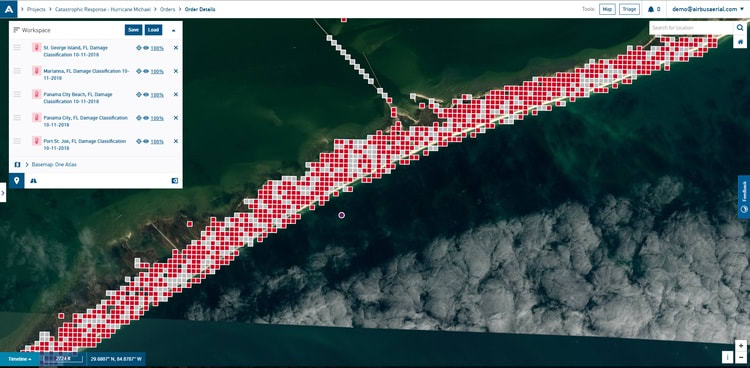
As the third strongest storm in the U.S. was striking the East Coast, Airbus Aerial technology was providing around-the-clock support analyzing the impact and aftermath of Hurricane Michael. Airbus Aerial uses a unique combination of satellites, manned aircraft and rotorcraft, and unmanned aircraft systems ( UAS ) together with data analytics technology and an artificial intelligence ( AI ), or machine learning, platform to help organizations supporting recovery efforts better understand and react to the storm as it rolled across the southeastern U.S. into the Gulf of Mexico.

Airbus Aerial, headquartered in Atlanta, had teams on the ground in affected areas to assess the situation as it evolved, collecting insights about impact to properties and the region.
Using the most advanced aerospace technologies, Airbus Aerial can collect, analyze, and deliver actionable data from a range of 100 feet off the ground up into the troposphere using a number of assets, including: UAS, helicopters, satellites, and more. The novel geospatial platform uses AI to transform the way aerospace technology, as part of a robust data analytics solution, provides critical insights not before possible, officials say.

Fusing Airbus' constellation of high-resolution satellites with fleets of unmanned aircraft, Airbus Aerial can collect, analyze, and distribute powerful, actionable data, focusing on what its customers need and then using the right tools for the job, officials describe.
“The power of Aerial is our ability to seamlessly integrate data from any aerospace asset, adapt to industry-specific problems, and provide customized data solutions,” a company representative adds. “Backed by Airbus, an international pioneer in the aerospace industry, we are a leader in designing, manufacturing, and delivering aerospace products, services, and solutions to customers on a global scale. We aim for a better-connected, safer, and more prosperous world.”
Airbus is a global provider of aeronautics, space, and related services. In 2017, it generated revenues of €67 billion and employed a workforce of around 129,000. Airbus offers a comprehensive range of passenger airliners from 100 to more than 600 seats. Also a provider of tanker, combat, transport, and mission aircraft, Airbus is one of the world’s leading space companies and delivers efficient civil and military rotorcraft solutions worldwide.
Working on AI in aerospace systems and platforms? Wrestling with AI challenges? Have AI and aerospace wisdom to share for the greater good of the industry? You're invited to get involved with SAE International -- contact
Courtney E. Howard is editorial director and content strategist at SAE International, Aerospace Products Group. Contact her by e-mail at
More From SAE Media Group
Aerospace & Defense Tech Briefs
SAE International Launches Aerospace Technology Symposium at Japan Aerospace 2018
Aerospace & Defense Tech Briefs
Industry Invited to Participate in AeroTech Aerospace and Defense Technical Program
Aerospace & Defense Tech Briefs
Lockheed Martin’s Next-Gen, 360-Degree Vision System Flies on the Bell V-280 Valor
Aerospace & Defense Tech Briefs
SAE International Extends Call for Abstracts, Seeks Submissions for AeroTech Conference
Aerospace & Defense Tech Briefs
SAE International Establishes a New AI Standards Committee at Le Bourget

Automotive Engineering
Airbus’ Connected Cabin Concept Is Materializing with First Round of Partnerships
Aerospace & Defense Tech Briefs
Air Force Tests Fully Autonomous UAS Control System
Aerospace & Defense Tech Briefs
ANSYS Will Help Airbus Develop AI-Enabled Flight Controls for the FCAS Program’s Autonomous Wingmen
Aerospace & Defense Tech Briefs
Martin UAV VTOL Unmanned Aircraft Taps Persistent Systems Wave Relay Data Link Technology
Aerospace & Defense Tech Briefs
Gaming Tech Helps Apache Maintainers Reduce Training Time
Aerospace & Defense Tech Briefs
Curtiss-Wright Black Boxes Receive European Approval
Aerospace & Defense Tech Briefs
AIA Predicts Flying Air Taxis, Supersonic Air Travel, and Space Industry for 2050
Aerospace & Defense Tech Briefs
Next Phase of the USAF Pilot Training Next Initiative Includes an Open Call for Innovative Solutions
Aerospace & Defense Tech Briefs
NATS Will Test AI at Heathrow to Reduce Weather-Related Flight Delays
Aerospace & Defense Tech Briefs
Persistent Systems Auto-Tracking Antenna Adds Aircraft to Network, Enhances Data Sharing
Aerospace & Defense Tech Briefs
New Zealand Will Become a Testbed for Airbus Unmanned Aircraft and Space Technology
Aerospace & Defense Tech Briefs
Artificial Intelligence Could Reduce CV-22 Osprey Maintenance
Aerospace & Defense Tech Briefs
Collins Aerospace Will Provide Avionics and Synthetic Vision for the Supersonic X-59 QueSST
Aerospace & Defense Tech Briefs
EU to Deploy UAV Traffic Management System by 2019
Aerospace & Defense Tech Briefs
New Swarm and Search AI Challenge Combines Machine Learning and UAS to Help Map Wildfires
Aerospace & Defense Tech Briefs
Sikorsky’s Autonomous Black Hawk Helicopter Takes Flight
Aerospace & Defense Tech Briefs
Airbus Will Lean on Start-Ups and Research Institutes for Europe’s Future Combat Air System
Aerospace & Defense Tech Briefs
Aireon to Launch Free, Real-Time Emergency Aircraft Location Service
Aerospace & Defense Tech Briefs
Air Mobility Innovations Take Center Stage at Aerospace Systems and Technology Conference
Aerospace & Defense Tech Briefs
DARPA’s Latest Drone Swarm Sprint Focuses on Virtual Environments
Aerospace & Defense Tech Briefs
Air Force Facility Dedicated to AI and Automation Opens in Pittsburgh
Aerospace & Defense Tech Briefs
Boeing’s Next EcoDemonstrator Test Bed Will Be a 777
Aerospace & Defense Tech Briefs
SaraniaSat Wins $5M NASA InVEST Contract for Hyperspectral Thermal Imager
Top Stories
NewsRF & Microwave Electronics
 Microvision Aquires Luminar, Plans Relationship Restoration, Multi-industry Push
INSIDERAerospace
 A Next Generation Helmet System for Navy Pilots
INSIDERDesign
 New Raytheon and Lockheed Martin Agreements Expand Missile Defense Production
INSIDERMaterials
 How Airbus is Using w-DED to 3D Print Larger Titanium Airplane Parts
NewsPower
 Ford Announces 48-Volt Architecture for Future Electric Truck
ArticlesAR/AI

Webcasts
Electronics & Computers
 Cooling a New Generation of Aerospace and Defense Embedded...
Automotive
 Battery Abuse Testing: Pushing to Failure
Power
 A FREE Two-Day Event Dedicated to Connected Mobility
Unmanned Systems
 Quiet, Please: NVH Improvement Opportunities in the Early Design Cycle
Automotive
 Advantages of Smart Power Distribution Unit Design for Automotive &...
Energy
 Sesame Solar's Nanogrid Tech Promises Major Gains in Drone Endurance