




Jaguar Land Rover Makes Eye Contact with New AV Research
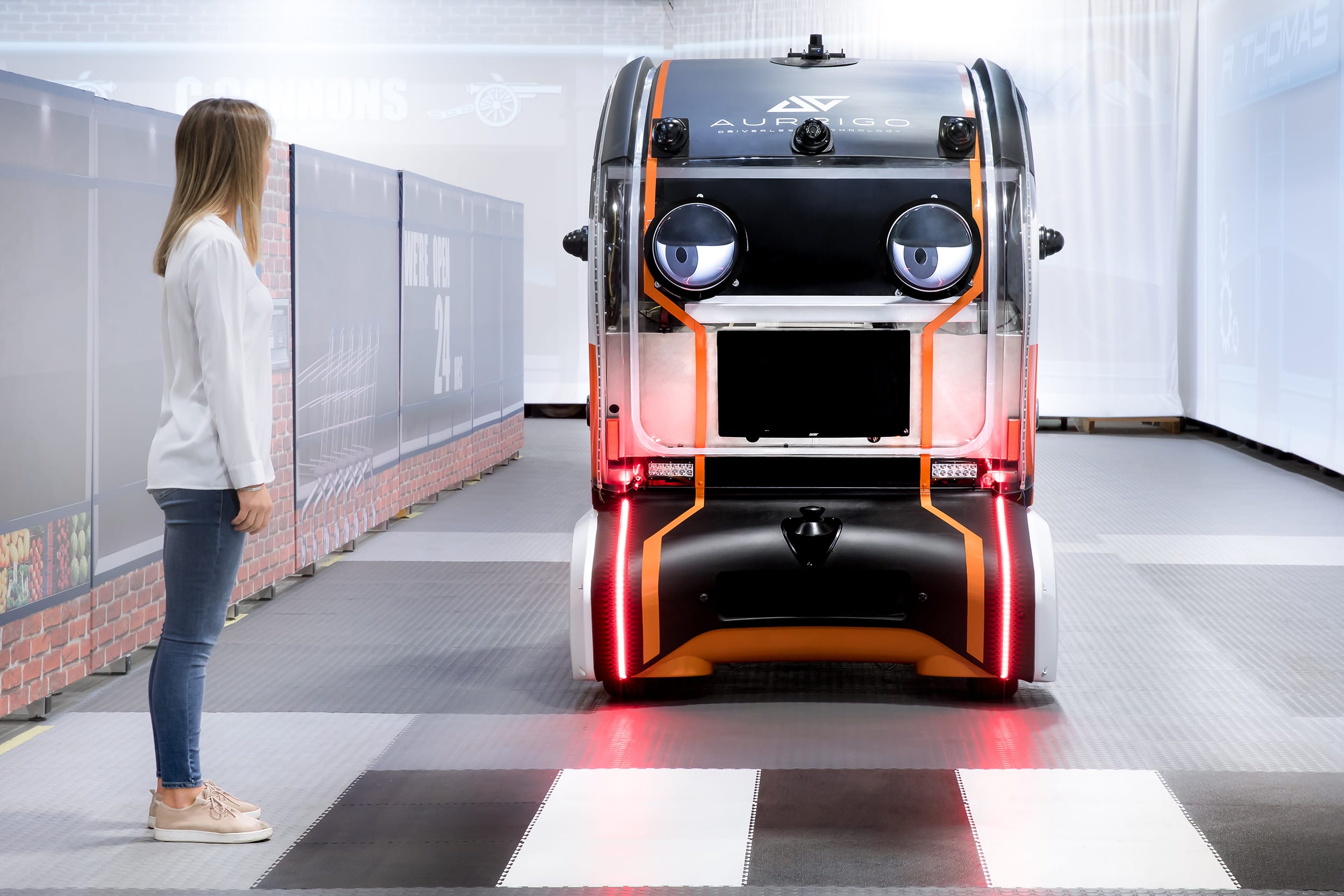
Jaguar Land Rover (JLR) engineers developing autonomous-vehicle (AV) driving systems are working with cognitive psychologists to determine how users—and particularly pedestrians—might be encouraged to fully trust new AV technology.
For this research study, JLR engineers are using an AV with large, blue virtual “eyes” that can track a pedestrian—although a production version might be expected to accomplish the goal in a less literal fashion.
The JLR psychological work comes alongside a recent report of some in the tech community suggesting pedestrians should be expected to “reprogram” their own behavior to make operation easier for AVs. The story aroused new skepticism regarding the prospects for near-term AV deployment if some developers believe humans should be “trained” on how best to survive in the automated-driving future.
Two-way street
“We want to know if it is beneficial to provide humans with information about a vehicle’s intentions—or whether simply letting a pedestrian know it has been recognized is enough to improve confidence,” said Pete Bennett, JLR’s Future Mobility Research Manager.
Called “trust trials,” the work is part of the United Kingdom government-backed Autodrive project. There are numerous other studies underway to determine the best methods to establish trust between man and machine, some seeking, like JLR’s work, to determine if it is possible to mimic the eye contact and other non-verbal signals pedestrians and human drivers exchange.
JLR is using dedicated autonomous test vehicles—dubbed Eye Pods—fitted with sophisticated vision systems to gather data to assess how much information future self-driving vehicles should share with other road users (but particularly pedestrians) to generate sufficient mutual trust. At present, states JLR, studies indicate that around two-thirds of pedestrians would be concerned about crossing a road populated by AVs.
Communication between a pedestrian and a conventional vehicle driver is a combination of vision (eye contact with the driver), speed and awareness assessment. There is invariably some mutuality about actions taken, or about to be taken, by both parties.
Eye contact. Literally
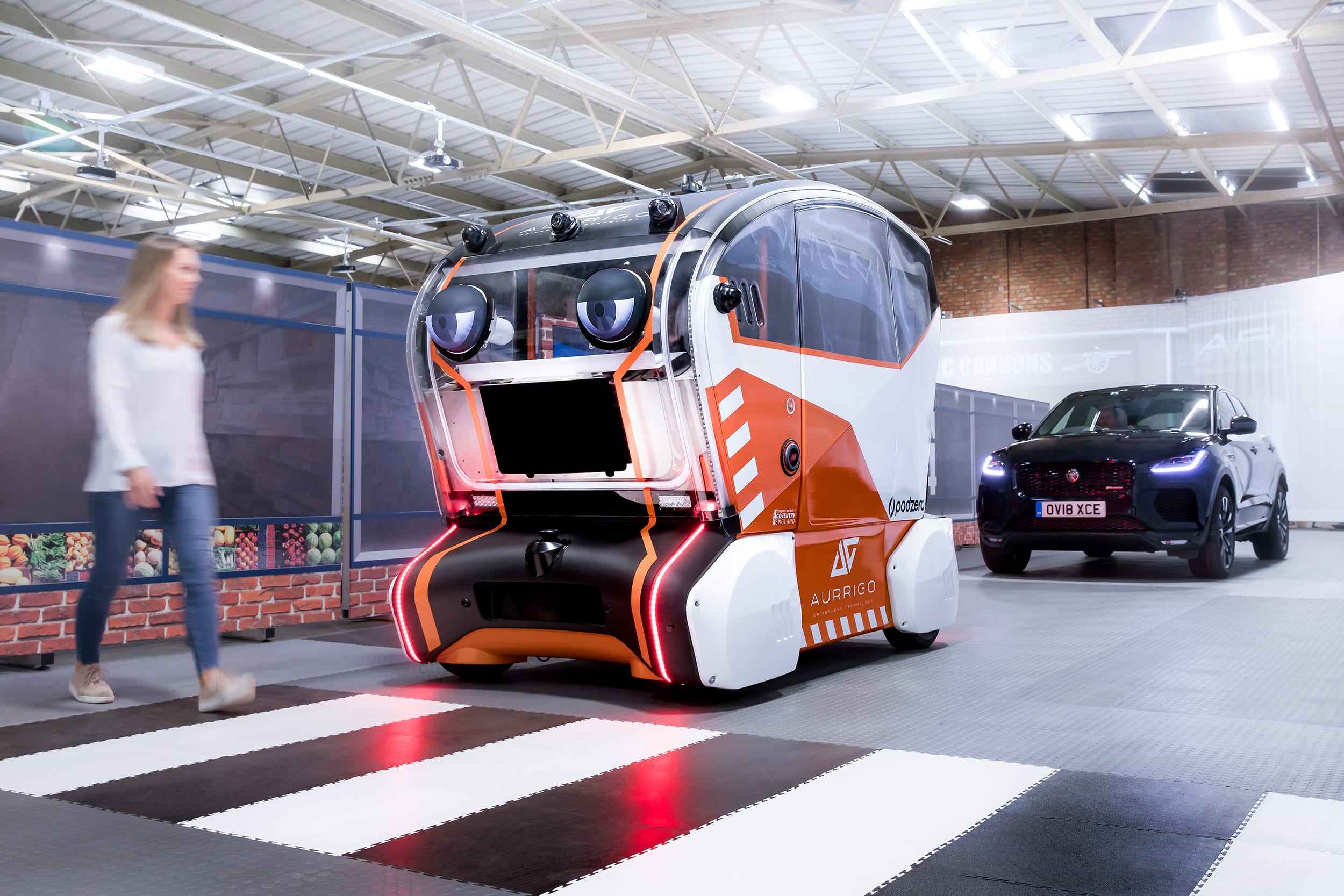
The test vehicles’ somewhat unnerving Eye Pods were devised by a team of advanced-technology engineers working in JLR’s Future Mobility division. The autonomous and therefore intelligent Pods run on a fabricated city street scene, constantly analyzing pedestrians’ behavior as they wait to cross the road. The company said the research Pod spots pedestrians—and appearing to “look” directly at them, signals via green or red lights that it has identified the pedestrian and simultaneously indicates if it will stop at a pedestrian crossing or take avoiding action as necessary. But it won’t wink, assures JLR.
Pedestrian “trust levels” are constantly monitored before and after the Eye Pod makes overall visual contact to find out whether the vehicle generated sufficient confidence that it would stop for the pedestrian. “Previous studies suggest as many 63% of pedestrians and cyclists say they would feel less safe sharing the road with a self-driving vehicle. Safety remains the number one priority as JLR invests in self-driving technology,” the company said.
The trial is aligned with the brand’s long-term AV-related strategic goals: to make cars safer, free up people’s valuable time, and improve mobility for everyone.
Bennett adds: “It’s second nature to glance at the driver of the approaching vehicle before stepping into the road. Understanding how this translates in tomorrow’s more-automated world is important.”
The trials are part of a wider study exploring how future connected and autonomous vehicles can replicate human behavior and reactions when driving. As part of the work, more than 500 test subjects have been studied interacting with the self-driving Pods designed by U.K. Autodrive partner Aurrigo.
The Autodrive project is a 3-year program that completes toward the end of 2018 and was formed to integrate autonomous and connected vehicles into real-world urban environments. Its targets include showing how autonomous and connected vehicles could solve everyday challenges such as congestion; demonstrating the commercial operation of electric, self-driving “pods” at a city scale and providing insight for key stakeholders and decision-makers, including legislators, insurers and investors.
More From SAE Media Group
Automotive Engineering
JLR Pavement Signals Throw New Light on AV Trust Levels
Automotive Engineering
Emulating 5G Networks for AV Testing
Automotive Engineering
Automated Vehicles Not an 'If' but a 'When'
Automotive Engineering
Continental’s New CTO to Lead Retooled R&D Pillar
Automotive Engineering
Motion Sickness Meets Autonomous Adaptable Dynamics
Automotive Engineering
SAE Brings Autonomy to the Public in New Demonstration Program
Off-Highway Engineering
WCX 2021: Top Engineers Talk Industry Transformation
Automotive Engineering
Preview: SAE 2021 WCX
Autonomous Vehicle Engineering
Prepping Cities for Vehicle Autonomy
Autonomous Vehicle Engineering
Speeding AV Testing with a Digital Twin
Automotive Engineering
Toyota Reinvesting in Collaborative Safety Research
Off-Highway Engineering
Trucks with Intuition
Autonomous Vehicle Engineering
Aptiv’s Satellite Route to ‘Democratizing’ Autonomous Tech
Automotive Engineering
Audio Updates You Can’t Even Hear
Automotive Engineering
Automated Vehicle Safety Series Addresses Design, Testing, Verification, and Validation
Autonomous Vehicle Engineering
5G Cellular-Enabled Test Infrastructure for Autonomous Vehicles Launched at U.K.’s Millbrook
Automotive Engineering
Talking SDVs and Zonal Architecture with TE Connectivity
Off-Highway Engineering
Sensors Evolve to Satisfy CV Demands
Automotive Engineering
Closing Gap to Leverage Enhanced Computational Power for SDV Advancement
Off-Highway Engineering
Realizing Software-Defined Commercial Vehicles
Automotive Engineering
Ford Releasing Comprehensive Dataset to Promote Autonomous R&D
Autonomous Vehicle Engineering
5G Cellular May Be Transformational for Automakers, Suppliers
Aerospace & Defense Tech Briefs
AIA Predicts Flying Air Taxis, Supersonic Air Travel, and Space Industry for 2050
Automotive Engineering
Toyota Unveils Autonomous E-Commerce Concept Vehicle, Development Alliance
Autonomous Vehicle Engineering
Data Drives Driverless Truck Launch
Off-Highway Engineering
State of the Industry: Ubiquitous Broadband Is Key
Automotive Engineering
As Early Autonomy Questions Roil the Industry, Toyota Hews to Driver-Enhancement Philosophy
Off-Highway Engineering
Advancing HMI Development of ADAS and Active Safety Systems
Autonomous Vehicle Engineering
Delivering on Autonomous Transport
Autonomous Vehicle Engineering
Industry Remains Unsettled on Vehicle Connectivity Standard
Top Stories
INSIDERDefense
 New Raytheon and Lockheed Martin Agreements Expand Missile Defense Production
NewsAutomotive
 Ford Announces 48-Volt Architecture for Future Electric Truck
INSIDERManufacturing & Prototyping
 Active Strake System Cuts Cruise Drag, Boosts Flight Efficiency
ArticlesTransportation
 Accelerating Down the Road to Autonomy
INSIDERMaterials
 How Airbus is Using w-DED to 3D Print Larger Titanium Airplane Parts
Road ReadyTransportation
Webcasts
Electronics & Computers
 Cooling a New Generation of Aerospace and Defense Embedded...
Power
 Battery Abuse Testing: Pushing to Failure
Connectivity
 A FREE Two-Day Event Dedicated to Connected Mobility
Automotive
 Quiet, Please: NVH Improvement Opportunities in the Early Design Cycle
Transportation
 Advantages of Smart Power Distribution Unit Design for Automotive &...
Aerospace
 Sesame Solar's Nanogrid Tech Promises Major Gains in Drone Endurance