




Cultivating the Next Generation of Engineers
Mechanical engineering professor wins SAE award honoring contributions with a lasting impact on humanity.
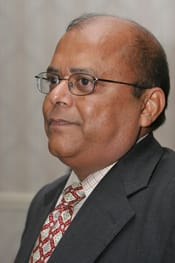
To say that Ramesh K. Agarwal, Ph.D., is prolific is an understatement. Over a distinguished career spanning 40 years, he has worked in various areas of computational science and engineering, including CFD, computational acoustics and electromagnetics, computational materials science, and computational geo-mechanics and combustion. In his time in the field, he has authored and co-authored more than 600 publications, and given plenary, keynote, and invited lectures at national and international conferences worldwide. He also continues to serve on several academic, government, and industrial advisory committees, and is a Fellow of 22 societies, including SAE International. And now, among his many prestigious honors, national and international awards, he has received the SAE Arnold W. Siegel Humanitarian Award. This award honors those whose mobility industry contributions have made a significant, positive, multi-generational impact on the world.
Recognizing “a big problem right now is: how do we motivate younger children to go into STEM?” Agarwal has worked with K-12 students to help them understand the field and spark their interest in STEM disciplines. While editing a book titled, “When the Wind Blows,” published by Holiday Press, he was challenged to explain aerodynamic theory in a way that could be understood by a 5-year-old. “Sometimes, it is not easy to [simplify theory] like this. You think an idea is straightforward, but maybe it isn’t when you try to explain it to younger students,” said Agarwal. And yet “once I dived into them, they were enjoyable challenges.” He has spent the past six summers serving as a mentor for high school students, providing them with research experience under the STARS Program administered by the University of Missouri—St. Louis. In this role, he found that “students have interesting perspectives and are very curious about things in STEM. I try to make it exciting for them.”
Agarwal’s passion for working with youth is a source of admiration from his peers. “Very few of us can imagine themselves to be engaged in such activities after an illustrious technical career,” said colleague Bharat K. Son, Ph.D., professor of mechanical engineering at Tennessee Tech University.
As one of the world’s top aerospace scientists, Agarwal’s breadth of work and impact on the education of today’s youth makes him the ideal recipient of the SAE Arnold W. Siegel Humanitarian Award. “[The award] has been a major highlight of my career. It has brought me a great deal of personal satisfaction knowing that my work has a human dimension to it, which has impacted the life of young children to high school and college students to professionals. At this stage in my life, it is very important for me if my work and efforts can motivate next generation to STEM disciplines to address the problems of energy, environment and resources facing humanity. This award is a validation of my efforts in this regard which is a source of great pleasure and satisfaction.”
To learn more about the SAE Arnold W. Siegel Humanitarian Award, and other SAE Awards, please visit the SAE Awards page .
More From SAE Media Group
Off-Highway Engineering
Advanced Simulation Techniques Drive Powertrain Design
Automotive Engineering
Subaru Uses ANSYS Tools to Accelerate Hybrid Vehicle Design
Aerospace & Defense Tech Briefs
SAE International Extends Call for Abstracts, Seeks Submissions for AeroTech Conference
Aerospace & Defense Tech Briefs
Airbus’ Quantum Computing Challenge May Fundamentally Change Aircraft Development
Aerospace & Defense Tech Briefs
Designing a High-Speed Decoy Unmanned Aerial Vehicle (UAV)
Aerospace & Defense Tech Briefs
Industry Invited to Participate in AeroTech Aerospace and Defense Technical Program
Autonomous Vehicle Engineering
Truck Platooning an Evolving Pathway to Full Autonomy
Aerospace & Defense Tech Briefs
Considerations of Aeroacoustics in Turbojet-Engine Testing
Off-Highway Engineering
Advances in Virtual Powertrain Development
Automotive Engineering
Handicapping the ‘Race Toward Zero’
Off-Highway Engineering
Garrett Two-Stage Turbos Ramp up Off-Highway
Automotive Engineering
An Immersive Solution for Thermally Safer EV Batteries
Automotive Engineering
WCX 2025: Luminary Cloud Debuts Foundational Datasets for Aerodynamic Sims
Aerospace & Defense Tech Briefs
SAE International Issues, Revises Technical Reports for Aerospace Engineering

Autonomous Vehicle Engineering
The Electric, Autonomous Revolution Lifts Off
Automotive Engineering
Cadillac to Launch 2023 Lyriq EV Months Earlier Than Planned
Automotive Engineering
Accelerating Racecar Innovation
Off-Highway Engineering
Schaeffler Optimizes Rolling Bearings for Hydraulic and Axle Drives
Aerospace & Defense Tech Briefs
Surviving the Challenge of Thermal Design in Aerospace Electronics
Photonics & Imaging Technology
Making VR a NASA Reality
Off-Highway Engineering
DENSO Boosts Its Mobility-As-A-Service and Connected Technologies with New Seattle R&D Lab
Aerospace & Defense Tech Briefs
AGI and ANSYS Partner to Integrate Next-Gen Digital Modeling into Engineering Design

Off-Highway Engineering
Cummins New X15 Engine Meets Upcoming Regs While Boosting Efficiency
Medical Design Briefs
The Digital Future of Medical Device Development
Motion Design
CAD Model Offers Robots Precise Pick-and-Place Solutions
Automotive Engineering
Jaguar Reveals Long-Awaited Clean-Sheet Entry-Level XE
Aerospace & Defense Tech Briefs
Software for Additive Design, Manufacturing Evolves Quickly
Aerospace & Defense Tech Briefs
An Automated System for Multi-Physics Modeling
Top Stories
INSIDERManufacturing & Prototyping
 How Airbus is Using w-DED to 3D Print Larger Titanium Airplane Parts
INSIDERManned Systems
 FAA to Replace Aging Network of Ground-Based Radars
NewsTransportation
 CES 2026: Bosch is Ready to Bring AI to Your (Likely ICE-powered) Vehicle
NewsSoftware
 Accelerating Down the Road to Autonomy
EditorialDesign
 DarkSky One Wants to Make the World a Darker Place
INSIDERMaterials
 Can This Self-Healing Composite Make Airplane and Spacecraft Components Last...
Webcasts
Defense
 How Sift's Unified Observability Platform Accelerates Drone Innovation
Automotive
 E/E Architecture Redefined: Building Smarter, Safer, and Scalable...
Power
 Hydrogen Engines Are Heating Up for Heavy Duty
Electronics & Computers
 Advantages of Smart Power Distribution Unit Design for Automotive...
Unmanned Systems
 Quiet, Please: NVH Improvement Opportunities in the Early Design...
