




GE Additive Unveils Project ATLAS Program’s First 3D Printer
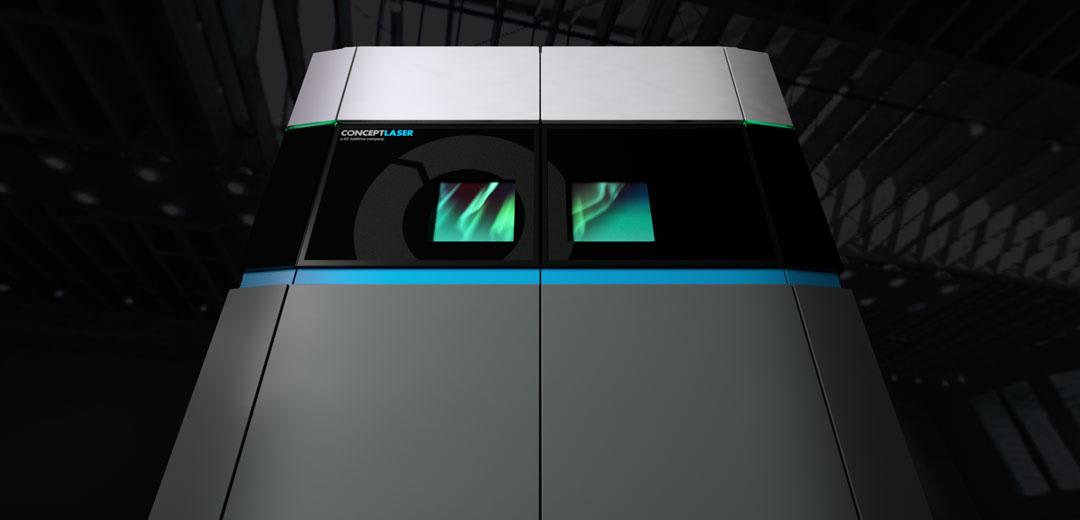
As additive technology continues to transform the manufacturing world with lighter and stronger parts, there has been an increasing demand from many industries for additive machines that are bigger and faster. Project ATLAS (Additive Technology Large Area System) is GE Additive’s company-wide program to develop the next-generation large additive machines.
This first beta machine was developed in nine months and caters to industries that require large complex metal parts, such as aviation, automotive, space, and oil and gas industries. It is said to offer "the world’s largest" direct metal laser melting (DMLM) build envelope.
“The machine can 3D print aviation parts suitable for making jet engine structural components and parts for single-aisle aircraft,” said Mohammad Ehteshami Vice President and General Manager of GE Additive. “It’s sized for the CFM LEAP engine and the resolution and features of the part are amazing.”
The new beta machine builds on technology previously developed by GE and combines DMLM expertise from the German 3D printer manufacturer, Concept Laser—which GE acquired in December 2016. The first few beta machines are currently being evaluated by a small group of customers and more will be available for delivery in 2018, with production occurring in Lichtenfels, Germany and Cincinnati, OH.
“Irrespective of industry, every customer has its own specific needs and its own unique levels of complexity. We regularly hear that next-generation machines need to be customizable and configurable. The new meter-class machine we’re debuting is our response to that feedback—a solution that is scalable and customizable and meets the needs of our industry, as it matures,” said Ehteshami.
The big volume (currently 1.1 x 1.1 x 0.3 m) is suitable for large titanium, aluminum, and alloy components with high resolution and complex geometries that are typical of aerospace-class parts. The beta machines incorporate 1-kW laser technology and are reconfigurable to incorporate additional lasers as well as a proprietary discrete dosing methodology to reduce powder consumption by 69% when compared to current traditional machines.
The printer also incorporates process and machine health monitoring through GE’s cloud-based “industrial internet” operating system, Predix. The system is currently in use on Concept Laser’s new M2 printers, which use Predix to monitor analytics to identify potential production issues.
GE is actively using additive manufacturing in several of its business units, including GE Aviation—which prints LEAP engine fuel nozzles. GE is also working on the Advanced Turboprop, which is soon to be the first commercial aircraft engine where more than one third of the components are designed and built using additive manufacturing methodology.
In addition to the $1.4 billion investment in Concept Laser and Arcam, GE has also invested approximately $1.5 billion in manufacturing and additive technologies over the past 10 years. In 2016, the company established GE Additive to become a leading supplier of additive technology, materials, and services for industries and businesses worldwide.
More From SAE Media Group
Off-Highway Engineering
Bosch Invested in Large-Scale Metal 3D Printing
Tech Briefs
Optimizing a CubeSat with Architected Materials

Aerospace & Defense Tech Briefs
3-D Manufacturing of Titanium Components Takes Off
Aerospace & Defense Tech Briefs
GE Aviation and DM3D to Ramp up 3D-Printed Fan Blade Production for GE9X Engine
Aerospace & Defense Tech Briefs
Additive Manufacturing Adoption Up, Growing Rapidly in Aerospace
Aerospace & Defense Tech Briefs
High-Strength Aluminum Powder Developed for Additive Manufacturing in Aerospace, Automotive
Aerospace & Defense Tech Briefs
Aerojet Rocketdyne Pursues Copper Alloy Additive Manufacturing for Thrust Chamber Assembly
Aerospace & Defense Tech Briefs
3D Printing Metal Parts on a Ship
Aerospace & Defense Tech Briefs
Laser Wire Additive Manufacturing System
Aerospace & Defense Tech Briefs
SAE International Issues First Technical Standards for Aerospace Additive Manufacturing
Aerospace & Defense Tech Briefs
Additive Manufacturing and Materials a Prime Focus for GKN Aerospace
Aerospace & Defense Tech Briefs
Equispheres Accelerates Additive Manufacturing Innovation with $5M from Lockheed Martin
Aerospace & Defense Tech Briefs
GKN Aerospace to Lead Research Collaboration into Additive Manufacturing
Aerospace & Defense Tech Briefs
Roush to Support the Aerospace Industry with the King of Metal 3D Printers
Aerospace & Defense Tech Briefs
3D-Printed NACA Inlet
Aerospace & Defense Tech Briefs
Lockheed Martin Will Merge Machine Learning with 3D Printing
Defense INSIDER
Army Leverages New Alliance for 3-D Printing Goals
Aerospace & Defense Tech Briefs
Lifting 3D Printing to New Heights

Aerospace & Defense Tech Briefs
MTU Develops New Turbine Blade Material in Record Time
Aerospace & Defense Tech Briefs
Norsk and SAE International Collaborate on World’s First Directed Energy Deposition Specification
Aerospace & Defense Tech Briefs
Improving the Surface Finish of Additive Manufactured Parts
Aerospace & Defense Tech Briefs
Portable 3D Printing Factory



Aerospace & Defense Tech Briefs
Sciaky, Aubert & Duval, and Airbus Join Together to Combine High-Power Forging with Additive Manufacturing
Off-Highway Engineering
Moving Metal AM Forward
Top Stories
INSIDERManufacturing & Prototyping
 How Airbus is Using w-DED to 3D Print Larger Titanium Airplane Parts
INSIDERManned Systems
 FAA to Replace Aging Network of Ground-Based Radars
NewsTransportation
 CES 2026: Bosch is Ready to Bring AI to Your (Likely ICE-powered) Vehicle
NewsSoftware
 Accelerating Down the Road to Autonomy
EditorialDesign
 DarkSky One Wants to Make the World a Darker Place
INSIDERMaterials
 Can This Self-Healing Composite Make Airplane and Spacecraft Components Last...
Webcasts
Defense
 How Sift's Unified Observability Platform Accelerates Drone Innovation
Automotive
 E/E Architecture Redefined: Building Smarter, Safer, and Scalable...
Power
 Hydrogen Engines Are Heating Up for Heavy Duty
Electronics & Computers
 Advantages of Smart Power Distribution Unit Design for Automotive...
Unmanned Systems
 Quiet, Please: NVH Improvement Opportunities in the Early Design...
