




Aerojet Rocketdyne Pursues Copper Alloy Additive Manufacturing for Thrust Chamber Assembly
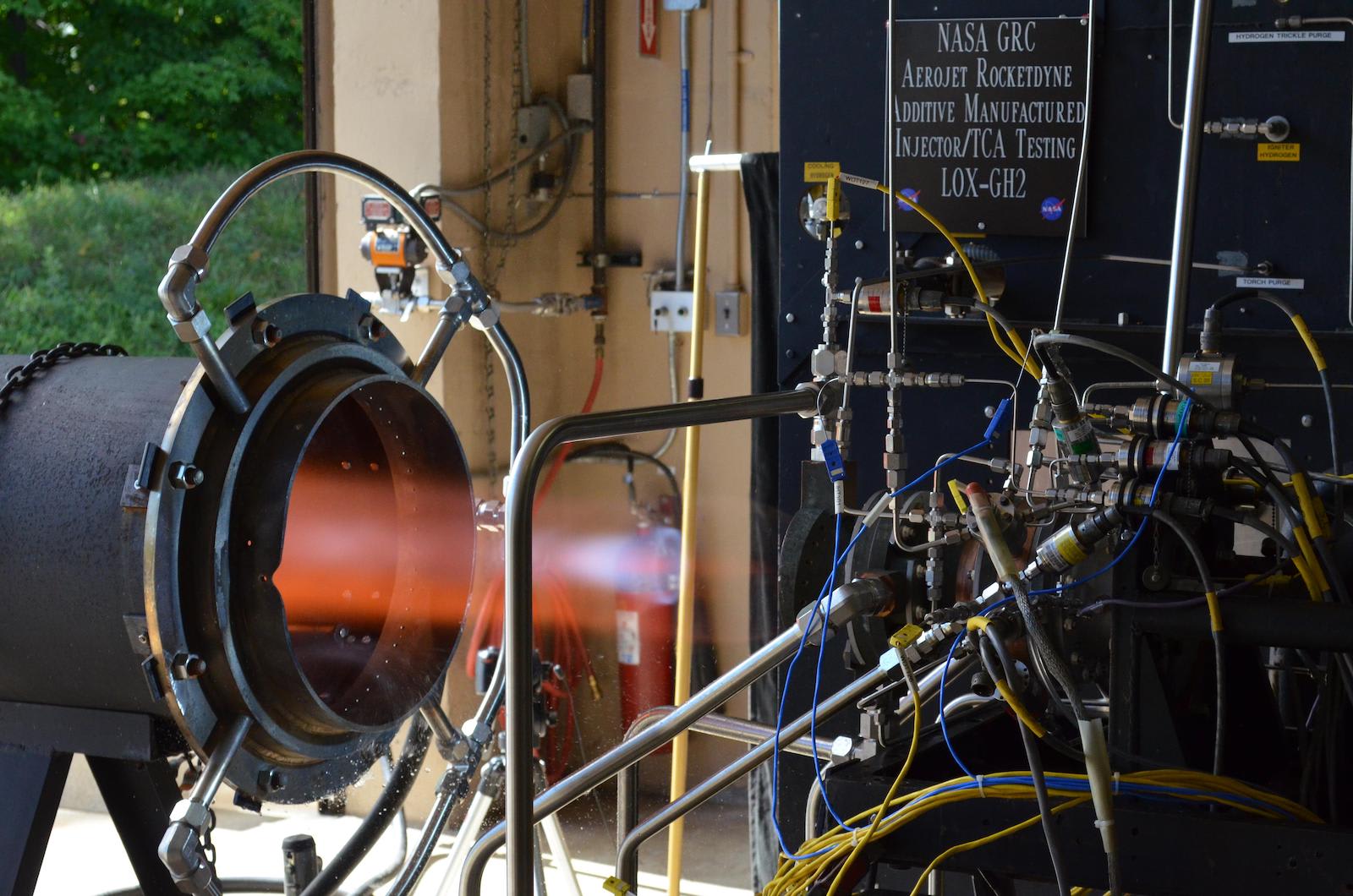
NASA and Aerojet Rocketdyne, a Sacramento, CA-based GenCorp company, announced Oct. 17 that they successfully completed a series of hot-fire tests on an advanced rocket-engine thrust chamber assembly (TCA) using copper alloy additive manufacturing (AM) technology.
The testing, claimed to be an industry first, was conducted with cooperation between Aerojet Rocketdyne, NASA’s Space Technology Mission Directorate Game-Changing Development Program, and NASA’s Glenn Research Center under a Space Act Agreement.
The hot-fire tests used Aerojet Rocketdyne’s proprietary Selective Laser Melting (SLM) copper alloy enhanced heat transfer design chamber, which demonstrated a “significant increase in performance” compared to traditional combustion chamber designs and material systems.
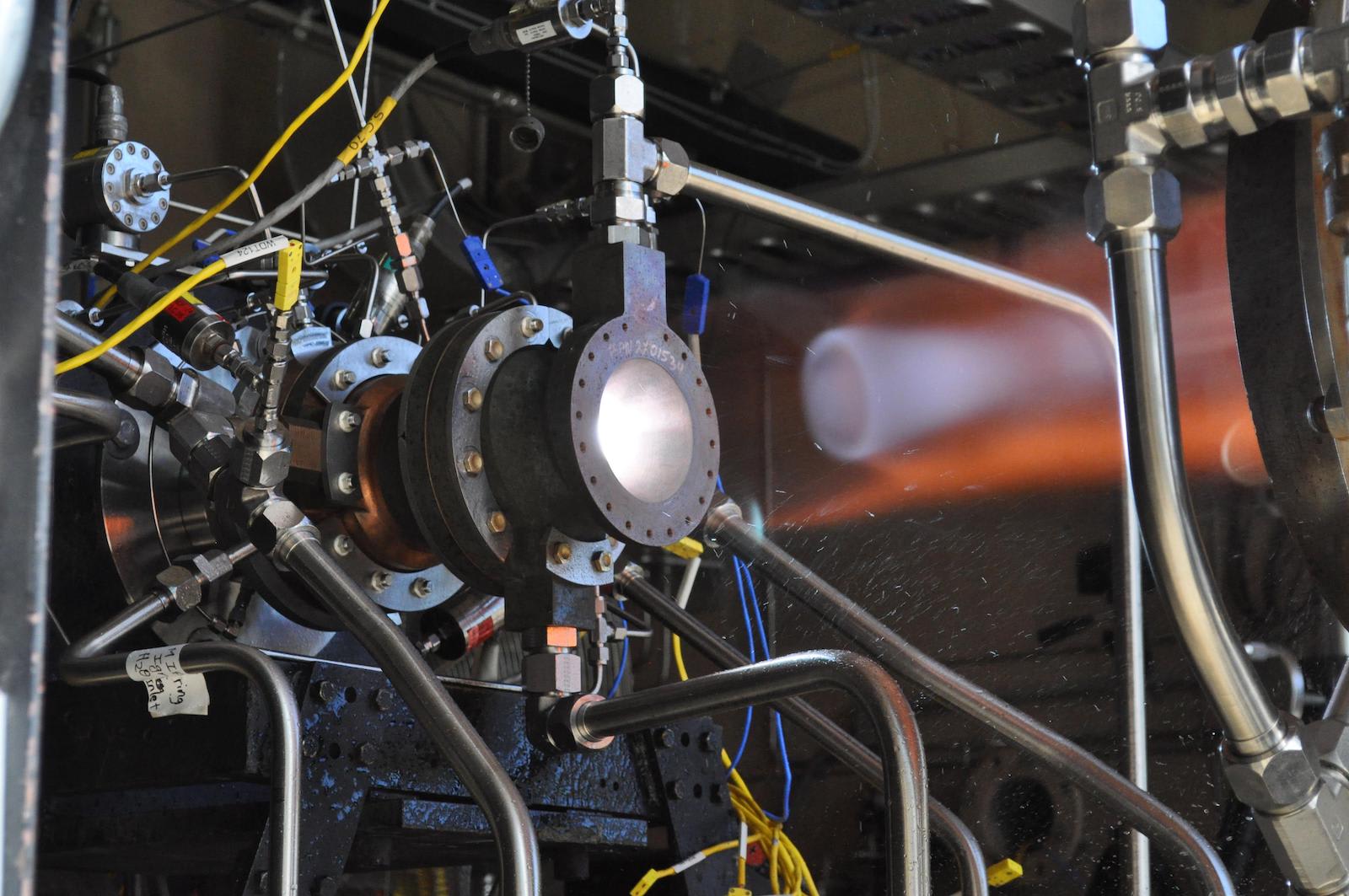
“In all, NASA and Aerojet Rocketdyne conducted 19 hot-fire tests on four injector and TCA configurations, exploring various mixture ratios and injector operability points. At the conclusion of the tests, the injector and chamber hardware were found to be in excellent condition, and test data correlated with performance predictions,” Lee Ryberg, Lead Project Engineer on Aerojet Rocketdyne’s Additive Manufacturing development team, said in a statement announcing the successful testing.
Aerojet Rocketdyne told Aerospace Engineering that it has been “aggressively working the methodical development of AM” for several years, for a number of alloys. The specific copper alloy employed in this round of hot-fire tests is proprietary and has been in some phase of development and demonstration for about the past three years.
“SLM of copper can be pretty tricky, for the reasons…regarding the conductivity of Cu,” a company spokesperson shared. “So it can be a challenge to get a solid, well-managed microstructure that will result in good mechanical properties.”
Other materials the company is exploring for the AM technology include a few different nickel alloys, some titanium, a couple of steels, and some aluminum, the spokesperson said.
“This work represents another major milestone in the integrated development and certification of the materials characterization, manufacturing processes, analysis, and design-tool technologies that are required to successfully implement Selective Laser Melting for critical rocket engine components,” Jay Littles, Director of Advanced Launch Programs at Aerojet Rocketdyne, said in the statement. “Aerojet Rocketdyne continues to expand the development of novel material and design solutions made possible through additive manufacturing, which will result in more efficient engines at lower costs. We are working on a range of additive-manufacturing implementation paths—from affordability and performance enhancement to legacy products such as the RL10 upper stage engine. We also are applying the technology to next-generation propulsion systems, including the Bantam Engine family, as well as our new large, high-performance booster engine, the AR1.”
The traditional materials that could be replaced by SLM copper alloy technology depend on the specific application. “For some of our legacy products, this type of additively-manufactured copper combustion chamber could replace a brazed steel tube combustion chamber. Moving from brazed steel tube construction to an integral copper chamber would have benefits in terms of component cost, lead time, and even performance, depending on the configuration,” the spokesperson told Aerospace Engineering.
Performance improvements, for this application, can include improved thermal management within the combustion chamber, “which can relate to improved component durability and even combustion efficiency,” according to Aerojet Rocketdyne.
Full-scale demonstration is the next step in the technology’s development path.
More From SAE Media Group
Off-Highway Engineering
Bosch Invested in Large-Scale Metal 3D Printing
Tech Briefs
Using 3D Printing to Strengthen Jet Engines
Aerospace & Defense Tech Briefs
Additive Manufacturing Adoption Up, Growing Rapidly in Aerospace
Aerospace & Defense Tech Briefs
SAE International Issues First Technical Standards for Aerospace Additive Manufacturing

Aerospace & Defense Tech Briefs
Laser Wire Additive Manufacturing System
Aerospace & Defense Tech Briefs
Roush to Support the Aerospace Industry with the King of Metal 3D Printers
Aerospace & Defense Tech Briefs
Equispheres Accelerates Additive Manufacturing Innovation with $5M from Lockheed Martin
Off-Highway Engineering
Mahle Advances 3D Printing Capabilities
Aerospace & Defense Tech Briefs
Evaluation of Additively Manufactured Ultrahard Steels

Aerospace & Defense Tech Briefs
Sciaky, Aubert & Duval, and Airbus Join Together to Combine High-Power Forging with Additive Manufacturing
Off-Highway Engineering
MELD Exploits Plastic Deformation of Metals with Non-Melt Additive Manufacturing
Off-Highway Engineering
Moving Metal AM Forward
Aerospace & Defense Tech Briefs
Aerojet Rocketdyne Gets a Boost from Additive Manufactured Components
Aerospace & Defense Tech Briefs
Norsk and SAE International Collaborate on World’s First Directed Energy Deposition Specification
Aerospace & Defense Tech Briefs
Additive Manufacturing and Materials a Prime Focus for GKN Aerospace
Off-Highway Engineering
EOS Releases Four New Metal Materials for Series Additive Manufacturing
Tech Briefs
Executive Roundtable: Additive Manufacturing
Aerospace & Defense Tech Briefs
GE Aviation and DM3D to Ramp up 3D-Printed Fan Blade Production for GE9X Engine
Aerospace & Defense Tech Briefs
Arconic Unveils Advanced Titanium Alloy for Higher Temperature Aerospace Applications
Aerospace & Defense Tech Briefs
Lockheed Martin Will Merge Machine Learning with 3D Printing
Aerospace & Defense Tech Briefs
Why are Aerospace & Defense Companies Embracing Additive Manufacturing?


Aerospace & Defense Tech Briefs
Orbex Debuts Innovative Smallsat Launch Vehicle
Medical Design Briefs
Near-Void-Free 3D Printing
Tech Briefs
3D Printing Stronger Carbon Nanotubes

Top Stories
NewsSensors/Data Acquisition
 Microvision Aquires Luminar, Plans Relationship Restoration, Multi-industry Push
INSIDERRF & Microwave Electronics
 A Next Generation Helmet System for Navy Pilots
INSIDERWeapons Systems
 New Raytheon and Lockheed Martin Agreements Expand Missile Defense Production
NewsAutomotive
 Ford Announces 48-Volt Architecture for Future Electric Truck
INSIDERAerospace
 Active Strake System Cuts Cruise Drag, Boosts Flight Efficiency
ArticlesTransportation

Webcasts
Aerospace
 Cooling a New Generation of Aerospace and Defense Embedded...
Energy
 Battery Abuse Testing: Pushing to Failure
Power
 A FREE Two-Day Event Dedicated to Connected Mobility
Automotive
 Quiet, Please: NVH Improvement Opportunities in the Early Design Cycle
Electronics & Computers
 Advantages of Smart Power Distribution Unit Design for Automotive &...
Unmanned Systems
 Sesame Solar's Nanogrid Tech Promises Major Gains in Drone Endurance