




Norsk Gives Boeing Manufacturing Edge with First 3D-Printed Titanium Components
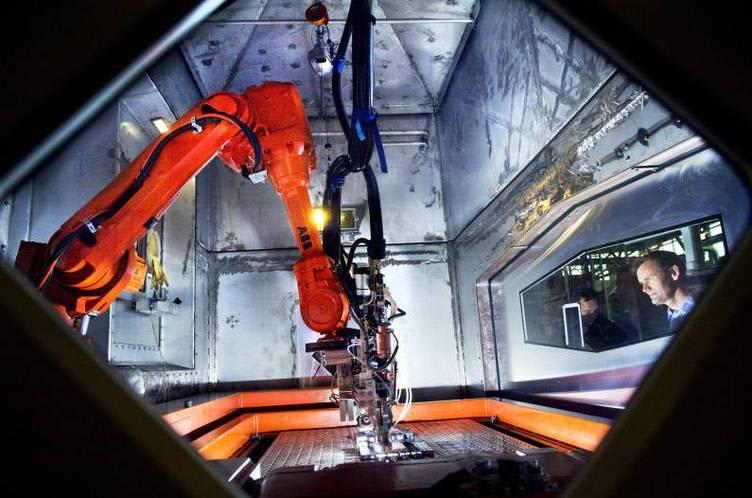
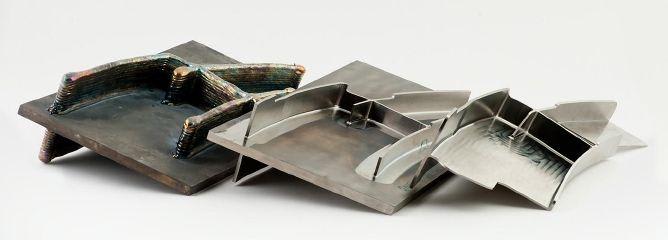
Norsk Titanium AS—which has been researching and developing its RPD (rapid plasma deposition) process for over 10 years—says it can produce titanium components that can cost from 50 to 75% less than other equivalent components. Its process involves feeding room-temperature titanium 6-4 wire into a plasma arc created by a pair of torches in argon gas environment. The titanium temperature is raised by thousands of degrees and then is robotically printed as a liquid by a robotic depositing arm. The titanium solidifies instantly after being deposited. The component is rapidly built up in layers in a closed-loop process and requires very little finish machining.
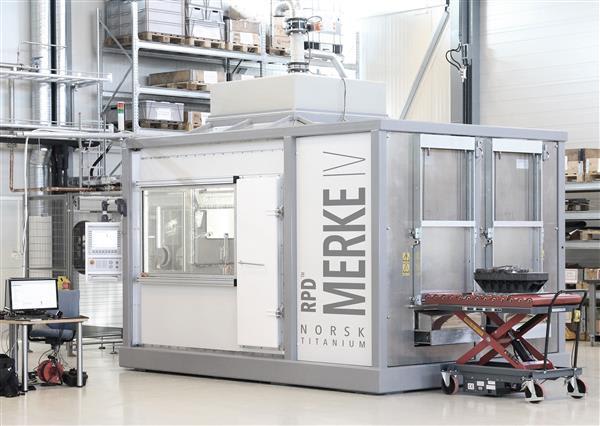
The system itself, a MERKE IV RPD machine, bears a resemblance to a standard computer numerical control (CNC) machining center—with a plasma arc instead of a spindle. Norsk President and CEO, Warren Boley stated that the MERKE IV RPD machine “can print 20 tons of titanium per year,” and that it’s “a game changer in terms of being able to produce aircraft quality titanium parts.”
This past April, Oslo-based Norsk announced that it will be producing via RPD 3D-printed structural titanium components for the Boeing 787 Dreamliner. Boeing designed the components and collaborated closely with Norsk throughout the development process. To certify these initial structural components on the Dreamliner, Boeing and Norsk undertook a rigorous testing program with Federal Aviation Administration (FAA) certification deliverables completed in February. Norsk is the first supplier for Boeing’s high deposition rate material specification.
“We are always looking at the latest technologies to drive cost reduction, performance, and value to our customers and Norsk’s RPD capability fits the bill in a new and creative way,” said John Byrne, Vice President, Airplane Materials and Structures, Supplier Management, Boeing Commercial Airplanes.
Norsk claims that the production cost is less than that of legacy forging and manufacturing techniques where billets of titanium are machined into components.
“You can take a 200-lb forging and produce a 20-lb part,” said Boley. “We can print 30 lb of material to produce a 20-lb part.” Producing a 200-lb billet and machining it down to a 20-lb component typically requires a lead time of 55 to 75 weeks. These same components can be created via RPD and machine finished within 2 to 3 hours.
Because of the significant reduction of waste and machining energy inherent in their additive process, Norsk claims up to 75% cost and time savings.
With an estimated 1000 titanium components in a Boeing 787 that can be manufactured using the RPD process, Boley stated that, “We think we can save $2500 per part; that’s $2.5 million per aircraft. At 144 aircraft a year, that’s $360 million. That kind of saving is revolutionary.”
Norsk also takes note of the environmental impacts that its RPD process brings as well. By reducing the amount of scrap titanium (approximately 40 lb of scrap to 1 lb that sees flight), the process also reduces the amount of ore that must be mined and processed.
The Dreamliner RPD components—as well as Norsk Titanium’s MERKE IV RDP machine that produced them—will be on display at the International Paris Airshow, Le Bourget in June.
More From SAE Media Group
Aerospace & Defense Tech Briefs
Norsk and SAE International Collaborate on World’s First Directed Energy Deposition Specification

Aerospace & Defense Tech Briefs
Reaching Forward and Back: 3D Printing Innovates While Breathing Life into Traditional Aero Manufacturing
Aerospace & Defense Tech Briefs
Etihad and Eos Partner to Develop 3D-Printed Cabin Interiors
Aerospace & Defense Tech Briefs
3D-Printed NACA Inlet

Aerospace & Defense Tech Briefs
The F-22 Raptor Gets Its First Metallic 3D-Printed Part
Aerospace & Defense Tech Briefs
Arconic and Airbus Cooperate on 3D Printing Research
Aerospace Manufacturing and Machining INSIDER
3D-Printed C-17 Replacement Part Saves Thousands for Air Force
Aerospace Manufacturing and Machining INSIDER
How Airbus is Using w-DED to 3D Print Larger Titanium Airplane Parts
Aerospace & Defense Tech Briefs
Weber Metals Unveils New 540-Meganewton Press for Aerospace Components
Aerospace & Defense Tech Briefs
3D-Printing Powders
Aerospace & Defense Tech Briefs
Lifting 3D Printing to New Heights
Defense INSIDER
New 3D-Printed Antenna Designs Reduce Cost, Weight and Size
Aerospace & Defense Tech Briefs
Aerospace Composites Experts Will Meet in Wichita This Month, Focusing on Validating Repairs Techniques
Aerospace & Defense Tech Briefs
Shape Memory Alloys at the Core of Future Aircraft Systems
Aerospace & Defense Tech Briefs
Portable 3D Printing Factory
Aerospace & Defense Tech Briefs
GE Additive Unveils Project ATLAS Program’s First 3D Printer
Defense INSIDER
3D-Printed Temporary Use Parts Reduce Downtime for Army Vehicles
Aerospace & Defense Tech Briefs
Boeing Virtualizes, Secures Additive Manufacturing Across Supply Chain with Assembrix
Aerospace & Defense Tech Briefs
3D Printing Aerodynamic Improvements
Aerospace & Defense Tech Briefs
3D Printing Metal Parts on a Ship
Aerospace & Defense Tech Briefs
Lockheed Martin Will Merge Machine Learning with 3D Printing
Aerospace & Defense Tech Briefs
Laser Wire Additive Manufacturing System
Aerospace Manufacturing and Machining INSIDER
How the US Navy Uses Organic Manufacturing to Combat Supply Chain Constraints
Aerospace & Defense Tech Briefs
GKN Aerospace to Lead Research Collaboration into Additive Manufacturing
Aerospace & Defense Tech Briefs
3-D Manufacturing of Titanium Components Takes Off
Aerospace & Defense Tech Briefs
SAE International Issues First Technical Standards for Aerospace Additive Manufacturing
Aerospace & Defense Tech Briefs
Additive Manufacturing and Materials a Prime Focus for GKN Aerospace
Top Stories
NewsSensors/Data Acquisition
 Microvision Aquires Luminar, Plans Relationship Restoration, Multi-industry Push
INSIDERRF & Microwave Electronics
 A Next Generation Helmet System for Navy Pilots
INSIDERWeapons Systems
 New Raytheon and Lockheed Martin Agreements Expand Missile Defense Production
NewsAutomotive
 Ford Announces 48-Volt Architecture for Future Electric Truck
INSIDERAerospace
 Active Strake System Cuts Cruise Drag, Boosts Flight Efficiency
ArticlesTransportation

Webcasts
Aerospace
 Cooling a New Generation of Aerospace and Defense Embedded...
Energy
 Battery Abuse Testing: Pushing to Failure
Power
 A FREE Two-Day Event Dedicated to Connected Mobility
Automotive
 Quiet, Please: NVH Improvement Opportunities in the Early Design Cycle
Electronics & Computers
 Advantages of Smart Power Distribution Unit Design for Automotive &...
Unmanned Systems
 Sesame Solar's Nanogrid Tech Promises Major Gains in Drone Endurance