




805-Hp Mercedes-AMG GT Concept Hybrid Heralds Production Model
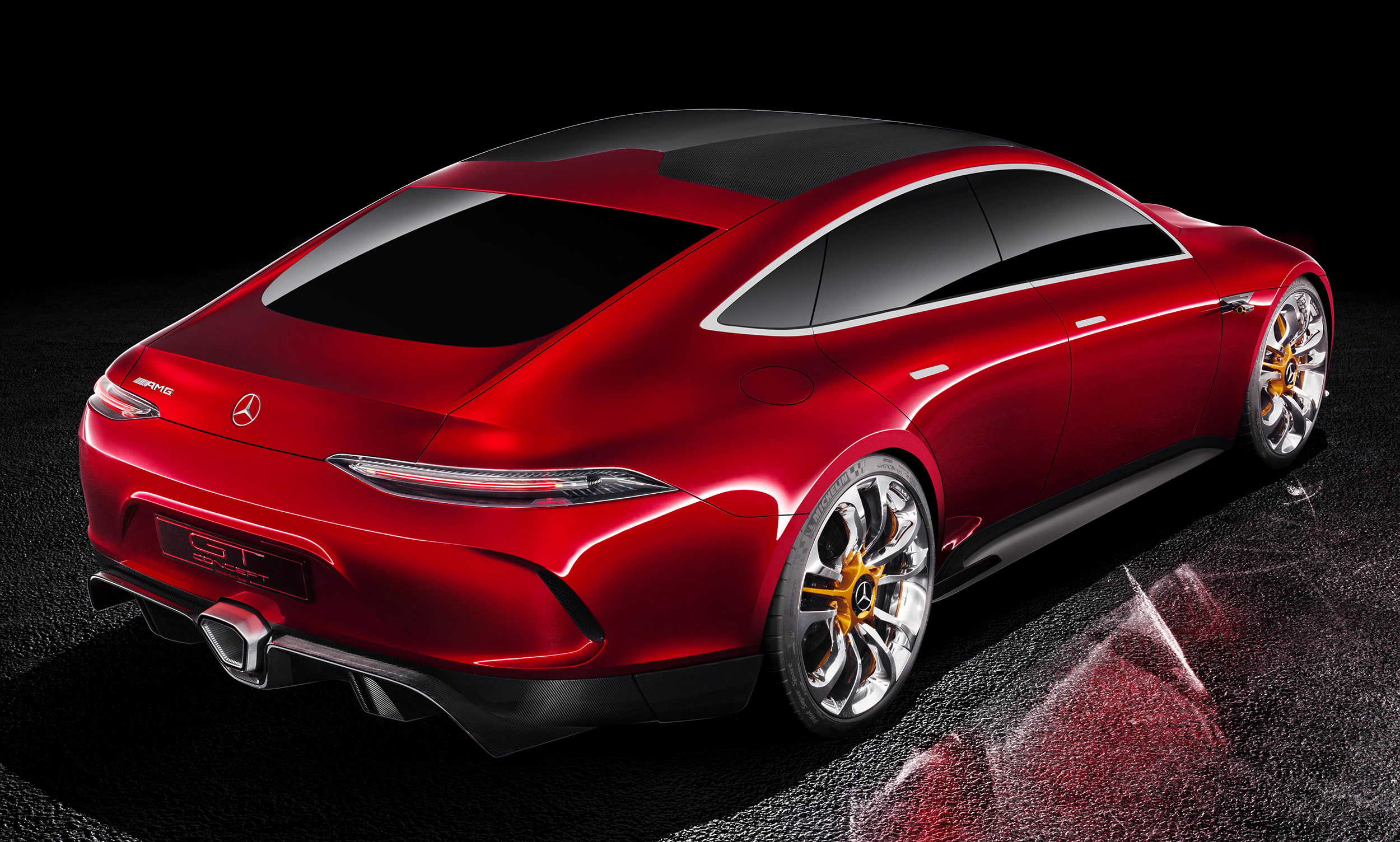
The 600-kW (805-hp) hybrid 4-door Mercedes-AMG GT unveiled at the 2017 Geneva motor show may be a concept now, but its production line is being readied.

The GT Concept, as it is currently designated, incorporates an operating strategy cascaded down from the Mercedes Petronas AMG Formula 1 car’s powerpack. It links to road cars via AMG HPP (High Performance Production).

A 5-door fastback sports sedan, the GT Concept is powered by a 4.0-L bi-turbo gasoline V8 and what AMG Chairman Tobias Moers describes as “a high performance” electric motor. The GT Concept and Hypercar will have modular, compact, upwardly scalable, energy-dense lightweight batteries, the whole system "intelligently networked," he noted. This provides a total system output of up to 600 kW, delivering a claimed sub-3-s 0-100 km/h (0-62-mph) dash time.
“The energy storage unit is more powerful than conventional hybrid batteries,” Moers said. When necessary, the battery charge is topped up by the V8 and via brake-energy recuperation.
The car signals the future at AMG, said Moers. “We are giving a preview of our third completely autonomously developed sports car. Like the AMG Hypercar, which we are presenting at the [2017] international motor show in Frankfurt, it illustrates how we are defining performance of the future at AMG.” The limited production run Hypercar promises to be the first street-legal car with a F1 engine.

Mercedes-AMG plans what it calls “segment specific” hybrids. All its hybrids will be designated EQ Power+.
The GT Concept gets fully variable 4MATIC+ all-wheel drive, the electric motor driving the rear wheels. Torque vectoring is applied to all wheels.
By no means for the first time on a concept, the GT Concept abandons door mounted rear-view mirrors in favor of (as AMG refers to them) “aerodynamically favorable” miniature cameras, which it dubs “mirror cams.” Mounted low down on the front fender, they look potentially vulnerable to both accidental damage and road dirt, but doubtless AMG engineers have solutions for both possibilities.
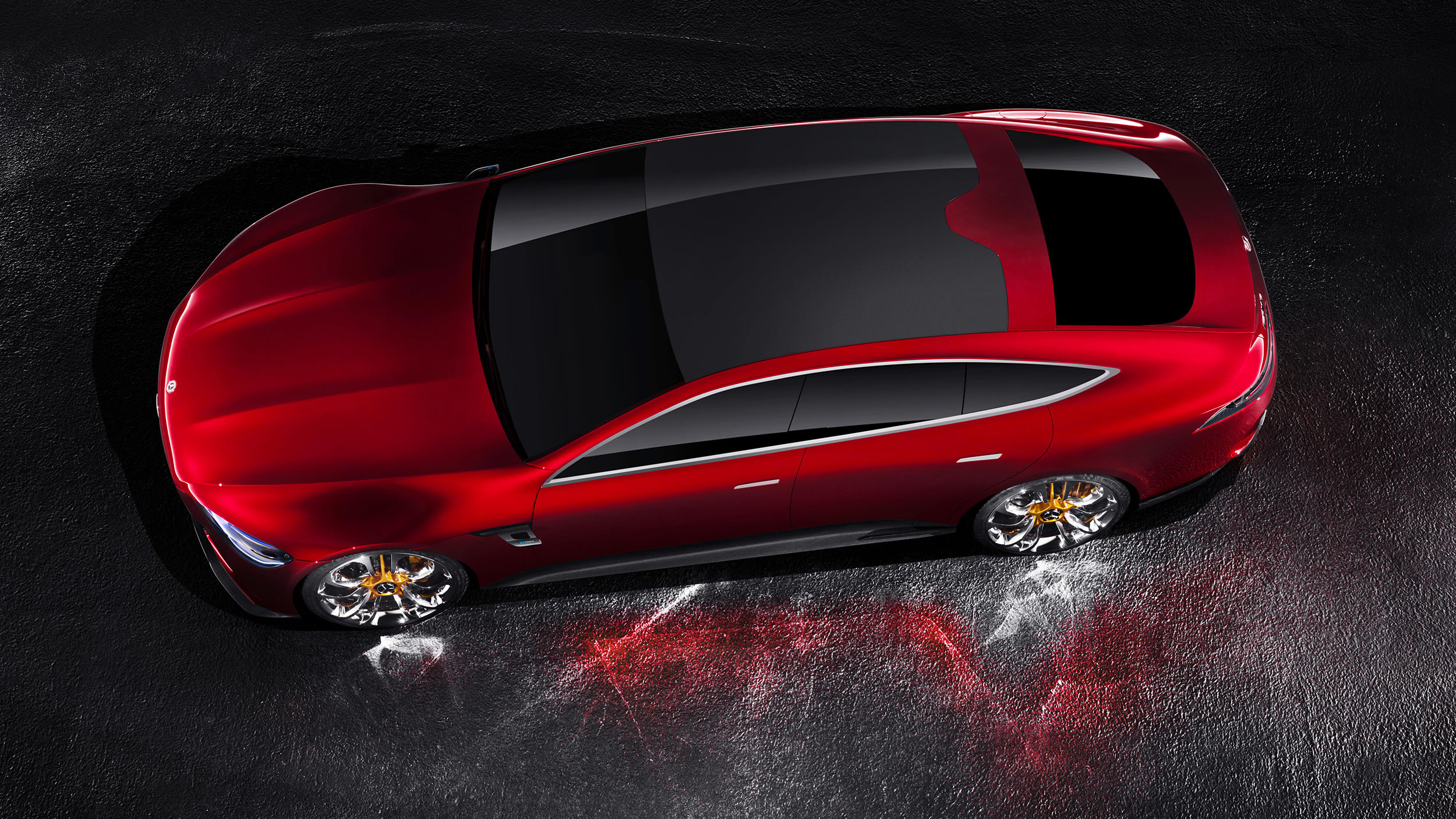
The concept is clearly a close relation of the 2-seat Mercedes-AMG GT but has its own identity. Its radiator grille with prominent bars is similar to that of the 1950s Panamericana 300 SL. Active grill shutters and side vents improve aerodynamic and thermal efficiencies.
Daytime running lights use nano-active-fiber technology with the turn signal integrated in the upper edge. Mercedes states that a ribbed cooling module is integrated into the tail light lens to “guide the waste heat to the exterior.”
The car has a carbon fiber rear diffuser (the material is used for other body elements, including the roof), and a centrally positioned exhaust tailpipe reminiscent of the Mercedes-AMG GT R. Carbon ceramic brakes are fitted.
The car's greenhouse is said to be “crouched and dynamic”; side windows are frameless. The vehicle is being alternately descrbed as a "4-door sports car" (previously used by Nissan for its Maxima) and as a "sports coupe," but more details of the Concept GT are expected to emerge on the run-up to production.
More From SAE Media Group
Automotive Engineering
Designing for Downforce

Automotive Engineering
Engineering the 2022 Toyota Tundra
Automotive Engineering
SAE Eye on Engineering Quick Take: Telsa Model S Troubles
Automotive Engineering
EXP 10 Speed 6 Could Preview Sportier Two Seater
Automotive Engineering
Mercedes-Benz AMG GT R Wins German Engineers’ Lightweighting Award

Automotive Engineering
BEV Streamliner Tops 350 Mph for U.S. Speed Record
Automotive Engineering
2022 Toyota Tundra: V8 Out, Twin-Turbo Hybrid Takes Over
Automotive Engineering
Jaguar Unveils Twin-Motor I-Pace Battery-Electric Crossover
Off-Highway Engineering
Freightliner’s Medium-Duty Makeover
Automotive Engineering
2021 Toyota Supra 2.0
Automotive Engineering
Mercedes Boosts Off-Road Prowess of 2019 G-Wagen
Automotive Engineering
McLaren Faces the Electrified and Autonomous Future

Automotive Engineering
Infiniti Creates 'Executive Boardroom' for 2015 Model
Automotive Engineering
Advanced Aerodynamics Features Applied to Mustang
Automotive Engineering
Fisker Karma Retrofitted as VL Destino, First Delivery Tagged for 2014
Automotive Engineering
Infiniti Concept Conjures a New-Tech Q45

Automotive Engineering
PSA's E-TENSE Shows Design Cues for Future DS Models
Automotive Engineering
Mustang Loses Scoops, Little Else in Transition to RHD
Automotive Engineering
Corvette Hybrid Development Defies GM’s All-Electric Mantra
Automotive Engineering
SAE WCX 2022: OEM Learnings from Level 2 ADAS
Tech Briefs
Product of the Month
Automotive Engineering
NAIAS 2017: Stinger Gives Kia a Fast, Nimble Sedan
Automotive Engineering
Lotus Breaks out with New Eletre Electric SUV
Automotive Engineering
GT Concept Reveals Opel/Vauxhall’s Sports Car Template
Automotive Engineering
Lexus RC F Coupe Provides V8 Excitement
Automotive Engineering
Jaguar’s Making of a Sports Sedan
Top Stories
INSIDERManufacturing & Prototyping
 How Airbus is Using w-DED to 3D Print Larger Titanium Airplane Parts
INSIDERManned Systems
 FAA to Replace Aging Network of Ground-Based Radars
NewsTransportation
 CES 2026: Bosch is Ready to Bring AI to Your (Likely ICE-powered) Vehicle
NewsSoftware
 Accelerating Down the Road to Autonomy
EditorialDesign
 DarkSky One Wants to Make the World a Darker Place
INSIDERMaterials
 Can This Self-Healing Composite Make Airplane and Spacecraft Components Last...
Webcasts
Defense
 How Sift's Unified Observability Platform Accelerates Drone Innovation
Automotive
 E/E Architecture Redefined: Building Smarter, Safer, and Scalable...
Power
 Hydrogen Engines Are Heating Up for Heavy Duty
Electronics & Computers
 Advantages of Smart Power Distribution Unit Design for Automotive...
Unmanned Systems
 Quiet, Please: NVH Improvement Opportunities in the Early Design...
