




NASA BLI Propulsor May Leapfrog Current High-Efficiency Designs
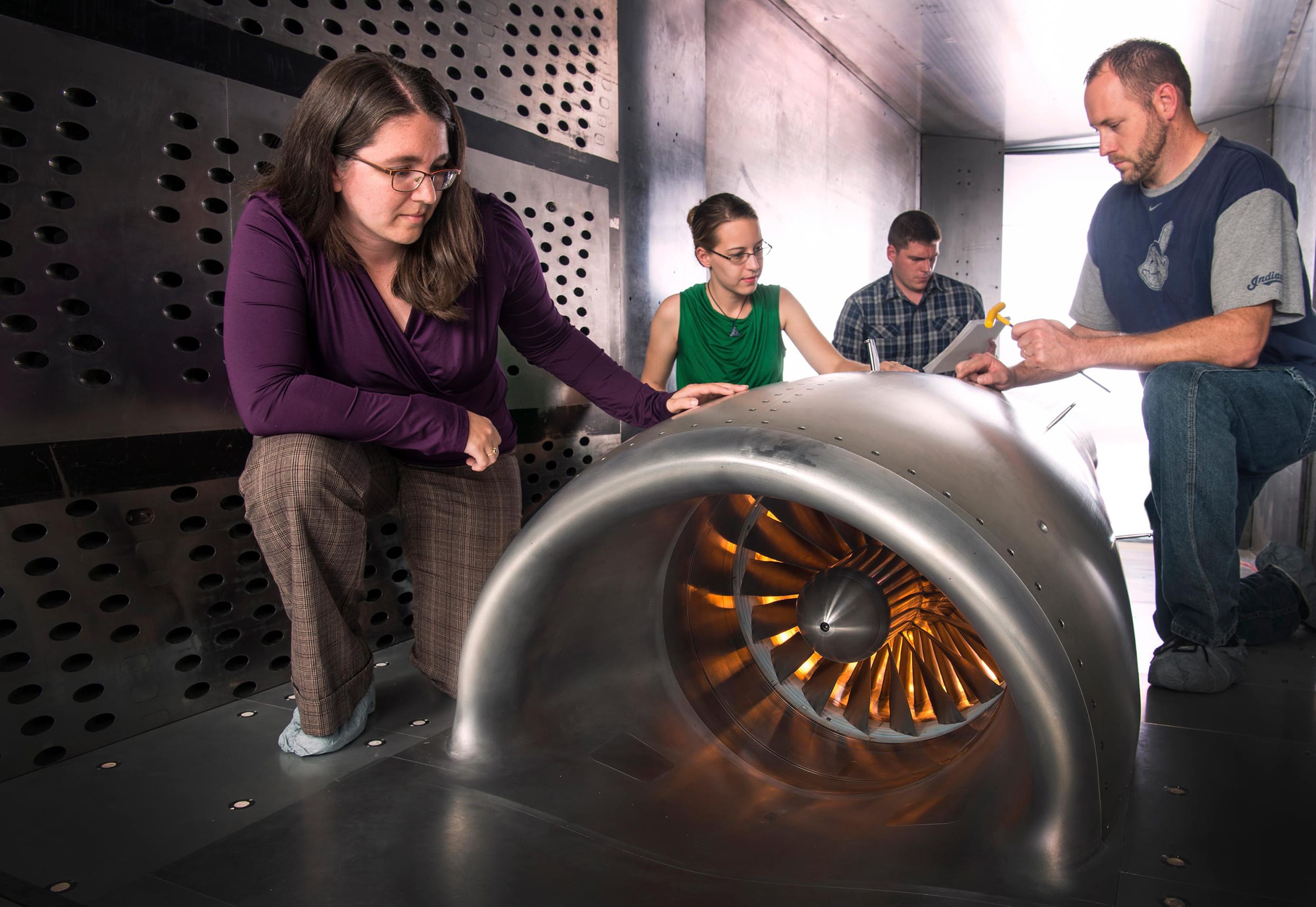
Fuel efficiency—and the economic and ecological benefits associated with it—continues to be the white rabbit of the global aviation industry. While engine builders look toward composites and electrification, and airframe designers toward lightweighting and aerodynamics, engineers at NASA’s Glenn Research Center (GRC) in Cleveland, OH, recently completed testing of a novel concept: the boundary layer ingesting (BLI) propulsor.

The BLI propulsor comprises a fan and inlet partially nested into the airframe—a departure from conventional subsonic fixed-wing aircraft arrangement where podded engines are positioned away from the fuselage. By embedding the inlet and fan, the BLI propulsor ingests the slow-moving boundary layer air that develops along aircraft surfaces during flight, the opposite goal of conventional engine placement.
The design is a cooperative effort between NASA and United Technologies Research Center, with research support from Virginia Polytechnic and State University.
The approach comes with challenges, as turbulent boundary layer air flow is distorted and affects fan performance and operation. A high-performance, distortion-tolerant fan capable of accelerating slow-moving boundary air needed to be developed.
“A key part of this research and testing was understanding the aeromechanics of how these fan blades react to a distorted flow and how to maintain their effective service lifespan,” said Jim Heidmann, manager of NASA’s Advanced Air Transport Technologies project.
Although the operational environment for the BLI propulsor is demanding, NASA engineers believe that the BLI propulsor is capable of achieving a 4-8% efficiency increase over current high-efficiency engines, such as the CFM International LEAP engine.

“Studies backed by more detailed analyses have shown that [BLI] propulsors have the potential to significantly improve aircraft fuel efficiency,” said David Arend, a BLI propulsion expert at NASA Glenn. “If this new design and its enabling technologies can be made to work, the BLI propulsor will produce the required thrust with less propulsive power input.”
The elimination of wake, drag, and weight of wing or pylon mounted engine nacelles can contribute to additional aircraft efficiency.
The BLI testing, which completed on December 9, was the first of its kind and required modifications to the NASA GRC 8’ x 6’ wind tunnel to accommodate and power the large propulsor model and boundary layer control system. NASA engineers varied wind speed, boundary layer thickness, and fan operation and monitored propulsor performance, operability, and structure. The experiment covered all phases of the flight envelope and simulated a wide range of operations including takeoff, max load, cruise, and descent.
Once all experiment data has been analyzed, the BLI propulsor fan and inlet arrangement will achieve technology readiness level (TRL) 4 status and the fully BLI propulsion-incorporated aircraft system will achieve TRL 3 status.
Planned applications for the BLI propulsor include “N+3” designs such as Aurora Flight Sciences’ D8 “Double Bubble” and NASA’s turboelectric STARC-ABL, both slated for 2030/2035.
According to Heidmann, a BLI demonstrator aircraft (or “X-plane”) may be possible within the next five to ten years.
More From SAE Media Group

Aerospace & Defense Tech Briefs
Boeing and NASA Unveil Lightweight, Ultra-Thin, More Aerodynamic Transonic Truss-Braced Wing Concept
Aerospace & Defense Tech Briefs
Researchers Work to Uncover Turboelectric Propulsion’s Unknown Challenges
Aerospace & Defense Tech Briefs
Boeing Completes Assembly of the First 777X
Aerospace & Defense Tech Briefs
Boeing to Leverage Aurora Acquisition for Technical Know-How
Aerospace & Defense Tech Briefs
Sikorsky-Boeing’s FVL Contender Takes Flight
Aerospace INSIDER
New DARPA X-Plane Will Have No Moving Control Surfaces
Aerospace INSIDER
Air Force Pilots Perform Remote Flights with Joby eVTOL

Aerospace & Defense Tech Briefs
Vertical Flight Society Applauds EVTOL Innovation, Bell Nexus UAM Concept
Aerospace & Defense Tech Briefs
GE, Lockheed Martin Commit to Aerion's Supersonic Bizjet
Aerospace INSIDER
Army Delivers First T901 ITEP Engines for FARA Prototype Helicopters
Aerospace INSIDER
Reliable Robotics to Provide Aircraft Automation Study for US Air Force
Aerospace & Defense Tech Briefs
Maintainers Design a $400 Maintenance Fixture to save the U.S. Air Force $500k per Year

Aerospace & Defense Tech Briefs
An X-Plane for Everyone?
Aerospace & Defense Tech Briefs
NASA’s Next X-Plane Passes Major Review
Aerospace & Defense Tech Briefs
NASA to Test Quiet Thump Supersonic Propulsion Technique, Measure Sound Levels and Community Response
Aerospace & Defense Tech Briefs
Jetoptera, GE Aviation Collaborate On, Demonstrate Hover with Fluidic Propulsion
Aerospace & Defense Tech Briefs
Aerion and Honeywell Collaborate on Revolutionary Flight Deck for Supersonic Bizjet
Aerospace Manufacturing and Machining INSIDER
GA-ASI Installs First V-Tail from GKN Aerospace onto MQ-9B RPA
Aerospace Manufacturing and Machining INSIDER
Small Low-Cost Engines for Drones and Collaborative Combat Aircraft
Aerospace INSIDER
Delta Air Lines, JetZero to Design Commercial Blended Wing Body Airliner
Aerospace & Defense Tech Briefs
Air Force Technology Timeline
Aerospace & Defense Tech Briefs
Future of British Air Power: The Next-Gen Tempest
Aerospace & Defense Tech Briefs
Sikorsky, Boeing Debut Future Vertical Lift Dual-Rotor Design with SB>1 DEFIANT Helicopter
Aerospace & Defense Tech Briefs
Japan Signs on for Second Boeing KC-46 Military Tanker and Transport Aircraft
Aerospace & Defense Tech Briefs
Lockheed Martin Skunk Works Begins Manufacturing X-59 Supersonic Aircraft Parts
Top Stories
INSIDERManufacturing & Prototyping
 How Airbus is Using w-DED to 3D Print Larger Titanium Airplane Parts
INSIDERManned Systems
 FAA to Replace Aging Network of Ground-Based Radars
NewsTransportation
 CES 2026: Bosch is Ready to Bring AI to Your (Likely ICE-powered) Vehicle
NewsSoftware
 Accelerating Down the Road to Autonomy
EditorialDesign
 DarkSky One Wants to Make the World a Darker Place
INSIDERMaterials
 Can This Self-Healing Composite Make Airplane and Spacecraft Components Last...
Webcasts
Defense
 How Sift's Unified Observability Platform Accelerates Drone Innovation
Automotive
 E/E Architecture Redefined: Building Smarter, Safer, and Scalable...
Power
 Hydrogen Engines Are Heating Up for Heavy Duty
Electronics & Computers
 Advantages of Smart Power Distribution Unit Design for Automotive...
Unmanned Systems
 Quiet, Please: NVH Improvement Opportunities in the Early Design...
