




Autonomous Vehicles Demonstrate Ground-Air Cooperation

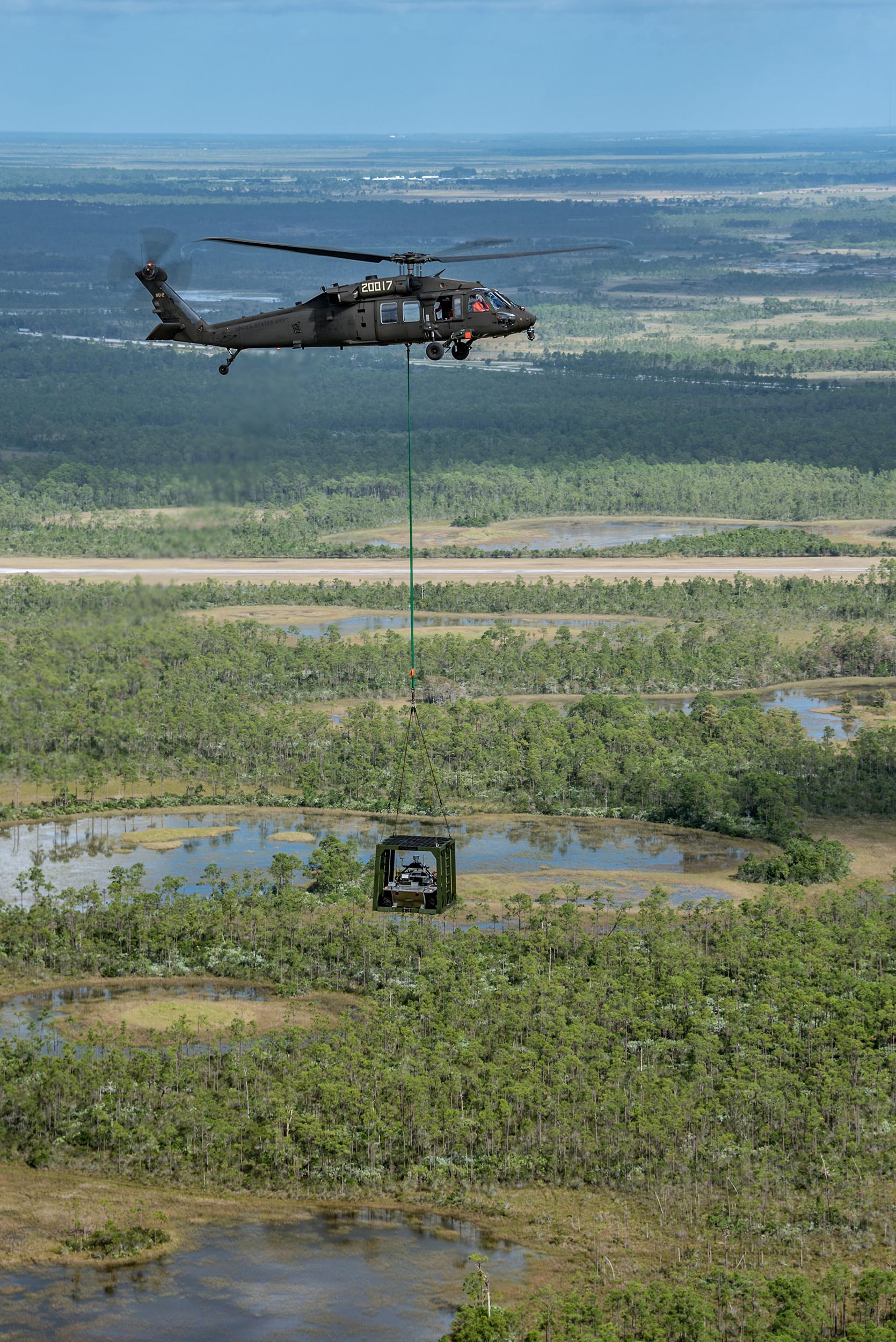
Carnegie Mellon University (CMU) and Sikorsky, a Lockheed Martin company, recently announced a joint autonomy demonstration that proved the capability of new, ground-air cooperative missions. The demonstration, which took place on Oct. 27 at Sikorsky's Development Flight Center in West Palm Beach, FL, used a UH-60MU Black Hawk helicopter enabled with Sikorsky's MATRIX Technology and CMU’s Land Tamer autonomous unmanned ground vehicle (UGV).
The goal for such missions is to prevent warfighters' exposure to hazardous conditions, such as chemically or radiologically contaminated areas.
"The teaming of unmanned aerial vehicles (UAVs) and unmanned ground vehicles, as demonstrated here, has enormous potential to bring the future ground commander an adaptable, modular, responsive and smart capability that can evolve as quickly as needed to meet a constantly changing threat," said Paul Rogers, director, U.S. Army Tank Automotive Research, Development and Engineering Center (TARDEC), in a statement announcing the demonstration’s results. "The cooperative effort between the Army labs, academia, and industry to bring solutions to the warfighter is exciting to see."
The demonstration was for TARDEC, through the Robotics Technology Consortium, which sponsored the Extending the Reach of the Warfighter through Robotics (ERWR) project. A video of the demonstration is available on YouTube.
Provided by the U.S. Army Aviation and Missile Research Development and Engineering Center's Aviation Applied Technology Directorate, the Black Hawk helicopter was modified with the Sikorsky autonomy kit, MATRIX, to deliver the required UAV capabilities. MATRIX was launched in 2013 for autonomous and optionally piloted vertical take-off and landing aircraft.
"The UH-60MU aircraft is a prototype of the UH-60 in a 'fly-by-wire' configuration," said William D. Lewis, AMRDEC director of Aviation Development. "'Fly-by-wire' technology is the foundational enabler that facilitates autonomous aircraft operations."
In the demonstration, the Black Hawk helicopter was operated in coordination with a UGV, developed by Carnegie Mellon's National Robotics Engineering Center (NREC). The UGV Land Tamer all-terrain vehicle combined key elements of several NREC autonomous systems to support missions in difficult environments.
"We were able to demonstrate a new technological capability that combines the strengths of air and ground vehicles," said Jeremy Searock, NREC technical project manager. "The helicopter provides long-range capability and access to remote areas, while the ground vehicle has long endurance and high-precision sensing."
During the demonstration mission, the unmanned helicopter picked up the UGV, flew a 12-mi (19-km) route, delivered it to a ground location, and released it. The drop-zone collaboration between the two autonomous systems demonstrated a “uniquely differentiating capability,” the organizations proclaimed.
The UGV autonomously navigated the course for more than 6 mi (10 km), while using its onboard chemical, biological, radiological, and nuclear (CBRN) sensors to detect simulated hazards and delivered this information back to a remote ground station. The UGV was optionally tele-operated to explore hazard sites in greater detail, when necessary.
The exercise culminated a 19-month project between Carnegie Mellon's NREC and Sikorsky. The collaboration between the UAV and UGV demonstrated the effectiveness of unmanned systems in addressing logistics needs in unknown or dangerous environments.
More From SAE Media Group
Aerospace & Defense Tech Briefs
Sikorsky to Provide an ALIAS to DARPA
Aerospace & Defense Tech Briefs
Sikorsky’s Autonomous Black Hawk Helicopter Takes Flight
Aerospace & Defense Tech Briefs
Martin UAV VTOL Unmanned Aircraft Taps Persistent Systems Wave Relay Data Link Technology
Aerospace & Defense Tech Briefs
Explainable-AI Image Recognition Is the Next Step for U.S. Air Force Unmanned Aircraft
Aerospace & Defense Tech Briefs
In Pursuit of Networked Drone Operations
Aerospace & Defense Tech Briefs
Insitu ScanEagle SUAS Boosts Coast Guard Mission Effectiveness
Aerospace & Defense Tech Briefs
Connect Them All
Aerospace & Defense Tech Briefs
AeroVironment Releases New Puma 3
Aerospace & Defense Tech Briefs
Boeing, Liquid Robotics Team on Solutions for Maritime Surveillance
Aerospace & Defense Tech Briefs
Collins Aerospace Taps Wind River Helix Virtualization Platform to Future-Proof Avionics

Aerospace & Defense Tech Briefs
Disruptive Flight Control Technology on Trial
Aerospace & Defense Tech Briefs
Lockheed Martin’s Next-Gen, 360-Degree Vision System Flies on the Bell V-280 Valor
Aerospace & Defense Tech Briefs
Sikorsky-Boeing’s FVL Contender Takes Flight
Aerospace & Defense Tech Briefs
Air Force Tests Fully Autonomous UAS Control System
Aerospace & Defense Tech Briefs
Effectiveness of Inter-Vehicle Communications and On-Board Processing for Close Unmanned Autonomous Vehicle Flight Formations
Aerospace & Defense Tech Briefs
Textron Systems, Textron Aviation Defense Demonstrate Simulated Manned-Unmanned Teaming Capability
Aerospace & Defense Tech Briefs
Aurora Proves Unmanned UH-1H Capabilities for Marines, Continues Orion UAS Work for USAF
Aerospace & Defense Tech Briefs
Artificial Intelligence Could Reduce CV-22 Osprey Maintenance
Aerospace & Defense Tech Briefs
Aitech Defense Will Provide Data Interface Technology for Boeing’s Unmanned MQ-25 Refueling Platform
Aerospace & Defense Tech Briefs
General Atomics Moves Toward Global RPA Flight Certification for MQ-9B SkyGuardian
Aerospace & Defense Tech Briefs
Curtiss-Wright Black Boxes Receive European Approval
Aerospace & Defense Tech Briefs
New Sensor Payload Helps Global Hawk Stay Relevant
Aerospace & Defense Tech Briefs
Vertical Aerospace Is Honeywell’s Latest Partner in the UAM Industry
Off-Highway Engineering
USPS Tests Autonomous Semi-Trailers for Long-Haul Mail Logistics
Aerospace & Defense Tech Briefs
Raytheon, UTC Merger Will Direct $8B R&D Budget Toward Hypersonics, Cybersecurity, AI, and Next-Gen Connected Aircraft
Aerospace & Defense Tech Briefs
DARPA’s Latest Drone Swarm Sprint Focuses on Virtual Environments
Aerospace & Defense Tech Briefs
US Army Tests Avionics in Effort to Upgrade Black Hawk Helicopters from Analog to Digital Glass Cockpit
Aerospace & Defense Tech Briefs
Airbus Aerial Harnesses Satellites, UAS, Helicopters, Data Analytics, and AI to Support Hurricane Recovery Efforts
Top Stories
INSIDERManufacturing & Prototyping
 How Airbus is Using w-DED to 3D Print Larger Titanium Airplane Parts
INSIDERManned Systems
 FAA to Replace Aging Network of Ground-Based Radars
NewsTransportation
 CES 2026: Bosch is Ready to Bring AI to Your (Likely ICE-powered) Vehicle
NewsSoftware
 Accelerating Down the Road to Autonomy
EditorialDesign
 DarkSky One Wants to Make the World a Darker Place
INSIDERMaterials
 Can This Self-Healing Composite Make Airplane and Spacecraft Components Last...
Webcasts
Defense
 How Sift's Unified Observability Platform Accelerates Drone Innovation
Automotive
 E/E Architecture Redefined: Building Smarter, Safer, and Scalable...
Power
 Hydrogen Engines Are Heating Up for Heavy Duty
Electronics & Computers
 Advantages of Smart Power Distribution Unit Design for Automotive...
Unmanned Systems
 Quiet, Please: NVH Improvement Opportunities in the Early Design...
