




Audi All-Electric Concept to Take on Tesla Model X

Audi revealed plans for a production battery EV sport crossover in 2018 when it rolled out the e-tron quattro concept at the 2015 Frankfurt Motor Show. The sleek SUV carries a large 95 kW·h lithium-ion battery pack and a trio of electric motors that have a continuous maximum output of 320 kW and a temporary maximum of 370 kW·h and more than 800 N·m (590 lb·ft) of torque.
Though it was termed a concept, “It is not a show car,” said Ralf-Gerhard Willner, head of vehicle concepts for Audi. “It is showing the direction for a series production car.”
To that end, and to offset the considerable cost of its abundant advanced technology, Audi used as many existing mainstream production components as possible, he said. “It was a goal for the team to use existing components to make it feasible from a finance standpoint.”
The concept and eventual production model feature the second iteration of company’s MQB platform for longitudinal drivetrains, he said. This “evo” MQB trimmed away 110 kg (243 lb) as it is applied to the latest A4 model, he said. “A 95-kW·h battery is quite heavy, so we had an eye to reduce the weight of the body,” said Willner. “To do that, you must know all the components you can size down a little bit.”
Audi says the e-tron’s driving range is more than 500 km (311 mi) on a charge in highway driving. The vehicle’s top speed is limited to 210 km/h (130 mph), and it accelerates to 100 km/h (62 mph) from a stop in just 4.6 s, though testing either of those capabilities will obviously reduce the driving range. The aggressiveness of battery regeneration is driver-selectable though the S and D positions of the shifter and through the Audi drive select system.
A torque control management system sends power to the single front motor and two rear motors to vector thrust for maximum dynamic balance and stability. Additionally, it has all-wheel steering to provide both improved stability and maneuverability as needed.
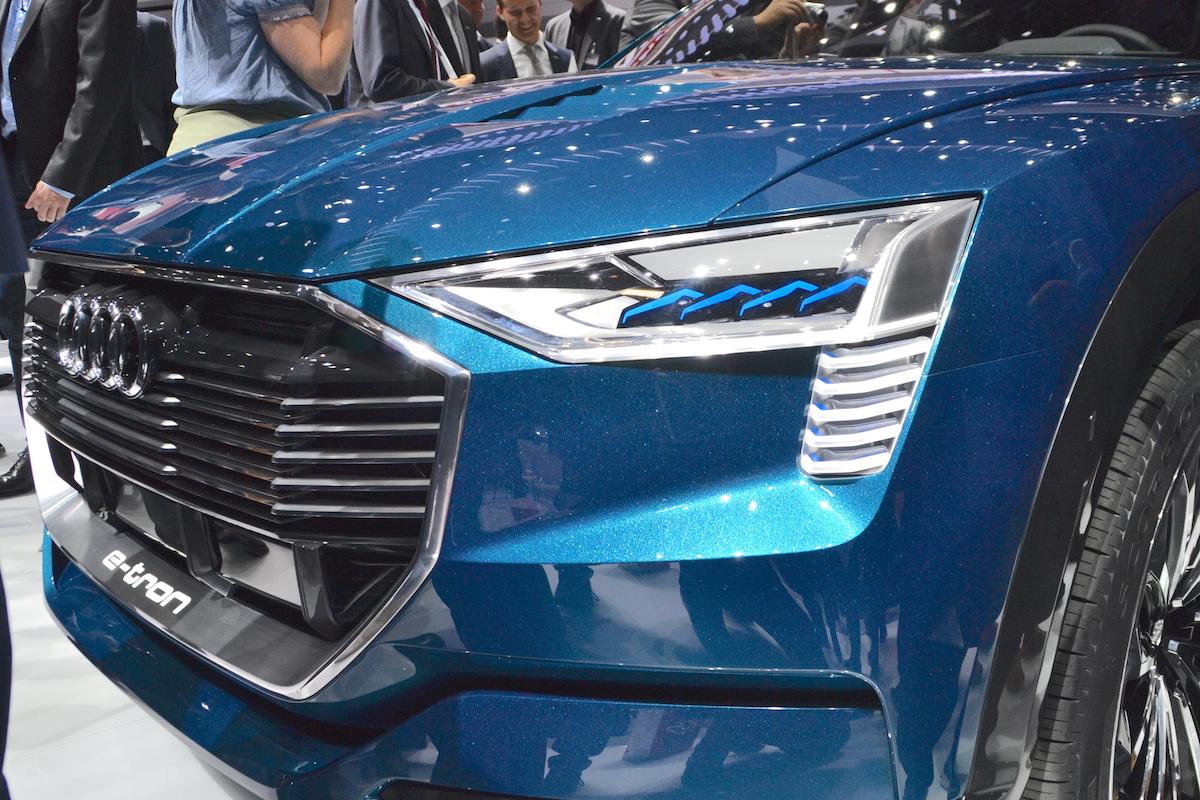
The hefty battery pack is integrated into the floor beneath the passenger compartment to lower the vehicle’s center of gravity and centralize its center of mass. Audi assembles its own battery packs from cells that are manufactured in Europe, but the company declined to identify the battery supplier. Willner did identify the battery chemistry as conventional lithium-ion, though of a next-generation design that is not yet commercially available.
The concept has a dual DC and AC charging system that lets drivers use existing DC chargers or Audi’s proposed inductive AC system. It is equipped with the company’s self-piloted parking system seen previously that can automatically dock the car atop the inducting charging mat.
In addition to passive measures of sleek, elongated bodywork and a tray enclosing the underbody, the e-tron takes active steps to minimize drag at highway speeds, including an automatically lowering air suspension and movable flaps on the hood, ahead of the wheels, and at the rear to produce a coefficient of drag of just 0.25. That is substantially lower than the class norm of more than 0.30.
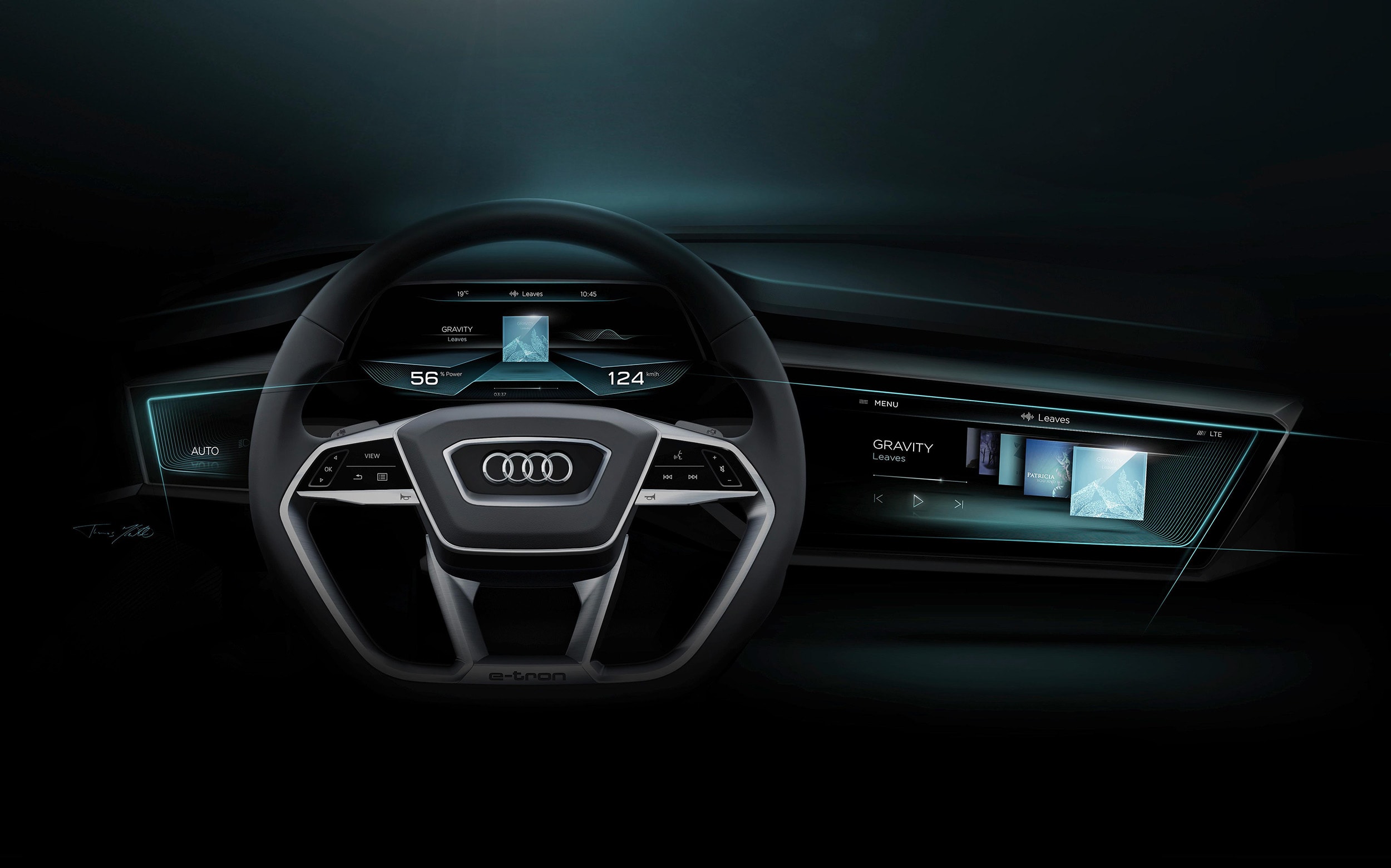
Inside, the e-tron concept is a four-seater, with a curved virtual cockpit centered on the driver. The digital instrument cluster is flanked on both sides by organic LED touch screen displays.
The left display controls the Audi’s automatic pilot system and its advanced Matrix Laser OLED forward lighting system, while the right handles navigation and infotainment. The car’s infotainment system is supplied Internet connectivity via a built-in LTE cellular module.
Audi hasn’t mentioned the e-tron’s planned production badging, but rumors at the show hinted at the name Q6 to slot it between the existing models.
More From SAE Media Group
Automotive Engineering
Lexus Unveils Concept Flagship Crossover
Automotive Engineering
Lucid Motors Unveils Air Electric Luxury Car
Automotive Engineering
2023 Cadillac Lyriq Executive Chief Engineer: New EV Her ‘North Star’
Automotive Engineering
Lotus Just Unveiled the World’s Most Powerful Car
Automotive Engineering
5 More HP for 2026 Kia Sportage: First Drive
Automotive Engineering
Q80 Inspiration Concept Previews Future Top-Range Infiniti, New Engine Family
Automotive Engineering
Peugeot Seeks International Appeal with Quartz Concept
Automotive Engineering
Engineering the 2022 Toyota Tundra
Automotive Engineering
Nissan Debuts Tech-Laden 2022 Ariya EV SUV
Automotive Engineering
Nissan Shows Gripz Crossover Concept
Automotive Engineering
Volkswagen Re-Engineers Tiguan
Automotive Engineering
Audi's New Compact Q2 Blends 3-Cylinder Efficiency, Agile Chassis
Automotive Engineering
Audi Lightens New Generation Q7
Automotive Engineering
Integrating a Plug-In Hybrid Jeep
Automotive Engineering
Mercedes-Benz Melds SUV and Coupe Styling for GLE Coupe
Automotive Engineering
Systems-engineering a New 4x4 Benchmark
Tech Briefs
Making EVs Accessible for All
Off-Highway Engineering
Israeli Startup REE Reinvents the Wheel with a Modular Approach to Future EV Design
Automotive Engineering
Mazda’s 2024 CX-90 Offers Turbo I-6, PHEV Propulsion
Automotive Engineering
Acura TLX Is Honda’s New Body-Build Benchmark
Automotive Engineering
Jaguar Reveals Its 2040 Future and Electrifies the E-Type
Automotive Engineering
Toyota Reveals New Platform, Hybrid Powertrain in C-HR Concept
Automotive Engineering
Audi Shows Design, Fuel-Cell Directions
Automotive Engineering
Discovery Sport Introduces Evoque-Based Land Rover
Automotive Engineering
Infiniti Creates 'Executive Boardroom' for 2015 Model
Automotive Engineering
Audi TT Quattro Sport
Automotive Engineering
Porsche Ties Sportscar Label to Its New Macan SUV
Automotive Engineering
Infiniti Concept Conjures a New-Tech Q45
Automotive Engineering
Nissan Tries to Re-Create Murano Buzz Through Design
Automotive Engineering
Mitsubishi PHEV Concept Destined for Production?
Top Stories
INSIDERManufacturing & Prototyping
 How Airbus is Using w-DED to 3D Print Larger Titanium Airplane Parts
INSIDERManned Systems
 FAA to Replace Aging Network of Ground-Based Radars
NewsTransportation
 CES 2026: Bosch is Ready to Bring AI to Your (Likely ICE-powered) Vehicle
NewsSoftware
 Accelerating Down the Road to Autonomy
EditorialDesign
 DarkSky One Wants to Make the World a Darker Place
INSIDERMaterials
 Can This Self-Healing Composite Make Airplane and Spacecraft Components Last...
Webcasts
Defense
 How Sift's Unified Observability Platform Accelerates Drone Innovation
Automotive
 E/E Architecture Redefined: Building Smarter, Safer, and Scalable...
Power
 Hydrogen Engines Are Heating Up for Heavy Duty
Electronics & Computers
 Advantages of Smart Power Distribution Unit Design for Automotive...
Unmanned Systems
 Quiet, Please: NVH Improvement Opportunities in the Early Design...
