




Toyota Reveals New Platform, Hybrid Powertrain in C-HR Concept

The C-HR crossover concept is an important vehicle for Toyota, demonstrating the Japanese automaker's desire for more "engaging" design. Unique styling is a key attribute for a new vehicle, particularly in the highly competitive European C-segment market, said Karl Schlicht, Executive Vice President of Toyota Motor Europe, at the Paris Motor Show unveiling.

Significantly, the company's ED² (European Design Development) studio based in Southern France led the design for the concept, which introduces what Toyota calls a "diamond architecture" styling theme. The lower bodywork is "sculpted to represent the facetted surfaces of a highly durable, precision-cut gemstone," press materials expound.
Setting such florid descriptions aside, the styling hints at the future design direction for its vehicles, Toyota promises.
Key design elements in the front include a slim upper grille extending into the headlights that incorporate a unique 3-D treatment of the daytime running lights, as well as an aero-inspired floating front spoiler. From the side, the glasshouse tapers to the rear window, which along with the "spoiler-tipped roof line" creates the effect of a floating roof.
Beyond the design elements, the crossover concept is significant because it introduces a new platform with what Toyota claims will be a lower center of gravity and increased structural rigidity. Improved handling and a more "fun-to-drive" vehicle are important bogeys for the C-HR, said a Toyota spokesman after the concept's Paris debut.
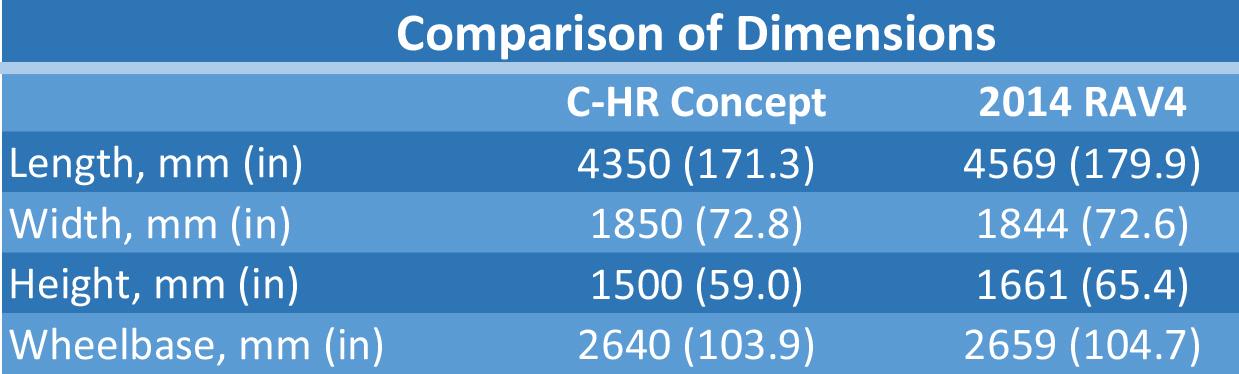
Smaller than the RAV4, the crossover concept is 4350 mm (171.3 in) long, 1850 mm (72.8 in) wide, and 1500 mm (59.0 in) tall, with a wheelbase of 2640 mm (103.9 in). (See chart for size comparison to the 2014 RAV4.)
The concept also employs a new full-hybrid powertrain that reportedly will deliver "significantly" improved fuel efficiency.
Questions to the spokesperson regarding the new hybrid system, platform specifics, and material usage were invariably met with “Unfortunately, I cannot provide any more details at this time.”
He did offer, though, that the next-generation hybrid system is "certainly a level up from what we have in our current [hybrid] vehicles."
The European market is a major one for Toyota and Lexus hybrid sales. Through the first eight months of 2014, hybrid sales for the brands reached 107,000 units, representing 28% of the Toyota Group sales in Western Europe.
More From SAE Media Group
Automotive Engineering
Toyota Stretches SUV Line-Up with World Debut of Grand Highlander
Automotive Engineering
5 More HP for 2026 Kia Sportage: First Drive
Automotive Engineering
Lexus Unveils Concept Flagship Crossover
Automotive Engineering
Making over the World’s Leading Hybrid
Automotive Engineering
Integrating a Plug-In Hybrid Jeep
Automotive Engineering
Lexus Sharpens Best-Selling RX for 2016
Automotive Engineering
Engineering the 2022 Toyota Tundra
Automotive Engineering
2026 Nissan Sentra Review: Putting the Pieces Together
Automotive Engineering
Lexus Unveils A-Segment Crossover Concept
Automotive Engineering
2023 Cadillac Lyriq Executive Chief Engineer: New EV Her ‘North Star’
Automotive Engineering
Systems-engineering a New 4x4 Benchmark
Automotive Engineering
Tenured Production CEO Leading VW’s U.S. Electrified Manufacturing Push
Automotive Engineering
Acura TLX Is Honda’s New Body-Build Benchmark
Automotive Engineering
Mitsubishi PHEV Concept Destined for Production?
Tech Briefs
Making EVs Accessible for All
Automotive Engineering
Audi All-Electric Concept to Take on Tesla Model X
Automotive Engineering
Q80 Inspiration Concept Previews Future Top-Range Infiniti, New Engine Family
Automotive Engineering
2022 Toyota Tundra: V8 Out, Twin-Turbo Hybrid Takes Over
Off-Highway Engineering
Western Star Adds ‘Weight Sensitive’ 47X to Vocational Lineup
Automotive Engineering
Innovative ‘Afreecar’ Wins SAE’s 2021 Create the Future Design Award
Automotive Engineering
Bringing Back the Hot Hatch: 2023 Toyota GR Corolla
Automotive Engineering
2024 Lexus GX Ready for Off-Road Adventure with New Platform, E-KDSS
Aerospace & Defense Tech Briefs
AeroMobil Debuts Special Edition Sky Dragon Personal Transport Aircraft Targeted at Fast-Growing Market in China
Automotive Engineering
2022 Hyundai Santa Cruz: A Truck by Any Other Name
Automotive Engineering
Subaru Uses ANSYS Tools to Accelerate Hybrid Vehicle Design
Automotive Engineering
Core Ford, New Ford…One Ford?
Automotive Engineering
Toyota Gives a Look at Its Re-Engineered 2016 Prius
Automotive Engineering
Magna’s New Active Airdam Boosts 2019 Ram Fuel Efficiency
Automotive Engineering
Engineering a Marvel of a Maverick Hybrid Transmission
Automotive Engineering
All-Electric Nissan Ariya Handles Ultra-Cold Temps on Pole to Pole Trek
Top Stories
INSIDERManufacturing & Prototyping
 How Airbus is Using w-DED to 3D Print Larger Titanium Airplane Parts
INSIDERManned Systems
 FAA to Replace Aging Network of Ground-Based Radars
NewsTransportation
 CES 2026: Bosch is Ready to Bring AI to Your (Likely ICE-powered) Vehicle
NewsSoftware
 Accelerating Down the Road to Autonomy
EditorialDesign
 DarkSky One Wants to Make the World a Darker Place
INSIDERMaterials
 Can This Self-Healing Composite Make Airplane and Spacecraft Components Last...
Webcasts
Defense
 How Sift's Unified Observability Platform Accelerates Drone Innovation
Automotive
 E/E Architecture Redefined: Building Smarter, Safer, and Scalable...
Power
 Hydrogen Engines Are Heating Up for Heavy Duty
Electronics & Computers
 Advantages of Smart Power Distribution Unit Design for Automotive...
Unmanned Systems
 Quiet, Please: NVH Improvement Opportunities in the Early Design...
