




Argonne Helps Private Industry Develop Engines Faster and Cheaper
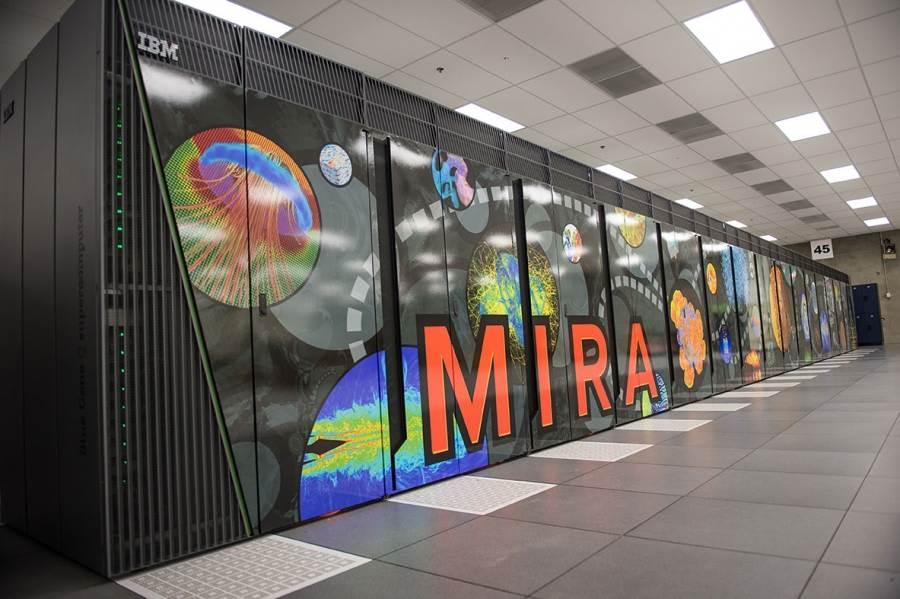
In a bid to expand use of its expertise to a wider audience, Argonne National Laboratory (ANL) developed the Virtual Engine Research Institute and Fuels Initiative. This VERIFI service is backed by a 10-petaflop IBM Blue Gene/Q computer (called MIRA), unique experimental facilities, and computational scientists and engineers with experience gained in solving problems for the federal government.
The test facilities include what is claimed as the brightest X-ray beam facility along with fuel and engine labs. Other unique facilities include electron microscopes and a photon source imager. ANL can also use reconfigurable experimental test engines to validate results of simulations.
“We can take a typical combustion problem that might run on 24 cores and scale that up to 1000 or more,” said Dr. Sibendu Som of ANL. On 24 cores, that simulation might take 14 h, on 1000 it might take but a few minutes. However, the advantage of such raw computing power could also be directed to higher fidelity models or more challenging phenomenon, such as detailed spray models.
“At Argonne, one of the models we developed uniquely couples the flow inside the nozzle to the spray and combustion,” he said, featuring a bidirectional feedback loop. This is needed since spray is affected by fluctuating temperatures in the combustion chamber, making the process highly nonlinear.
While Som reported that the VERIFI team will work with any customer’s or partner’s code, it has already ported the CONVERGE CFD and combustion model from Convergent Science to run on 2000 cores on MIRA. Its complex nozzle flow and spray model is implemented on its version of CONVERGE. “It will soon be available commercially through Convergent as well,” he said.
There is always uncertainty in understanding nature, either through numerical simulation or experimentation.
“We have tools to measure uncertainty and quantify it,” said Som. “Based on an uncertainty quantification for any particular parameter, we can then tell how a target [based on that parameter] is influenced.”
ANL developed tools to quantify the influence of uncertainty from both experimental results and numerical simulations. For example, hundreds of different parameters affect soot, from fuel composition to fuel injection timing among many others.
“You can apply uncertainty on each of these parameters and our tool will tell you which are the most important for soot formation, in this example,” he said. (Refer to SAE paper 2014-01-1117 for more details.)
While the MIRA computer has about 768,000 cores available, scaling up any particular problem beyond 2000 does not currently seem to be worth it, according to Som. “In fact, beyond 10,000 it actually gets slower because of the communications overhead.” ANL intends to work on this problem, as well as incorporate optimization algorithms to make finding a best solution even faster.
Working with VERIFI can take one of two forms: a full-cost contract with ANL that protects proprietary data, or a Cooperative Research and Development Agreement (CRADA) with cost-sharing but fewer protections on IP rights. Som reports that two diesel companies that specialize in heavy-duty engines have both taken advantage of a CRADA arrangement, while a domestic OEM has contracted with them with IP protections attached.
For a video of Som describing the initiative, visit this link .
More From SAE Media Group

Off-Highway Engineering
Argonne, Convergent, and Cummins Team up to Simulate Fuel Injectors
Automotive Engineering
CAE Mastery Helped Achates Power Create Its New Engine
Off-Highway Engineering
Caterpillar Joins Argonne's VERIFI Team to Undertake Cooperative Virtual Engine Design
Automotive Engineering
EPA Uses ANSYS Technology for Reduced-Emission Test Engine
Automotive Engineering
Argonne Announces New Initiative, VERIFI, to Optimize Engine Combustion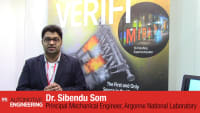
Automotive Engineering
DSpace Launches Simphera AV Development Simulator
Off-Highway Engineering
Achieving Grid Convergence in Large Internal-Combustion Engine Simulations
Autonomous Vehicle Engineering
Horiba to Expand Virtual AV Vetting with Physical-Body Testing

Automotive Engineering
Modeling and Simulation Platform
Battery Technology
Using Multiphysics to Predict and Prevent EV Battery Fire
Aerospace & Defense Tech Briefs
AIA Predicts Flying Air Taxis, Supersonic Air Travel, and Space Industry for 2050
Automotive Engineering
Simulating to Track Soot Formations in Diesel Engines
Automotive Engineering
BMW, Classiq Find Better Architectures Through Quantum Computing
Automotive Engineering
Engine System Analysis
Automotive Engineering
Simulation Rules: Scrubbing Heat, Sound and Dirt from Autonomous EVs

Automotive Engineering
Simulation-Driven Design
Off-Highway Engineering
Machine Learning Drives Design Space Exploration
Off-Highway Engineering
Siemens Improves Optimization for Engine Development
Off-Highway Engineering
CV Autonomy: Picking the 'Low-Hanging Fruit'
Off-Highway Engineering
Digitalization of Product Engineering

Off-Highway Engineering
Advanced Simulation Techniques Drive Powertrain Design


Top Stories
INSIDERManufacturing & Prototyping
 How Airbus is Using w-DED to 3D Print Larger Titanium Airplane Parts
INSIDERManned Systems
 FAA to Replace Aging Network of Ground-Based Radars
NewsTransportation
 CES 2026: Bosch is Ready to Bring AI to Your (Likely ICE-powered) Vehicle
NewsSoftware
 Accelerating Down the Road to Autonomy
EditorialDesign
 DarkSky One Wants to Make the World a Darker Place
INSIDERMaterials
 Can This Self-Healing Composite Make Airplane and Spacecraft Components Last...
Webcasts
Defense
 How Sift's Unified Observability Platform Accelerates Drone Innovation
Automotive
 E/E Architecture Redefined: Building Smarter, Safer, and Scalable...
Power
 Hydrogen Engines Are Heating Up for Heavy Duty
Electronics & Computers
 Advantages of Smart Power Distribution Unit Design for Automotive...
Unmanned Systems
 Quiet, Please: NVH Improvement Opportunities in the Early Design...
