




Hot for Powertrain
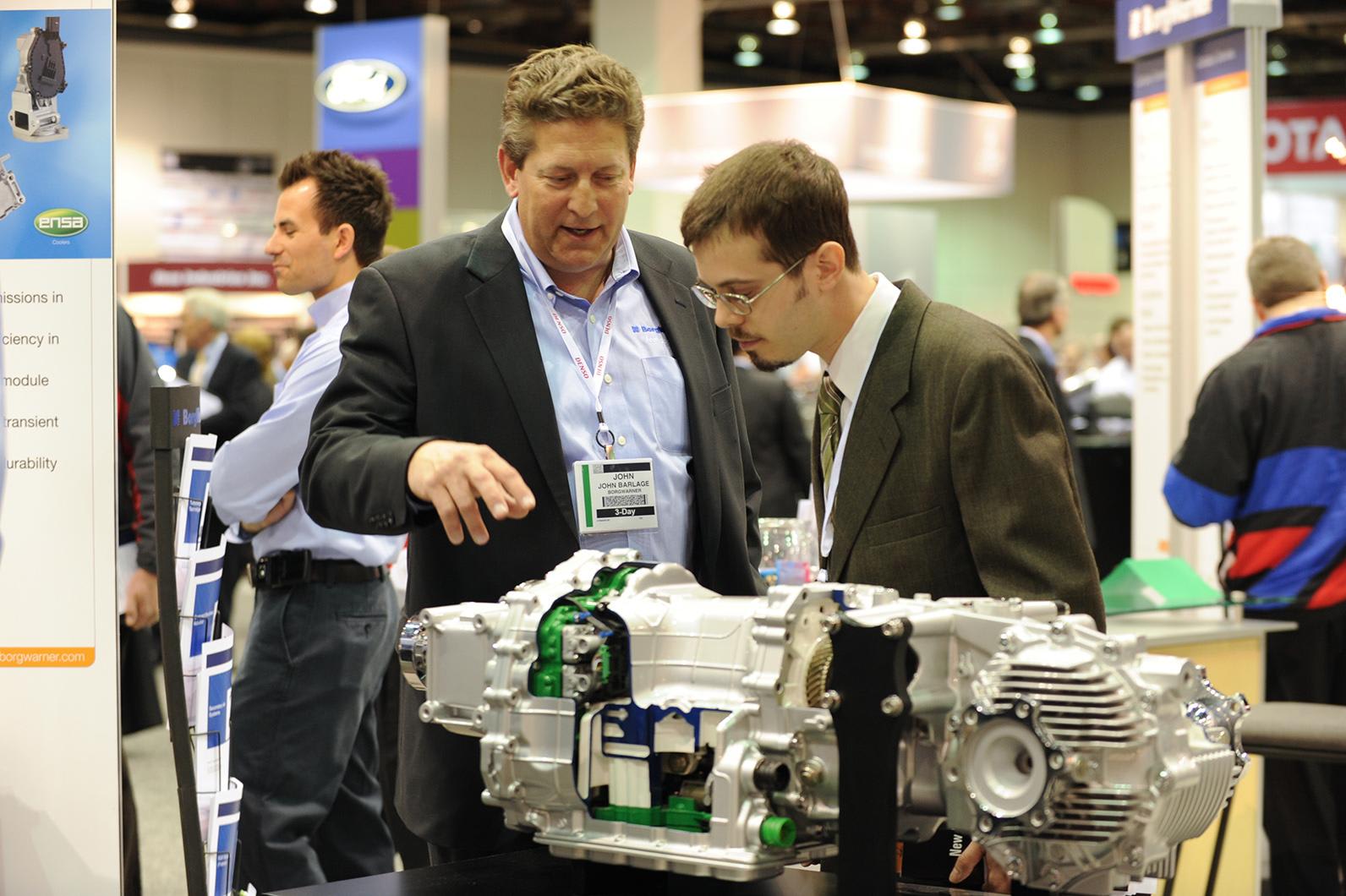
Are you looking for deep and valuable powertrain knowledge that only comes from top-level technical presentations and insider-quality networking? Then point your GPS towards North America’s “Motor City” next month for two consecutive SAE International events—the High Efficiency IC Engine Symposium, April 6-7 at the Westin Book Cadillac Hotel, and the SAE World Congress, April 8-10, a few blocks away at Detroit’s newly revamped Cobo Hall.

Engineers and technologists who are regulars at these consecutively-staged conferences report that they are a “must attend” for anyone involved in vehicle powertrain design, development, fuels, controls, aftertreatment, testing, and the regulatory landscape.
Beginning Sunday, April 6, the SAE High Efficiency IC Engine Symposium has become the much-anticipated kick-off for Congress week. Its two-day technical program will cover the issues and technologies that are critical for creating more fuel efficient, lower emitting, customer-pleasing, and market-compliant engines. The expert discussions will cover all facets of advanced combustion, including the latest in boosting, cooled EGR, direct injection, high-power ignition, fully variable valvetrains, waste-heat recovery, aftertreatment strategies, hybridization, and controls.
The symposium agenda (confirmed as of late February) is included here.
Powertrain at SAE World Congress
SAE International will be publishing more than 1400 Technical Papers in conjunction with the 2014 World Congress, and over 60% of those papers are related to Powertrain. Automotive Engineering asked Dr. Paul Richards, an SAE Fellow and Chair of the Powertrain, Fuels & Lubricants Activity, to provide an overview of World Congress as it applies to that professional community. (Dr. Richards also will be moderating the Monday afternoon session at the IC Engines Symposium.)
Reducing CO2 is the focus of virtually all powertrain participants at this year’s Congress, he explained, so many of this year’s technical papers will focus on the latest activities in emissions control. The program gets rolling Tuesday morning with Dr. Tim Johnson of Corning Inc. giving his annual review of the advances that have taken place during the past year. In the afternoon, a panel discussion will address the perennial question: Is internal combustion engine (ICE) development finished? Dr. Richards said this session will examine the future use of fossil fuels as the industry follows a roadmap to ever lower CO2 emissions.
“Have we reached the evolutionary limit of ICE hardware and control development?” he asks, posing a question that many attendees of this session may share. For those who argue that the venerable ICE still has legs (and a business case) going forward, the SAE World Congress will offer new papers on gasoline engine downsizing strategies. Among the topics covered, for example, is the U.K. collaborative project Ultraboost, which demonstrates extreme downsizing by producing the same torque from a 60% downsized engine. The paper’s authors believe this could lead to a 35% reduction in vehicle CO2 emissions.
Meanwhile a new paper from California-based Achates Power will show that an opposed piston, two-stroke diesel is capable of similar CO2 emissions reduction and is capable of meeting the 2025 fuel efficiency and emissions regulations.
For many, the optimum route to CO2 reduction is powertrain hybridization. According to Dr. Richards, technical sessions during the first half of Congress will hear from groups around the world that are developing and testing advanced hybrid electric powertrains. Hybrid powertrains present an excellent chance to “create new possibilities” (the 2014 Congress theme) by breaking the traditional—and, some would argue, limiting—mechanical linkage between engine and road wheels. This topic is explored in the concept of a free piston engine to generate the electricity to power the electric drive motor(s).
If the ICE only has to generate electrical power, then it is no longer necessary to convert cylinder pressure directly into rotary motion. Thus the use of a linear generator has many advantages. Dr. Richards revealed that Toyota will present a couple of papers on a development engine—a two-stroke!—that has demonstrated continuous stable operation of such a generator.
While compressed natural gas (CNG) has been used to power IC engines for many years, the recent collapse in the price of gas in North America, as a result of shale-gas production, has renewed interest in natural gas as a motor fuel. On Wednesday, April 9, a morning panel will discuss CNG use for light duty vehicles. Dual-fuel potential also gives engineers the possibility to control the reactivity of the fuel to suit engine operating conditions. Known as Reactivity Controlled Compression Ignition (RCCI), it is the subject of 2014 technical papers from leading research establishments in the U.S. and Europe, including FEV and three papers authored by the University of Wisconsin research team.
Expert discussions at the AVL and FEV theatres
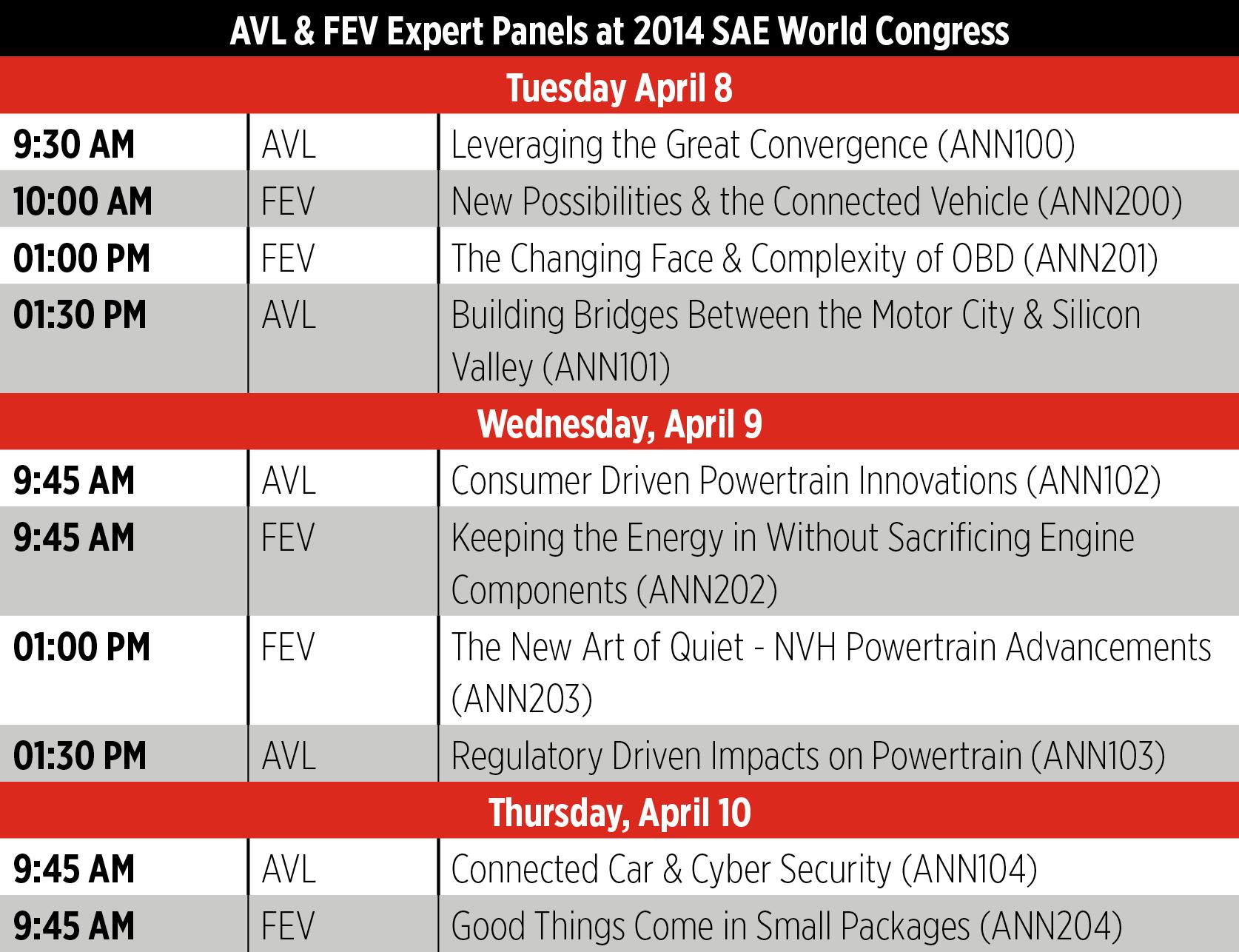
Perennially popular panel discussions regarding powertrain take place at the AVL Technology Leadership Center and the FEV Powertrain Innovation Forum, Tuesday through Thursday April 8-10. Highlights are noted in the following table.
More From SAE Media Group
Automotive Engineering
New Four-Chamber Rotary Engine Could Supplant Wankel and Piston Engines for UAV Applications
Off-Highway Engineering
Mahle, Liebherr Develop Active Pre-Chamber for Hydrogen ICE
Automotive Engineering
Injecting a Sense of Urgency to Clean up Diesels
Automotive Engineering
Achates Powers toward Production
Aerospace & Defense Tech Briefs
X Marks the Spot
Off-Highway Engineering
Could This Infinitely Variable Compression Mechanism Be the Next Piston Engine Game-Changer?
Automotive Engineering
RCCI Engine Begins In-Vehicle Demonstration Testing
Automotive Engineering
Frictionless Engine Seals
Automotive Engineering
Mazda Pushes the Propulsion Frontier
Automotive Engineering
Extending a Wankel Future on Hydrogen Fuel
Automotive Engineering
Optimizing Hybrids for Cost and Efficiency
Automotive Engineering
German Spark-Ignited Compression-Ignition Research Paralleling Mazda’s SPCCI
Automotive Engineering
V-Charging Aims to Add Muscle to Downsized Engines
Automotive Engineering
New Axial-Piston Engine Aimed at Range Extenders, Military Applications
Automotive Engineering
SwRI’s D-EGR Demo Car Wows SAE Engines Symposium with 42% BTE
Off-Highway Engineering
Navistar Updates A26 Engine, Improves FE by 4%
Automotive Engineering
Reconsidering CNG as an Alt-Fuel Solution
Automotive Engineering
Audi Evolves the Miller Cycle in Its New 2.0-L Spark-Ignition Engine
Automotive Engineering
Engine Researchers: 50% Gasoline-Engine Efficiency in Sight
Automotive Engineering
Keeping Combustion in the Conversation
Automotive Engineering
UAV Turbines to Tackle 200-Hp Class UAV Engines for U.S. Army
Aerospace & Defense Tech Briefs
2050 Aircraft Engine Designs Go Radical, Part 2
Off-Highway Engineering
Developing an Alternative Engine Concept
Off-Highway Engineering
Kohler Extends Its Hand in Off-Highway Diesels
Automotive Engineering
Pushing the ICE Forward, Gradually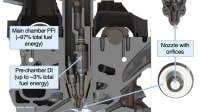
Automotive Engineering
Extending the ICE Age: Hyundai Optimizing Engines and Fuels
Off-Highway Engineering
Cummins’ New Mid-Displacement Turbos Quieter and More Efficient
Automotive Engineering
U.K. Universities Lead R&D for Low-Cost Catalysts, Low-CO2 Combustion
Automotive Engineering
Turbocharger Speed Sensors Aim for Light-Duty Applications
Automotive Engineering
Answering the Fuel-cell Compressor Question
Top Stories
INSIDERManufacturing & Prototyping
 How Airbus is Using w-DED to 3D Print Larger Titanium Airplane Parts
INSIDERManned Systems
 FAA to Replace Aging Network of Ground-Based Radars
NewsTransportation
 CES 2026: Bosch is Ready to Bring AI to Your (Likely ICE-powered) Vehicle
NewsSoftware
 Accelerating Down the Road to Autonomy
EditorialDesign
 DarkSky One Wants to Make the World a Darker Place
INSIDERMaterials
 Can This Self-Healing Composite Make Airplane and Spacecraft Components Last...
Webcasts
Defense
 How Sift's Unified Observability Platform Accelerates Drone Innovation
Automotive
 E/E Architecture Redefined: Building Smarter, Safer, and Scalable...
Power
 Hydrogen Engines Are Heating Up for Heavy Duty
Electronics & Computers
 Advantages of Smart Power Distribution Unit Design for Automotive...
Unmanned Systems
 Quiet, Please: NVH Improvement Opportunities in the Early Design...
