




Material Derived from Trees Could Replace Liquid Electrolytes
The material could pave the way for better, safer solid-state batteries.

In pursuit of batteries that deliver more power and operate more safely, researchers are working to replace the liquids commonly used in today’s lithium-ion batteries with solid materials. Researchers have now developed a new material for use in solid-state batteries that’s derived from an unlikely source: trees.
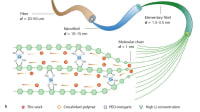
The team demonstrated a solid ion conductor that combines copper with cellulose nanofibrils — polymer tubes derived from wood. The paper-thin material has an ion conductivity that is 10 to 100 times better than other polymer ion conductors. It could be used as either a solid battery electrolyte or as an ion-conducting binder for the cathode of an all-solid-state battery.
Today’s lithium-ion batteries, which are widely used in everything from cellphones to cars, have electrolytes made from lithium salt dissolved in a liquid organic solvent. The electrolyte’s job is to conduct lithium ions between a battery’s cathode and anode. Liquid electrolytes work well but they have some downsides. At high currents, tiny filaments of lithium metal, called dendrites, can form in the electrolyte, leading to short circuits. In addition, liquid electrolytes are made with flammable and toxic chemicals that can catch fire.
Solid electrolytes have the potential to prevent dendrite penetration and can be made from nonflammable materials. Most of the solid electrolytes investigated so far are ceramic materials, which are good at conducting ions but they’re also thick, rigid, and brittle. Stresses during manufacturing as well as charging and discharging can lead to cracks and breaks. The new material, however, is thin and flexible — almost like a sheet of paper — and its ion conductivity is on par with ceramics.
Computer simulations of the microscopic structure of the copper-cellulose material were performed to understand why it is able to conduct ions so well.
The modeling study revealed that the copper increases the space between cellulose polymer chains, which normally exist in tightly packed bundles. The expanded spacing creates ion superhighways through which lithium ions can zip by relatively unimpeded.
In addition to working as a solid electrolyte, the new material can also act as a cathode binder for a solid-state battery. To match the capacity of anodes, cathodes need to be substantially thicker. That thickness, however, can compromise ion conduction, reducing efficiency. For thicker cathodes to work, they need to be encased in an ion-conducting binder. Using the new material as a binder, the team demonstrated what they believe to be one of the thickest functional cathodes ever reported.
For more information, contact Kevin Stacey at
More From SAE Media Group
Battery Technology
Tough, Solid Electrolyte Battery Component
Battery Technology
New Materials Move Li-Ion Batteries Toward the Solid-State Endgame

Battery Technology
Spreadable Way to Stabilize Solid-State Batteries
Battery Technology
Nanostructured Alloy for Battery Anodes
Battery Technology
Doubling Battery Performance with Lithium Metal

Battery & Electrification Technology
Enhancing the Performance of All-Solid-State Batteries

Battery & Electrification Technology
New Material Offers Promise for Solid-State Batteries
Battery Technology
Semi-Liquid Metal Anode
Battery & Electrification Technology
Building Temperature-Resilient Batteries
Tech Briefs
Building Temperature-Resilient Batteries
Battery & Electrification Technology
Technique Extends Next-Generation Lithium Metal Batteries


Battery & Electrification Technology
Anode-Free Lithium Batteries with Maximized Energy Density
Tech Briefs
Stable, Efficient, Anode-Free Sodium Battery
Battery & Electrification Technology
A New Way to Enhance Durability of Lithium Batteries
Battery Technology
Hybrid Membrane Doubles the Lifetime of Rechargeable Batteries
Battery Technology
Low-Cost, Fast Production of Solid-State Batteries
Battery Technology
Flexible, Thin-Film Battery
Battery & Electrification Technology
Designing Sodium-Ion Batteries with Extended Longevity

Automotive Engineering
Niobium: Magic Metal for Battery Anodes?

Battery & Electrification Technology
Developing Safer Batteries with Solid-State Polymer Electrolytes

Top Stories
INSIDERDefense
 New Raytheon and Lockheed Martin Agreements Expand Missile Defense Production
NewsAutomotive
 Ford Announces 48-Volt Architecture for Future Electric Truck
INSIDERManufacturing & Prototyping
 Active Strake System Cuts Cruise Drag, Boosts Flight Efficiency
ArticlesTransportation
 Accelerating Down the Road to Autonomy
INSIDERMaterials
 How Airbus is Using w-DED to 3D Print Larger Titanium Airplane Parts
Road ReadyTransportation

Webcasts
Electronics & Computers
 Cooling a New Generation of Aerospace and Defense Embedded...
Power
 Battery Abuse Testing: Pushing to Failure
Connectivity
 A FREE Two-Day Event Dedicated to Connected Mobility
Automotive
 Quiet, Please: NVH Improvement Opportunities in the Early Design Cycle
Transportation
 Advantages of Smart Power Distribution Unit Design for Automotive &...
Aerospace
 Sesame Solar's Nanogrid Tech Promises Major Gains in Drone Endurance