




Characterization of Turbulent Unsteady Separation Using Photonic Micro-Skin Friction and Wall Pressure Sensors
Investigating the structure and dynamics of unsteady/transient separated turbulent boundary layers using a photonic skin friction and wall pressure sensor.
The goal of this research was to investigate the structure and the dynamics of unsteady/transient separated turbulent boundary layers for 4×10³ < ReΘ< 1.4×10⁴. Central to the study is the characterization of the streamwise and spanwise fluctuating skin friction and wall pressure fluctuations in and around the separation zone.
During the initial stage of the project, a photonic skin friction and wall pressure sensor will be implemented to measure directly and at the same spatial location the unsteady skin friction and wall pressure. The photonic sensor will be an extension of previous sensor development efforts, which were limited to low to moderate-frequency wall shear stress measurements.
The proposed work will be carried out in the specially designed test section of a low-speed wind tunnel. There is a need of reliable wall shear stress sensors to (a) corroborate existing theories and (b) provide precise two-dimensional, skin friction data well-resolved in time and space for the development and validation of models that can predict the onset and extent of stall in transient separated turbulent boundary layers.
The main goal is to generate high fidelity data, taking into account the evolution of the boundary layer from its origin, and to identify key issues and challenges regarding current understating of unsteady separated turbulent boundary layer flows. Detailed velocity mapping will be carried out in and around the separation region using hotwire anemometry, laser doppler velocimetry (LDV) and particle image velocimetry (PIV). These detailed velocity field measurements, together with the unsteady skin friction and wall pressure, will fully characterize the unsteady separated flow region. In addition, the extensive data collected (velocity, turbulence quantities, wall shear stress, wall pressure, and higher order moments) will be analyzed in a systematic way to allow for the prediction of the onset and extent of stall in transient separated turbulent boundary layers.
This research also responds to previous works on unsteady/steady turbulent boundary layers that have highlighted a number of related issues: (a) the urgent need of high-resolution direct measurements of the mean and fluctuating components of the skin friction, since it seems that the behavior of the near wall as well as the outer wall region depends on the friction velocity and in all these years of turbulent boundary layer research (especially zero pressure gradient) the friction velocity has been inferred, for the most part, from the Clauser chart. Some attempts have been made to measure directly the wall shear stress, yet some of these measurements have not been taken into consideration since they do not agree with the law of the wall. In addition, the most reliable way to identify and characterize the bursting process as well as large organized structures of the turbulent boundary layer is through the measurement of the frequency fluctuations of the wall shear stress; (b) the need for carefully controlled boundary layer experiments over a wide range of Reynolds numbers; (c) information regarding the development of the boundary layer (tripping devices, transition) from its initial stage, since it is not clear what is the necessary development length for a turbulent boundary layer to be independent from its initial condition; (d) the need for clearly defined initial conditions; (e) the need for new data on unsteady separated turbulent boundary layers since each available data reports the dependence of the boundary layer on a single parameter.
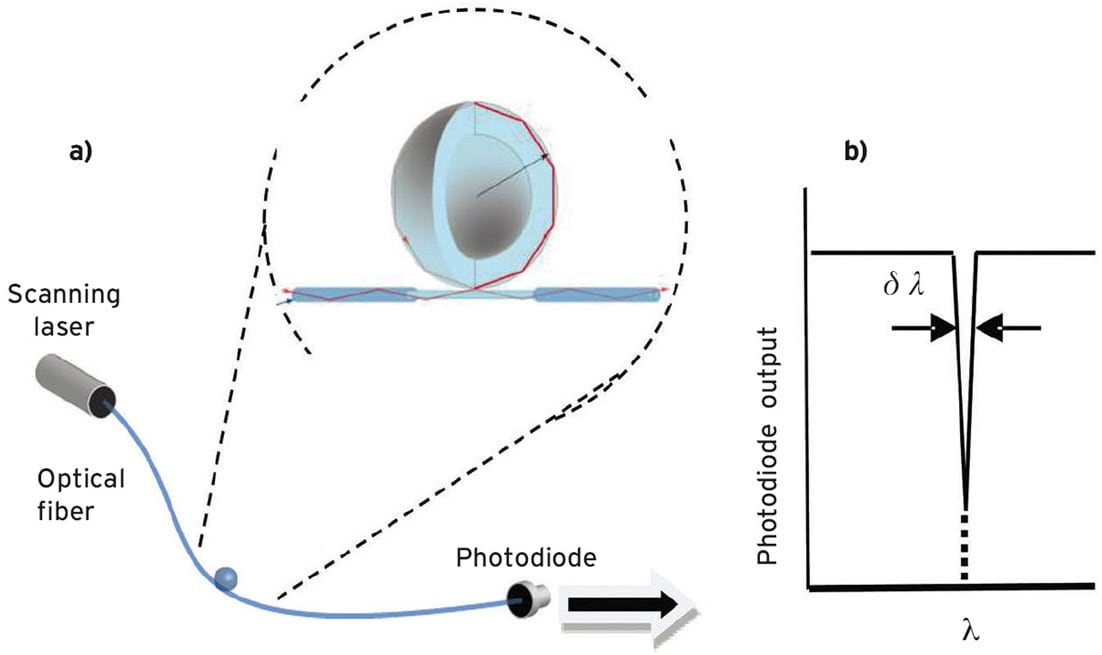
Central to these studies is the characterization (using direct measurement) of the two-dimensional unsteady fluctuating skin friction and wall pressure fluctuations. Photonic skin friction sensors and wall pressure sensors will be developed and implemented to measure simultaneously, at the same spatial location, the unsteady fluctuating streamwise and spanwise skin friction and wall pressure. The sensing approach is based on the whispering gallery mode (WGM) of dielectric micro-cavities. In optics, the whispering gallery mode phenomenon (WGM) arise from total internal reflection of light at the internal surface of a high index of refraction dielectric resonator embedded in a surrounding medium of lower refractive index.
This work was done by Tindaro Ioppolo of Southern Methodist University for the Army Research Office. For more information, download the Technical Support Package (free white paper) below. ARL-0235
This Brief includes a Technical Support Package (TSP).
Characterization of Turbulent Unsteady Separation Using Photonic Micro-Skin Friction and Wall Pressure Sensors
(reference ARL-0235) is currently available for download from the TSP library.
Don't have an account?
More From SAE Media Group
Air Force Research Laboratory Technology Horizons
AFRL Finding Ways to Decrease Unmanned Air Vehicle Costs
Aerospace INSIDER
Optical Flow Visualization Applied to Jet Engine Testing
Aerospace INSIDER
Research Could Lead to Noise Reduction in Aircraft Engines
Tech Briefs
Fluid Mechanics Comes to Life in 3D
Aerospace & Defense Tech Briefs
Inside the Navy’s Quiet Water Tunnel Facility

Aerospace INSIDER
Engineers Assess Flow Quality in Wind Tunnel Test Facility
NASA Spinoff
Space Age Swimsuit Reduces Drag, Breaks Records
Automotive Engineering
Tesla Aerodynamicists Use CFD to Evaluate Yaw Performance
Aerospace & Defense Tech Briefs
Experimental Confirmation of an Aquatic Swimming Motion Theoretically of Very Low Drag and High Efficiency
Tech Briefs
Embedded Fiber Optic Sensors (EFOS)
Tech Briefs
Device Eliminates Vortices and Vibration
Off-Highway Engineering
Evaluating Real-World Aerodynamics for a Class 8 Tractor-Trailer

Sensor Technology
Smart Windows Self-Illuminate on Rainy Days
Photonics & Imaging Technology
Custom Optomechanics in Industrial UV Lasers
Aerospace & Defense Tech Briefs
Some Advances in Reducing Drag and Suppressing Convection
Photonics & Imaging Technology
Ray Optics Simulation of Inertial Navigation Systems
Motion Design INSIDER
AI-Trained Vehicles Can Adjust to Extreme Turbulence on the Fly
Aerospace & Defense Tech Briefs
Nonlinear Effects in Transformation Optics-Based Metamaterial Shields for Counter Directed Energy Weapon Defense
Tech Briefs
Chip Measures Quantities with Quantum Precision
Photonics & Imaging Technology
Monitoring Additive Manufacturing with an Optical Microphone
Photonics & Imaging Technology INSIDER
Tying Overlapping Laser Beams into Stable 'Optical Knots'
Motion Design INSIDER
Nimble Dimples: Agile Underwater Vehicles Inspired by Golf Balls
Photonics & Imaging Technology INSIDER
Fundamental Optics Experiments Seek to Create Better Long-Range Sensors
Tech Briefs
Lee Visco Jet Animation
Tech Briefs
Rocket Nozzle Side-Load Analysis Software
Aerospace & Defense Tech Briefs
Notre Dame’s New Boundary Breaking Mach 10 Quiet Wind Tunnel
Medical Design Briefs
Winter 2022 Resource Guide
Overview
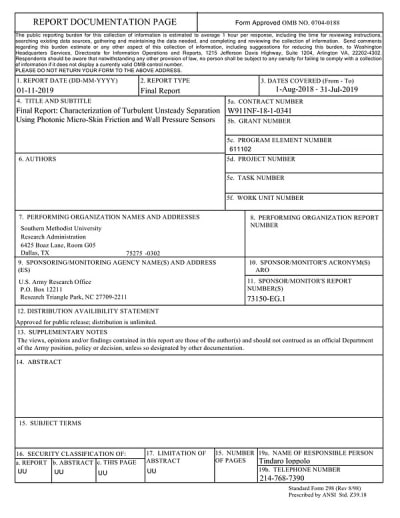
The document is the final report for the research project titled "Characterization of Turbulent Unsteady Separation Using Photonic Micro-Skin Friction and Wall Pressure Sensors," conducted by Tindaro Ioppolo at Southern Methodist University. The project was funded by the U.S. Army Research Office under Agreement Number W911NF-18-1-0341, covering the performance period from August 1, 2018, to July 31, 2019.
The primary goal of the research was to develop and characterize advanced sensor technologies for measuring turbulent flow phenomena, particularly focusing on unsteady separation. The report outlines the innovative use of photonic micro-skin friction sensors and wall pressure sensors, which are designed to provide high-resolution measurements in turbulent flows. These sensors are crucial for understanding complex fluid dynamics, which have significant implications in various engineering applications, including aerodynamics and hydrodynamics.
The report is structured into several key sections. It begins with an overview of the research goals and vision, followed by a detailed description of the sensor concepts developed during the project. The experimental setup for opto-electronic measurements is elaborated, showcasing the methodologies employed to test the sensors in both steady and unsteady flow conditions.
Results from the experiments are presented, highlighting the performance of the sensors in canonical flow scenarios. The findings indicate that the developed sensors can effectively capture the dynamics of turbulent flows, providing valuable data that can enhance the understanding of flow separation and its implications on performance in engineering systems.
Additionally, the report discusses future plans for the research, suggesting potential avenues for further exploration and development of the sensor technologies. The bibliography section provides references to relevant literature that supports the research findings.
Overall, this report contributes to the field of fluid dynamics by presenting novel sensor technologies that can improve the measurement and characterization of turbulent flows. The insights gained from this research are expected to aid in the design and optimization of various systems where turbulent flow plays a critical role. The document is approved for public release, ensuring that the findings are accessible to the broader scientific community and industry stakeholders.
Top Stories
INSIDERDefense
 New Raytheon and Lockheed Martin Agreements Expand Missile Defense Production
NewsAutomotive
 Ford Announces 48-Volt Architecture for Future Electric Truck
INSIDERManufacturing & Prototyping
 Active Strake System Cuts Cruise Drag, Boosts Flight Efficiency
ArticlesTransportation
 Accelerating Down the Road to Autonomy
INSIDERMaterials
 How Airbus is Using w-DED to 3D Print Larger Titanium Airplane Parts
Road ReadyTransportation

Webcasts
Electronics & Computers
 Cooling a New Generation of Aerospace and Defense Embedded...
Power
 Battery Abuse Testing: Pushing to Failure
Connectivity
 A FREE Two-Day Event Dedicated to Connected Mobility
Automotive
 Quiet, Please: NVH Improvement Opportunities in the Early Design Cycle
Transportation
 Advantages of Smart Power Distribution Unit Design for Automotive &...
Aerospace
 Sesame Solar's Nanogrid Tech Promises Major Gains in Drone Endurance