




Novel Instrument Enhances Ability to Measure Nuclear Materials
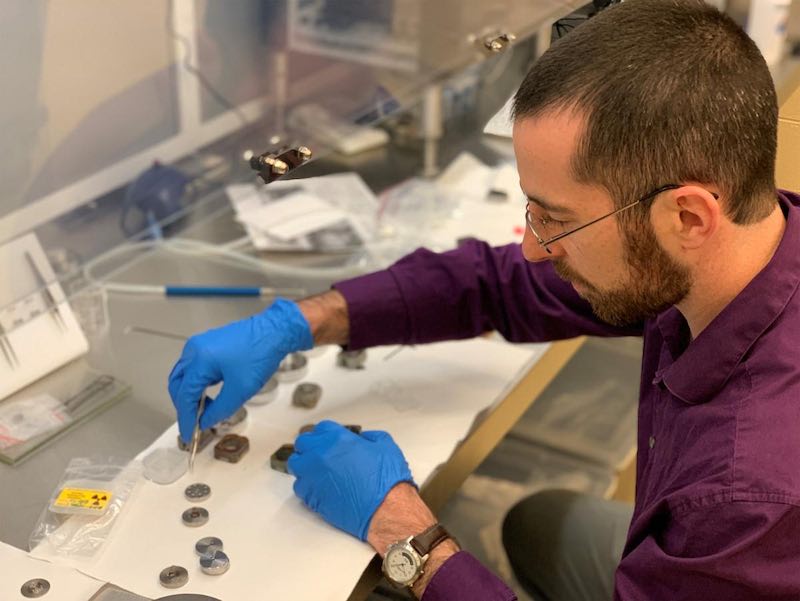
Researchers with the U.S. Naval Research Laboratory (NRL) designed and built an instrument called NAUTILUS to provide new measurement capabilities to measure nuclear, cosmo/geo-chemical, and electronic materials.
At the end of last year, NRL participated in an international round-robin exercise, called Nuclear Signatures Inter-laboratory Measurement Evaluation Program (NUSIMEP-9), sponsored by the European Commission (Nuclear Safety and Security Division) to measure microscopic particulate samples with “unknown” uranium isotope ratios.
“NRL recently received the final report from the international round-robin exercise and found that the Laboratory performed quite well, correctly identifying all of the “unknown” isotopic compositions,” said David Willingham, a research chemist and head of the Accelerator Mass Spectrometry Section. “In this case, NRL used a globally unique mass spectrometer called NAUTILUS to perform these measurements, as part of the Accelerator Mass Spectrometry Section’s participation in the NUSIMEP-9 sample analysis exercise.”
The NUSIMEP-9 test samples were prepared to mimic environmental sampling/nuclear Safeguards missions, such as those performed by the International Atomic Energy Agency (IAEA). The exercise was conducted for the IAEA’s Network of Analytical Laboratories (NWAL), of which NRL is not a member; however, NRL does collaborate with the laboratories to develop better uranium-bearing particle analyses. The IAEA is responsible for deterring the proliferation of nuclear weapons by detecting early the misuse of nuclear material or technology, and by providing credible assurances that states are honoring their safeguards obligations. The analysis of nuclear material samples and environmental samples taken by IAEA inspectors is an essential component of this undertaking.
Twenty-two other laboratories were involved, many of which perform these types of measurements as their core mission (e.g., IAEA) with their instruments dedicated solely for these types of measurements. A key element of the safeguards system is the physical inspection of nuclear facilities by IAEA inspectors. States declare in considerable technical detail the types and quantities of nuclear material they possess. Among other verification measures, IAEA inspectors may take nuclear material samples from various points of the nuclear fuel cycle and collect environmental samples by swiping surfaces at various locations during the conduct of a verification activity.
These samples, which may be in solid, liquid, or gaseous form, are then subject to sophisticated analysis by IAEA scientists. The scientists focus on the isotopic make-up of uranium and plutonium contained in the samples, unaware of the country from which they were obtained. The analytical results provide a powerful tool for supporting conclusions as to the correctness and completeness of states' nuclear material declarations and help to inform the IAEA’s evaluation of whether a state is complying with its safeguards obligations.
More From SAE Media Group
Defense INSIDER
How to Dismantle a Nuclear Bomb
Defense INSIDER
Lab-Designed Instrumentation Flies Aboard Unarmed Missile
Tech Briefs
Real-Time Airborne Particle Analyzer

Tech Briefs
Radiation Detection with Plastic Scintillators
Defense INSIDER
Experimental Box Could Track Nuclear Activity by Rogue Nations
Defense INSIDER
Coding and Computers Could Help Detect Explosives
Aerospace & Defense Tech Briefs
Assessment of Non-Traditional Isotopic Ratios by Mass Spectrometry for Analysis of Nuclear Activities
Defense INSIDER
NIF Experiments Support Warhead Life Extension

Defense INSIDER
New Technology Demonstrated During Arctic Exercise

Aerospace & Defense Tech Briefs
Matrix-Free Assisted Laser Desorption Ionization Using Metal-Organic Frameworks
Aerospace & Defense Tech Briefs
Inter-Laboratory Combat Helmet Blunt Impact Test Method Comparison
Defense INSIDER
Air Force Is Developing Mach 18 Wind Tunnel
Tech Briefs
Video Game Imaging Meets Nuclear Reality
Aerospace & Defense Tech Briefs
Data Recorder and Mission Computer
Aerospace & Defense Tech Briefs
Monitoring a Nearshore Beneficial Use Site: Application of a Benthic Sled and Video Annotation

Defense INSIDER
Explosive Destruction System Begins Eliminating Chemical Weapons

Tech Briefs
3D-Printed Steel Passes the Test
Defense INSIDER
Optimizing Radiation Detection for Homeland Security, DoD

Tech Briefs
Ultrasensitive Vapor Detection System
Aerospace & Defense Tech Briefs
Biological Threat Detectors
Tech Briefs
Integrated Multiphysics and Advanced Diagnostics
Top Stories
NewsSensors/Data Acquisition
 Microvision Aquires Luminar, Plans Relationship Restoration, Multi-industry Push
INSIDERRF & Microwave Electronics
 A Next Generation Helmet System for Navy Pilots
INSIDERWeapons Systems
 New Raytheon and Lockheed Martin Agreements Expand Missile Defense Production
NewsAutomotive
 Ford Announces 48-Volt Architecture for Future Electric Truck
INSIDERAerospace
 Active Strake System Cuts Cruise Drag, Boosts Flight Efficiency
ArticlesTransportation

Webcasts
Aerospace
 Cooling a New Generation of Aerospace and Defense Embedded...
Energy
 Battery Abuse Testing: Pushing to Failure
Power
 A FREE Two-Day Event Dedicated to Connected Mobility
Automotive
 Quiet, Please: NVH Improvement Opportunities in the Early Design Cycle
Electronics & Computers
 Advantages of Smart Power Distribution Unit Design for Automotive &...
Unmanned Systems
 Sesame Solar's Nanogrid Tech Promises Major Gains in Drone Endurance