




Monitoring a Nearshore Beneficial Use Site: Application of a Benthic Sled and Video Annotation
Passive survey method provides less labor and resource intensive system for monitoring the effects of dredging on aquatic life in nearshore beneficial use sites.
The U.S. Army Corps of Engineers (USACE) Portland Districts (NWP) maintains safe and navigable waterways in Oregon through a variety of dredging projects, including channel deepening, and dredging sandbars. Placement of dredged sediment occurs at preselected, specific geographic areas categorized as nearshore beneficial use sites. Beneficial use sites are commonly monitored before, during, and after disposal, to evaluate dredge management practices and to avoid potentially adverse effects to the marine environment.
Ecological monitoring focuses on the survey of fish and epibenthic invertebrate species distribution and abundance. Surveys are conducted within, and outside the disposal area to assess changes in population or community structure, and to establish diversity indices for comparisons over time. A commonly used survey method to accomplish this goal is a bottom trawl survey, whereby a net is dragged along a preselected part of the ocean floor for a specific time and distance. The net is then retrieved onto the boat where the aquatic life can be more closely examined and the taxa are sorted. Traditional trawl surveys are labor and resource intensive, highlighting the opportunity to improve alternative “passive” survey methods.
A towed benthic sled is a passive method that has been used for several decades. A benthic sled is typically fabricated of aluminum or steel pipe with flanges to attach equipment like an imaging system and lighting. The sled is towed behind a boat across the sediment surface to collect video of organisms and physical features near the bottom. The benthic sled post-survey analysis usually relies on annotations made by human observers, which is often labor and software intensive. Therefore, long term video collection projects, occurring over many years, often require robust software tools to effectively analyze data sets.
For several years, the NWP has employed NOAA and ODFW custom built benthic sleds equipped with a video system to help monitor marine animals near the sediment surface at NWP’s nearshore beneficial use sites. The Video Annotation and Reference System (VARS), developed and used by the Monterey Bay Aquarium Research Institute (MBARI) for their deep-sea video annotations, was identified by the U. S. Army Engineer Research and Development Center (ERDC) to annotate the underwater video collected at nearshore beneficial use sites. Benthic sleds, or underwater sleds, have been used for several decades for video or image surveys. Sled designs are classified based on where the sled is assigned to operate in the water column as bottom contacting or bottom tending. A bottom contacting sled design is the one most commonly used. This design sinks to the bottom and maintains contact with the bottom while being towed on skids. A bottom tending sled is designed to be semi-buoyant, allowing the user to adjust the sled buoyance to achieve a specific depth. Bottom tending sleds are less conventional survey platforms, requiring some knowledge in control systems, fabrication, and electronics to successfully build, deploy, and operate.
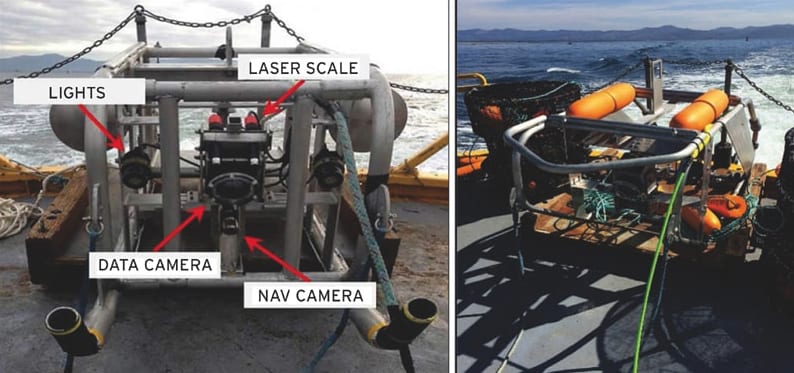
Equipment such as image sensors or lasers for measurement scale can typically be mounted with limited modification to either sled design. Benthic sleds towed by NOAA and ODFW are bottom contacting designs and have been deployed in shallow and deep water (>70 m). NOAA sled accessories have included a high-resolution camera for the primary data acquisition (data camera, Canon Vixia HF R20 camcorder 1080p) enclosed in a waterproof housing, two light intensity-adjustable floodlights, a navigation camera (Multi SeaCam 2060) and two laser pointers (SeaLaser 100) to provide a measurement scale for items of interest in the video field of view. The data camera is internally powered, all other electrical and data transmission to the surface is accomplished via an umbilical coaxial cable. The data camera is usually set to a fixed focus and oriented to acquire video of an approximately 2-meter2 area in front of the sled, with the laser pointers positioned near the center of the camera’s field of view.
This work was done by Justin Wilkens, Jarod Norton, and G. Curtis Roegner for the Army Corps of Engineers Portland Districts. ERDC-0007
This Brief includes a Technical Support Package (TSP).
Monitoring a Nearshore Beneficial Use Site: Application of a Benthic Sled and Video Annotation
(reference ERDC-0007) is currently available for download from the TSP library.
Don't have an account?
More From SAE Media Group
Tech Briefs
Computer Detects and Understands Body Language
Photonics & Imaging Technology
Machine Vision Applications in Laser Measurement Systems
Aerospace & Defense Tech Briefs
Coastal Lidar and Radar Imaging System (CLARIS) Lidar Data Report
Photonics & Imaging Technology
Detecting Threats Beyond the Limits of Human, Sensor Sight
Automotive Engineering
Ultra-Wide, Low-Distortion Lenses for Crash Testing Environments
Motion Design
Vision Sensors in Factory Automation
Aerospace & Defense Tech Briefs
Geospatial Accuracy of Small Unmanned Airborne System Data in the Coastal Environment
Aerospace & Defense Tech Briefs
Adding Context to Full-Motion Video for Improved Surveillance and Situational Awareness
Photonics & Imaging Technology
Standard Digital Camera and AI to Monitor Soil Moisture

Photonics & Imaging Technology
Preventing Heat-Induced Image Warping in Machine Vision Line Scan Cameras
Photonics & Imaging Technology
Novel Flexible Terahertz Camera Can Inspect Objects with Diverse Shapes
Aerospace & Defense Tech Briefs
Maritime Unmanned Aircraft System
Photonics & Imaging Technology
Using Digital Microscopes as Inspection Tools
Photonics & Imaging Technology
Measuring Aging, Fat and Water Content in Meat Products Using Hyperspectral Imaging
Tech Briefs
5 Ws of the Lead-Detection Smartphone System
Tech Briefs
NASA at 60: From Space to Earth
Photonics & Imaging Technology
AI-Based Machine Vision & the Future of Automotive In-Cabin Technologies

Automotive Engineering
AutoSens: Nodar’s Plan to Make Park Assist Tech Better, Cheaper, Cleaner
Automotive Engineering
Thermal Imaging Makes Its Case for ADAS, AVs
Aerospace & Defense Tech Briefs
Localization and Mapping of Unknown Locations with Unmanned Ground Vehicles
Photonics & Imaging Technology
Inspection of Bulk Material with Trilinear Line-Scan and Prism Cameras

Photonics & Imaging Technology
3D Imaging in Space
Aerospace & Defense Tech Briefs
SaraniaSat Wins $5M NASA InVEST Contract for Hyperspectral Thermal Imager
Overview
The technical note (TN) discusses the application of a benthic sled and video annotation software by the U.S. Army Corps of Engineers (USACE) Portland District (NWP) for monitoring marine animals in nearshore beneficial use sites. The primary objectives of the TN are to describe the benthic sled, compare it with traditional bottom trawl surveys, outline the VARS software used for video annotation, and review automated annotation technologies.
Benthic sleds, which have been utilized for decades, are classified into two types: bottom contacting and bottom tending. The bottom contacting sled, commonly used by NOAA and ODFW, maintains contact with the seafloor while being towed. It is equipped with high-resolution cameras, adjustable floodlights, and laser pointers for measurement scaling. This design allows for effective video or image surveys in both shallow and deep waters, providing a lower environmental impact compared to traditional trawl surveys.
The TN highlights that benthic sled surveys are generally more successful in estimating the mean density of aquatic organisms, although they may be limited in species identification to megafauna. The VARS software, developed by the Monterey Bay Aquarium Research Institute (MBARI), is employed for manual annotation of the video data collected. This user-friendly software allows researchers to annotate video frames, storing relevant data such as species identification, population size, and environmental conditions in a database. The software is open-source and customizable, facilitating efficient data management and analysis.
Additionally, the document discusses advancements in automated annotation technologies aimed at reducing the need for human intervention in video analysis. These systems are designed to detect, classify, and quantify marine organisms in underwater videos, thereby improving data collection efficiency and minimizing the environmental impact associated with traditional sampling methods.
In summary, the TN emphasizes the importance of using benthic sleds and advanced video annotation techniques for effective marine monitoring. By integrating these technologies, the USACE aims to enhance the understanding of aquatic ecosystems while minimizing the ecological footprint of their monitoring efforts. The document advocates for continued development and implementation of automated systems to further improve the efficiency and effectiveness of underwater surveys.
Top Stories
NewsAutomotive
 Microvision Aquires Luminar, Plans Relationship Restoration, Multi-industry Push
INSIDERDesign
 A Next Generation Helmet System for Navy Pilots
INSIDERWeapons Systems
 New Raytheon and Lockheed Martin Agreements Expand Missile Defense Production
NewsPower
 Ford Announces 48-Volt Architecture for Future Electric Truck
INSIDERAerospace
 Active Strake System Cuts Cruise Drag, Boosts Flight Efficiency
ArticlesTransportation

Webcasts
Aerospace
 Cooling a New Generation of Aerospace and Defense Embedded...
Test & Measurement
 Battery Abuse Testing: Pushing to Failure
Internet of Things
 A FREE Two-Day Event Dedicated to Connected Mobility
Transportation
 Quiet, Please: NVH Improvement Opportunities in the Early Design Cycle
Electronics & Computers
 Advantages of Smart Power Distribution Unit Design for Automotive &...
Aerospace
 Sesame Solar's Nanogrid Tech Promises Major Gains in Drone Endurance