




Fundamental Aspects of Single Molecule and Zeptomole Electroanalysis
Using the principles of electro-analytical chemistry to detect target molecules at very low concentration with high specificity, simplicity, and low power.
The objective of this research program was to provide the fundamental understanding required for using the principles of electroanalytical chemistry to detect target molecules at very low concentration, including single molecules, with high specificity, simplicity, and low power.

Attainment of this objective required fundamental investigations of reaction kinetics, catalytic activity, nanoparticle synthesis, adsorption, and signal enhancement at surfaces. The results of this study lay the groundwork necessary for detecting and responding to the presence of low levels of CB (chemical, biological) agents.
Additionally, investigations of single electrochemical events have allowed researchers to uncover phenomena and properties that are not apparent by studying processes involving large numbers of molecules, as is typical in conventional electrochemical experiments in which an ensemble average of the data is treated.
The approach in this project has been to use a novel electrochemical method to greatly amplify the presence of specific molecules or classes of molecules. The project is based on results demonstrating the detection of individual collisions between catalytic nanoparticles and electrodes, a process called “electrocatalytic amplification” (ECA). The project also relied on a high degree of expertise with the following:
Synthesis of nanoparticles having well-defined sizes, compositions, and structures that result in tailored catalytic and magnetic functions;
Functionalization of electrodes and nanoparticles with biological probes such as DNA and proteins;
New concepts in microfluidic design for manipulating very small amounts of solution and capturing small numbers of labeled targets; and
Fabrication of nanoscale electrodes having dimensions that are on the same size scale (~ 3 nm) as the catalytic labels used to signal the presence of individual molecules.
The approach to the problem is illustrated in above. Here, a target DNA sequence (shown in green) is detected when it switches on an electrochemical reaction. An approach similar to that shown in the figure was used to detect single catalytic particles and demonstrated that amplification factors as high as 109 can be achieved. Note that although it was decided to illustrate DNA detection as a model analyte in the figure, the basic approach is also applicable to proteins and small-molecules.
This work was done by Richard M. Crooks, Allen J. Bard, and Keith J. Stevenson of The University of Texas at Austin; and Bo Zhang of the University of Washington for the Defense Threat Reduction Agency. DTRA-0009
This Brief includes a Technical Support Package (TSP).
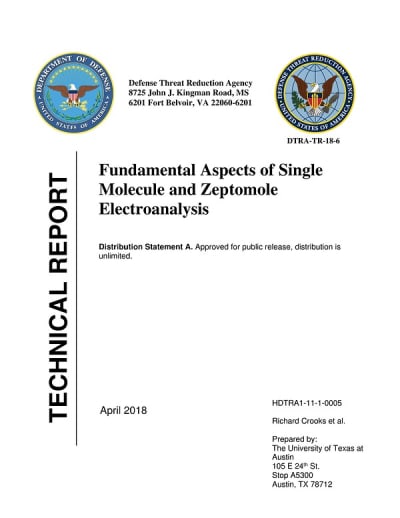
Fundamental Aspects of Single Molecule and Zeptomole Electroanalysis
(reference DTRA-0009) is currently available for download from the TSP library.
Don't have an account?
More From SAE Media Group
Sensor Technology
New Nanoparticle-Based Sensors Can Measure Residual Herbicides in Food

Electronics & Sensors INSIDER
New Photonic Effect Could Speed Drug Development
Photonics & Imaging Technology
New Electron Microscopy Technique Offers First Look at Previously Hidden Processes

Tech Briefs
Nanoscale Pillars Act as Memory Foam
Photonics & Imaging Technology
New Imaging Method Aids in Water Decontamination
Tech Briefs
E-Tongue Nanosensor Array
Aerospace & Defense Tech Briefs
Matrix-Free Assisted Laser Desorption Ionization Using Metal-Organic Frameworks

Tech Briefs
A Lightweight Material Stronger than Steel


Sensor Technology
A Nanotech Sensor Turns Molecular Fingerprints into Bar Codes



Medical Design Briefs
Shaping the Future of Polymer Nanocarriers

Medical Design Briefs
Nanobiosensor Detects SARS-CoV-2


Tech Briefs
VaCNT Makes Up a Promising Membrane Material
Tech Briefs
Smartphone-Based Medical Tests
Medical Design Briefs
DNA Nanotechnology Tools Help Develop New Therapies
Photonics & Imaging Technology
Compact MEMS-Based NIR Spectroscopy for Mobile Applications
Overview
The document is a final technical report detailing research conducted by a team from The University of Texas at Austin, led by Principal Investigator Richard M. Crooks, with co-investigators Allen J. Bard, Keith Stevenson, and Bo Zhang from the University of Washington. The research, funded under Grant/Award #: HDTRA1-11-1-0005, spans from August 8, 2011, to June 1, 2017, and focuses on the fundamental aspects of single molecule and zeptomole electroanalysis.
The primary objective of the research was to enhance the understanding of electroanalytical chemistry principles to detect target molecules at extremely low concentrations, including single molecules. This goal necessitated in-depth investigations into various aspects such as reaction kinetics, catalytic activity, nanoparticle synthesis, adsorption, and signal enhancement at surfaces. The findings from this research are intended to lay the groundwork for detecting and responding to low levels of chemical and biological agents, particularly concerning chemical warfare (CB) agents.
The report emphasizes the innovative electrochemical methods developed during the study, which significantly amplify the detection of specific molecules or classes of molecules. By focusing on single electrochemical events, the researchers uncovered phenomena and properties that are often obscured in traditional electrochemical experiments that analyze large ensembles of molecules. This approach allows for a more nuanced understanding of molecular behavior and interactions.
Additionally, the report includes specific experimental methodologies, such as the use of Exonuclease I (Exo I) and Duplex Specific Nuclease (DSN) in conjunction with platinum nanoparticle (PtNP) conjugates, to study the interactions of microRNA (miRNA) solutions. These experiments were conducted under controlled conditions, with precise temperature and mixing protocols to ensure accurate results.
Overall, the report provides a comprehensive overview of the advancements made in the field of electroanalysis, highlighting the potential applications of these techniques in various scientific and security-related fields. The research not only contributes to the academic understanding of electrochemical processes but also has practical implications for the detection of hazardous substances at low concentrations. The findings are significant for future developments in analytical chemistry and related disciplines.
Top Stories
INSIDERDefense
 New Raytheon and Lockheed Martin Agreements Expand Missile Defense Production
NewsAutomotive
 Ford Announces 48-Volt Architecture for Future Electric Truck
INSIDERManufacturing & Prototyping
 Active Strake System Cuts Cruise Drag, Boosts Flight Efficiency
ArticlesTransportation
 Accelerating Down the Road to Autonomy
INSIDERMaterials
 How Airbus is Using w-DED to 3D Print Larger Titanium Airplane Parts
Road ReadyTransportation

Webcasts
Electronics & Computers
 Cooling a New Generation of Aerospace and Defense Embedded...
Power
 Battery Abuse Testing: Pushing to Failure
Connectivity
 A FREE Two-Day Event Dedicated to Connected Mobility
Automotive
 Quiet, Please: NVH Improvement Opportunities in the Early Design Cycle
Transportation
 Advantages of Smart Power Distribution Unit Design for Automotive &...
Aerospace
 Sesame Solar's Nanogrid Tech Promises Major Gains in Drone Endurance