




Maintaining Enterprise Resiliency Via Kaleidoscopic Adaption and Transformation of Software Services (MEERKATS)
Implementing new technologies to create a more resilient, secure cloud computing environment.
This research investigates a new vision for increasing the resilience of computing clouds by elevating continuous change, evolution, and misinformation as first-rate design principles of the cloud's infrastructure. The work is motivated by the fact that today's clouds are very static, uniform, and predictable, allowing attackers who identify a vulnerability in one of the services or infrastructure components to spread their effect to other, mission-critical services. The goal is to integrate into clouds a new level of unpredictability for both their services and data so as to both impede an adversary's ability to achieve an initial system compromise and, if a compromise occurs, to detect, disrupt, and/or otherwise impede their ability to exploit this success.
As a step toward this vision, a broad set of new technologies that add continuous change, deception, and unpredictability to cloud environments were designed, implemented, evaluated, and in some cases deployed. These technologies present significant advances along five major directions:
- continuous migration technologies that can enable for the first time the swift migration of cloud-resident services and data either in response to an attack or continuously so as to present a moving-target defense;
- cloud information flow tracking technologies that can track cloud- resident data at larger scales than ever before, enabling cloud users (e.g., service administrators) to audit the flow of their information in the cloud;
- misinformation and decoy technologies that can automatically generate deceptive information – bogus information that appears genuine – so as to confuse, bait, and track attackers;
- cloud monitoring and self-healing technologies that can integrate information from many sensors spread across the cloud to detect complex, multi-stage attacks;
- stable multithreading technologies that can reduce the security risks posed by concurrent programs by ensuring that upon every execution, a program takes one of a few pre-checked schedules that have already been validated as safe; and
- hardware-enhanced memorization technologies that enable efficient execution of highly replicated environments.
This work was done by Roxana Geam-basu, Dimitris Mitropoulos, Simha Sethu-madhavan, and Junfeng Yang of Columbia University; Angelos Stravrou and Dan Fleck of George Mason University; and Matthew Elder and Azzedine Benameur of Symantec for the Air Force Research Laboratory. AFRL-0245
This Brief includes a Technical Support Package (TSP).
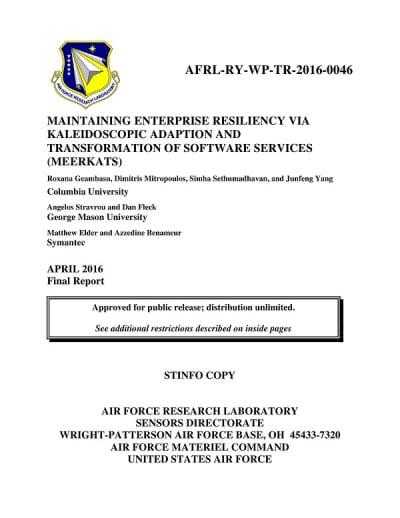
Maintaining Enterprise Resiliency Via Kaleidoscopic Adaption and Transformation of Software Services (MEERKATS)
(reference AFRL-0245) is currently available for download from the TSP library.
Don't have an account?
More From SAE Media Group
Tech Briefs
Hacker-Resistant Cloud Software System

Off-Highway Engineering
Big Data’s Benefits Keep A-Comin’
Aerospace & Defense Tech Briefs
Developing and Validating Statistical Cyber Defenses
Aerospace & Defense Tech Briefs
Cloud Security & Compliance
Off-Highway Engineering
Security, Bandwidth Drive Over-The-Air Development
Automotive Engineering
Cybersecurity Firm Enlists AI in Battle as Threats Increase
Automotive Engineering
Cybersecurity Expert Says Crowdstrike and CDK Global Incidents Serve as Wake-Up Calls

Aerospace & Defense Tech Briefs
Information Warfare: Staying Protected at the Edge
Aerospace & Defense Tech Briefs
GE Aviation Chooses Microsoft Azure to Help Drive Digital Transformation in Aviation
Automotive Engineering
'Function on Demand' Brings Opportunities, Security Challenges
Aerospace & Defense Tech Briefs
Automation Streamlines Accreditation to Speed Aerospace and Defense Technology Deployment
Tech Briefs
A ‘Smarter’ Way to Protect an Electric Grid
Aerospace & Defense Tech Briefs
AIA Predicts Flying Air Taxis, Supersonic Air Travel, and Space Industry for 2050

Off-Highway Engineering
Addressing Configuration Controls in an Era of Multiple Security Frameworks
Medical Design Briefs
Proactive Cybersecurity Saves Healthcare Organizations from Data Breaches
Aerospace & Defense Tech Briefs
Deterministic and Modular Architecture for Embedded Vehicle Systems
Automotive Engineering
Automotive Cybersecurity Needs Serious Work
Automotive Engineering
OTA Will Drive Cybersecurity Programs
Aerospace & Defense Tech Briefs
Hands-on Cybersecurity Studies: Multi-Perspective Analysis of the WannaCry Ransomware
Off-Highway Engineering
Software Needs Security, and Security Needs Software: A Scientific Overview
Automotive Engineering
Survey Reveals Cyber, Quality Challenges of Vehicle Connectivity
Off-Highway Engineering
Securing CAN Networks in Commercial Vehicles
Tech Briefs
Streaming Software Speeds Apps
Medical Design Briefs
Cybersecurity Standards for Medical Devices
Medical Design Briefs
Securing the Future of Healthcare through the Right Cybersecurity Architecture
Overview
The document titled "Maintaining Enterprise Resiliency via Kaleidoscopic Adaption and Transformation of Software Services (MEERKATS)" presents a comprehensive exploration of advanced technologies aimed at enhancing the resilience of cloud environments against a variety of threats. The report outlines a series of innovative strategies that focus on continuous change, deception, and unpredictability to bolster cloud security.
Key advancements discussed in the report include:
-
Continuous Migration Technologies: These technologies enable the rapid migration of cloud-resident services and data in response to attacks or as a proactive measure, effectively creating a moving-target defense. This approach complicates attackers' efforts by constantly altering the environment.
-
Cloud Information Flow Tracking: The report introduces technologies capable of tracking cloud-resident data at unprecedented scales, enhancing visibility and control over data flows within cloud infrastructures.
-
Misinformation and Decoy Technologies: The development of automated systems that generate deceptive information aims to confuse and mislead attackers. By creating bogus yet convincing data, these technologies can bait attackers and facilitate tracking their activities.
-
Cloud Monitoring and Self-Healing Technologies: These systems integrate data from multiple sensors to detect complex, multi-stage attacks. They are designed to respond dynamically to threats, ensuring that cloud services can recover and maintain functionality even under attack.
-
Stable Multithreading Technologies: This innovation addresses security risks associated with concurrent programming by ensuring that programs execute in a controlled manner, reducing vulnerabilities during execution.
-
Hardware-Enhanced Execution Memoization: This technique allows for efficient execution in highly replicated environments, optimizing performance while maintaining security.
The report emphasizes the importance of these technologies in creating a resilient cloud infrastructure capable of withstanding a broad spectrum of cyber threats. It highlights the collaborative efforts of researchers from Columbia University, George Mason University, and Symantec, showcasing the significance of interdisciplinary approaches in tackling complex security challenges.
Overall, the MEERKATS report serves as a vital resource for understanding the evolving landscape of cloud security and the innovative strategies being developed to enhance resilience. It underscores the necessity for continuous adaptation and transformation in software services to safeguard against emerging threats in an increasingly digital world.
Top Stories
INSIDERManufacturing & Prototyping
 How Airbus is Using w-DED to 3D Print Larger Titanium Airplane Parts
NewsAutomotive
 Microvision Aquires Luminar, Plans Relationship Restoration, Multi-industry Push
INSIDERAerospace
 A Next Generation Helmet System for Navy Pilots
INSIDERDesign
 New Raytheon and Lockheed Martin Agreements Expand Missile Defense Production
ArticlesAR/AI
 CES 2026: Bosch is Ready to Bring AI to Your (Likely ICE-powered) Vehicle
Road ReadyDesign

Webcasts
Semiconductors & ICs
 Advantages of Smart Power Distribution Unit Design for Automotive...
Unmanned Systems
 Quiet, Please: NVH Improvement Opportunities in the Early Design...
Electronics & Computers
 Cooling a New Generation of Aerospace and Defense Embedded...
Power
 Battery Abuse Testing: Pushing to Failure
AR/AI
 A FREE Two-Day Event Dedicated to Connected Mobility
