




Permeation Tests on Polypropylene Fiber Materials
Study attempts to determine if polypropylene nanofiber materials can be used in air filtration systems to remove toxic vapors.
The Toxic Industrial Chemical/Toxic Industrial Material (TIC/TIM) Task Force MFR#1 published in February 2009 focuses on inhalation hazards in an operational environment and provides a list of compounds prioritized based on toxic hazard and the likelihood of an encounter. With these types of vapor threats, cartridge-based air purifying respirators are used to protect the warfighter against chemical exposure. Traditional air purification materials often rely on porous carbons such as activated carbon or activated charcoal. Ongoing efforts seek to improve the performance of carbon materials in air purification applications as well as provide alternative materials.
For this study, polypropylene nanofiber materials provided by Apollo NanoTech Inc were evaluated for their potential use in removing vapor phase targets. A Thermolyne incubator (Compact Series 5000) was modified to conduct water vapor transport studies based on guidance provided by the ASTM E 96 protocol. Water vapor transport through a material is determined by measuring the rate of water loss through the material over a period of time.
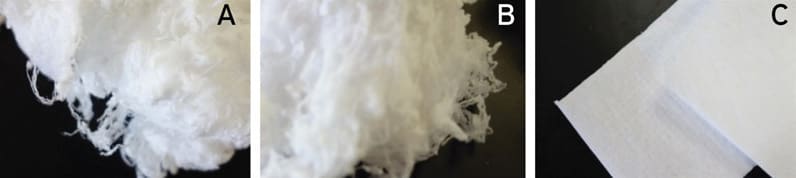
A scintillation vial (20 mL) was filled with 16.9 mL deionized water (± 0.1 mL) over which the sample material was sealed with parafilm (water 1.27 cm from sample surface). The sample was weighed and placed in the incubator. Drierite was used to lower the humidity in the incubator and a dry nitrogen stream was flowed across the surface of the sample (250 sccm). Weight measurements were collected at 30 to 45 min intervals using an analytical balance. The temperature of the incubator was 25°C (±1°C). This instrument was used to evaluate permeation of water through the various functionalized fabrics.
The temperature in the custom environmental chamber was controlled using a probe inside the chamber that adjusts an Air-Therm ATX heater. Mass flow controllers, regulated by an inline Vaisala humidity probe, governed the ratio of humid to dry air entering the chamber. An Aerosol Vapor Liquid Assessment Group (AVLAG) test cell was used for these evaluations.
The AVLAG cell was set up for single flow diffusive penetration testing using a single air or nitrogen stream. The “headspace” above the swatch was stagnant, and the differential pressure above and below the swatch was zero. A sample (2.54 × 2.54 cm) was sandwiched between two supports with 0.64 cm2 circular openings. The sample assembly was placed in the AVLAG cell and equilibrated to the desired humidity for 2h. Target was introduced by placing liquid drops on top of glass wool using a repeating dispenser. Challenge was applied to the surface of the sample in the static region of the AVLAG cell; therefore, evaporation was not a significant consideration. A direct line from the permeation cell to a dedicated FID allowed for continuous monitoring of target concentrations. The FID used Peak Simple, six-channel data acquisition software (SRI) for signal capture and peak integration. Excess flow from the direct line (above 50 mL/min) was filtered through a carbon scrubber.
Microwave modification of fabrics was used for modification of the polypropylene sheets. The initiation solution was prepared by mixing 5 mL ammonium hydroxide (28 – 30%) with 92 mL of isopropanol. To this solution, 3 mL tetraethyl orthosilicate (TEOS) was added to the ammonium hydroxide solution. The fabric substrate was fully submerged in the TEOS mixture and removed to a glass, microwave safe dish. The sample was microwaved using 1,200W for 30s. This process was repeated for a total of three cycles. Treated fabric was dried at 100°C for 30 min.
To prepare the sol, 1.9g Pluronic P123, 0.5g mesitylene, and 2.12g 1,2-bis (trimethyoxysilyl)ethane (BTE) were mixed with 16g ethanol at room temperature with a magnetic stir bar in a sealed container. At this point, 6.07g 0.1 M HNO3 was added dropwise, and stirring continued for 6h. The TEOS treated fabric was dipped into the prepared sol at a rate of 270 mm/min. The sample was hung to dry in a 60°C oven for 24h followed by drying in a vacuum oven at 60°C for an additional 24h. The fabric sample was then immersed in ethanol at 60°C for 48h to extract surfactant.
The sample was rinsed with additional ethanol and dried overnight at 60 – 65°C. To functionalize the sorbent material with primary amine groups, the fabric was submerged in a solution of 3-aminopropyltriethoxy silane (APS) in toluene at 0.5% volume/volume for 1h. Samples were then rinsed thoroughly with toluene and dried at 100°C. The porphyrin was added to this sample by submerging in a solution of 0.6 mg/mL porphyrin in 0.1 M 2-(N-morpholino) ethansulfonic acid (MES) buffer pH 5.5 with 5 mg 1-ethyl-3-(3-dimethylaminopropyl)carbodiimide (EDC). Samples were incubated overnight before rinsing thoroughly with water and drying at 100°C overnight.
Samples were evaluated using the permeation system with 2-chloroethyl ethyl sulfide (half mustard; CEES), dimethyl methylphosphonate (DMMP), and methyl salicylate (MES) as the targets. Evaluations used 1 μL of the targets. The total exposed area in the AVLAG system was 0.64 cm2 providing surface exposure concentrations of 16.7 g/m2 for CEES; 18.0 g/m2 for DMMP; and 18.3 g/m2 for MES.
This work was done by Brandy J. White, Martin H. Moore, and Brian J. Melde for the Naval Research Laboratory. NRL-0074
This Brief includes a Technical Support Package (TSP).
Permeation Tests on Polypropylene Fiber Materials
(reference NRL-0074) is currently available for download from the TSP library.
Don't have an account?
More From SAE Media Group
Aerospace & Defense Tech Briefs
SAE International Extends Call for Abstracts, Seeks Submissions for AeroTech Conference
Tech Briefs
Synthesizing Diamond From Liquid Feedstock
Tech Briefs
Turning Carbon Dioxide into Liquid Fuel
Aerospace & Defense Tech Briefs
Fast Reacting Nano-Composite Energetic Materials: Synthesis and Combustion Characterization

Automotive Engineering
Hydrogen Storage Tank Options: Not Everything Need Look like a Sausage
Tech Briefs
'Artificial Leaf' Produces Clean Gas


Aerospace & Defense Tech Briefs
Wettability Tests of Polymer Films and Fabrics


Tech Briefs
Products of Tomorrow

Aerospace & Defense Tech Briefs
Industry Invited to Participate in AeroTech Aerospace and Defense Technical Program
Tech Briefs
VaCNT Makes Up a Promising Membrane Material

Tech Briefs
Leaf-Inspired Surface Prevents Frost Formation
Battery & Electrification Technology
Crafting Safe, Long-Cyclable Lithium Metal Batteries for High Temperatures
Tech Briefs
Stretchable, Flexible Biofuel Cell Runs on Sweat

Tech Briefs
Foldable Solar Cells
Tech Briefs
How to Generate Electricity — From Rust
Sensing Technology
Low-Power Hydrogen Sensor Detects Leaks in an Instant

Overview
The document titled "Permeation Tests on Polypropylene Fiber Materials" is a memorandum report from the Center for Bio/Molecular Science and Engineering at the Naval Research Laboratory (NRL). It focuses on the evaluation of polypropylene nanofiber materials for their potential applications in air filtration, specifically for the removal of toxic vapors. The research was conducted by Brandy J. White, Martin H. Moore, and Brian J. Melde, and it spans the period from August 1, 2017, to January 24, 2018.
The report outlines the methods used to assess the water vapor transport properties of the polypropylene materials, following the ASTM E 96 protocol. A modified Thermolyne incubator was employed to measure the rate of water loss through the materials over time. The experimental setup involved sealing a sample material over a scintillation vial filled with deionized water and measuring weight changes at regular intervals. The results indicated that the permeation of water through coated and functionalized fabric samples was comparable to that of unmodified fabrics.
The primary objective of the research was to explore the feasibility of using polypropylene nanofibers in air filtration systems. The study highlighted the low cost and scalability of these polymer materials, making them suitable for modification and application in air filtration technologies. The evaluation included both independent assessments of the fiber materials and their combination with novel organosilicate sorbent materials developed by NRL.
The findings suggest that polypropylene nanofiber materials could be effective in addressing vapor threats, particularly in military and industrial contexts where air quality is critical. The report emphasizes the importance of developing materials that can efficiently filter out harmful substances from the air, contributing to enhanced safety and health standards.
In conclusion, this memorandum report provides a comprehensive overview of the methodologies and findings related to the permeation tests on polypropylene fiber materials. It underscores the potential of these materials in air filtration applications, paving the way for future research and development in this area. The report is unclassified and approved for public release, ensuring that the insights gained can benefit a wider audience interested in advancements in material science and engineering.
Top Stories
INSIDERLighting Technology
 Using Ultrabright X-Rays to Test Materials for Ultrafast Aircraft
INSIDERManufacturing & Prototyping
 New 3D-Printable Nanocomposite Prevents Overheating in Military Electronics
INSIDERDefense
 F-22 Pilot Controls Drone With Tablet
Technology ReportAR/AI
 Talking SDVs and Zonal Architecture with TE Connectivity
INSIDERManufacturing & Prototyping
 New Defense Department Program Seeks 300,000 Drones From Industry by 2027
INSIDERAerospace
 Anduril Completes First Semi-Autonomous Flight of CCA Prototype
Webcasts
Test & Measurement
 SAE Automotive Engineering Podcast: Additive Manufacturing
Information Technology
 A New Approach to Manufacturing Machine Connectivity for the Air Force
Automotive
 Optimizing Production Processes with the Virtual Twin
Power
 EV and Battery Thermal Management Strategies
Manufacturing & Prototyping
 How Packet Digital Is Scaling Domestic Drone Battery Manufacturing
Automotive
 Advancements in Zinc Die Casting Technology & Alloys for Next-Generation...