




Wettability Tests of Polymer Films and Fabrics
Testing methods prove that plasma-modified films have altered surface chemistry to be more hydrophilic.
High-strength polymer materials are useful components in many multifunctional materials applications. However, because of low reactivity, their use is inhibited in many processing techniques. Polymer films and fibers possess low surface energies and need to be modified through surface activation prior to being used in composite systems where adhesive bonding is an issue. Treatment of polymer materials through plasma processing is one route to greatly increase surface reactivity. Once the surface has been plasma-modified, wettability by liquids can be examined to determine the treatment effects on the polymer material’s surface reactivity.
The atmospheric plasma system used for the surface treatments was an industrial scale plasma system from Sigma Technologies. The gases (He and He-O2) were injected into the electrode at atmospheric pressure and allowed to diffuse, forming a filamentary glow discharge. Helium is typically used to initiate and generate the plasma at atmospheric pressure before another gas is introduced into the system. The operation frequency was 90 kHz with an operating power of 1050 W.
UHMWPE fibers (with an average diameter of 100μm), UHMWPE films (Goodfellow, 75 μm thick), and nylon-6 films (Goodfellow, 75 mm thick) were exposed to the plasma created between the just described electrode and a second electrode covered by an alumina layer.
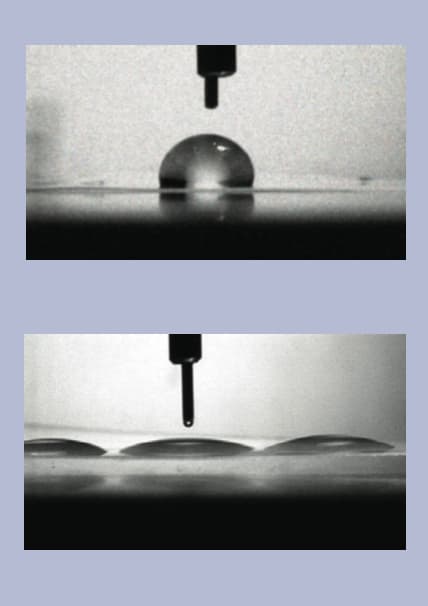
Wettability testing was carried out using one of two methods. For films, a static contact-angle setup using the sessile drop method was used. The setup consists of a micrometer-controlled syringe held in place above a moveable stage. Contact angles were recorded using a goniometer equipped with a charge-coupled-device camera and using an image capture program employing LabVIEW software. Contact angles were measured by defining a circle around the drop, and recording the tangent angle formed at the substrate surface. The LabVIEW program measures this angle on the left and right sides of the snapshot and then averages them for a final contact-angle value.
For static contact-angle measurements on films, small strips (5 × 1 cm) of the sample film are cut and placed onto a glass microscope slide using double-sided tape to ensure a flat viewing surface. The glass slide is placed onto the stage were a 5-μL drop is measured out from the syringe and dropped onto the film surface. The drop is allowed to reach equilibrium before the measurement is recorded and before evaporation occurs. Once the drop has been measured, the slide is moved to allow another drop to be placed on the sample surface. Between three and five drops are used for each sample, with the values being averaged for the final contact-angle value. This exact process was then repeated using methylene iodide, ethanol, and formamide. These liquids were chosen to cover a wide range of polarity.
Results obtained from the control films were compared with those of the plasma-modified surfaces, proving that the surface chemistry is altered and more hydrophilic surfaces are formed through plasma exposure.
This work was done by Daphne Pappas, Craig Copeland, and Robert Jensen of the Army Research Laboratory. ARL-0070
This Brief includes a Technical Support Package (TSP).
Wettability Tests of Polymer Films and Fabrics
(reference ARL-0070) is currently available for download from the TSP library.
Don't have an account?
More From SAE Media Group
Aerospace Manufacturing and Machining
Optimizing Plasma Treatments to RESOLVE Challenging Adhesion Issues
Aerospace & Defense Tech Briefs
Development of Hydrophobic Coatings for Water-Repellent Surfaces Using Hybrid Methodology
Tech Briefs
Synthesizing Diamond From Liquid Feedstock
Tech Briefs
Improved Silica Aerogel Composite Materials
Aerospace & Defense Tech Briefs
Permeation Tests on Polypropylene Fiber Materials


Medical Design Briefs
Adhesive Bonding of Plastics in Medical Devices, Part 2: Material Properties of Plastics

Tech Briefs
Composite Silica Aerogels Opacified With Titania

Medical Design Briefs
Thermally Engineering Templates for Highly Ordered Self-Assembled Materials


Sensing Technology
Low-Power Hydrogen Sensor Detects Leaks in an Instant

Medical Design Briefs
Transforming Plastic Parts into High-Value Products
Tech Briefs
Tools to Prepare Aluminum Surfaces for Bonding

Medical Design Briefs
The Use of Parylene-Coated Mandrels in the Balloon Catheter Manufacturing Process
Medical Design Briefs
Plasma Treatment: Transforming Plastic Parts into High-Value Products

Tech Briefs
Self-Growing 3D Objects
Medical Design Briefs
Effects of Surface Preparation on Medical Silicone Adhesive Performance


Overview
The document titled "Wettability Tests of Polymer Films and Fabrics and Determination of Their Surface Energy by Contact-Angle Methods" is a progress report authored by Daphne Pappas, Craig Copeland, and Robert Jensen, published by the U.S. Army Research Laboratory in March 2007. The report covers research conducted between June and December 2006, focusing on the wettability characteristics of nylon-6 and polyethylene films, as well as ultra-high molecular weight polyethylene (UHMWPE) woven fabrics.
The primary objective of the study is to investigate the effects of surface atmospheric plasma treatment on the wettability of these materials. Wettability is a critical property that influences how liquids interact with solid surfaces, which is essential for applications in coatings, adhesives, and other material interactions. The report outlines the methodologies employed for wettability testing, particularly using the Wilhelmy balance setup, which involves measuring the force exerted on a fabric strip as it is immersed in a liquid. This method allows for precise determination of the contact angle, which is a key indicator of surface energy.
The document is structured into several sections, including an introduction, experimental methods, results, conclusions, and references. The experimental section details the plasma modification techniques used to alter the surface properties of the polymer films and fabrics, followed by a description of the wettability testing procedures. The results section presents findings on how different treatments affect the surface energy and wettability of the materials tested.
The conclusions drawn from the research highlight the significance of atmospheric plasma treatment in enhancing the wettability of the tested polymers, suggesting potential applications in various fields where improved adhesion and interaction with liquids are desired. The report emphasizes the importance of understanding surface energy in the context of material performance and functionality.
Overall, this document serves as a comprehensive resource for researchers and practitioners interested in the field of polymer science, particularly in the areas of surface modification and wettability assessment. It provides valuable insights into the methodologies and implications of surface energy in practical applications, contributing to the advancement of material technologies.
Top Stories
INSIDERManufacturing & Prototyping
 How Airbus is Using w-DED to 3D Print Larger Titanium Airplane Parts
INSIDERManned Systems
 FAA to Replace Aging Network of Ground-Based Radars
NewsTransportation
 CES 2026: Bosch is Ready to Bring AI to Your (Likely ICE-powered) Vehicle
NewsSoftware
 Accelerating Down the Road to Autonomy
EditorialDesign
 DarkSky One Wants to Make the World a Darker Place
INSIDERMaterials
 Can This Self-Healing Composite Make Airplane and Spacecraft Components Last...
Webcasts
Defense
 How Sift's Unified Observability Platform Accelerates Drone Innovation
Automotive
 E/E Architecture Redefined: Building Smarter, Safer, and Scalable...
Power
 Hydrogen Engines Are Heating Up for Heavy Duty
Electronics & Computers
 Advantages of Smart Power Distribution Unit Design for Automotive...
Unmanned Systems
 Quiet, Please: NVH Improvement Opportunities in the Early Design...
