




NASA Takes Aviation Research to the ‘Max’
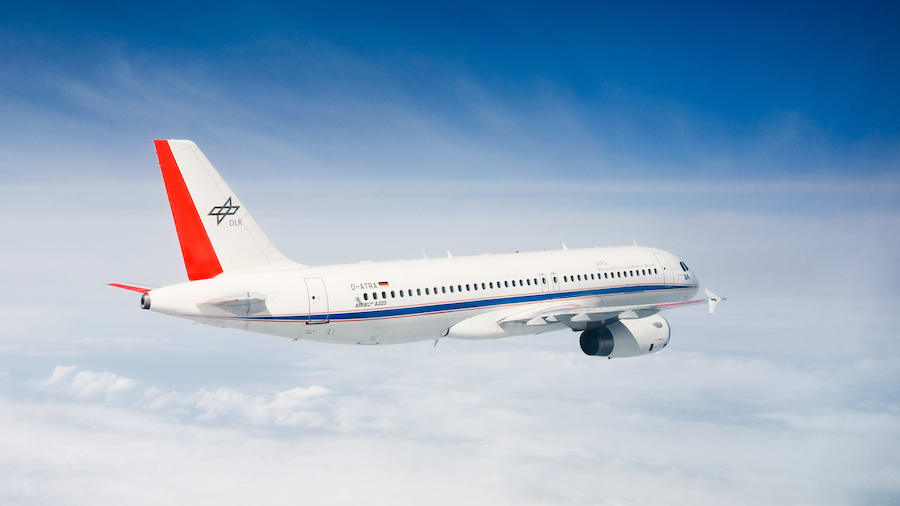
NASA and the German Aerospace Center (DLR) are studying what happens with engine performance, emissions, and contrail formation when using different types of fuels in jet engines. The international collaboration uses Germany’s Advanced Technology Research Aircraft (ATRA) A320 aircraft burning alternative biofuels, while NASA’s fully instrumented DC-8 Flying Laboratory trails a safe distance behind, sampling and analyzing gases and particles within the ATRA’s wake.
Contrails, and the solar-radiation-reflecting cirrus clouds that evolve from them, have a larger impact on Earth’s climate than all the aviation-related carbon dioxide emissions since the first powered flight by the Wright brothers in 1903.
More From SAE Media Group

Aerospace INSIDER
NASA Tests Alternative Jet Engine Fuels

Aerospace INSIDER
NASA Aims for Climate-Friendly Aviation
Aerospace INSIDER
Why Hybrid-Electric is a Key Solution for Decarbonizing Aviation
Tech Briefs
Preventing Gridlock on the Ground
Aerospace INSIDER
Four Quantum Computing Aviation Applications Being Researched by Airbus


Tech Briefs
How Jet Engine Flow Can Be Controlled Optically


Aerospace & Defense Tech Briefs
The New Airbus Wingman Aircraft
Aerospace Manufacturing and Machining INSIDER
New Reverse Bleed System for LEAP-1A Engines is Ready to Fly
Aerospace & Defense Tech Briefs
New Research on Noise Reduction for Next Generation Aircraft Engines
Tech Briefs
How Much Do You Know About Jet Engines?
Aerospace INSIDER
Wing Configuration Could Reduce Fuel Consumption
NASA Spinoff
An Electronic Traffic Monitor for Airports
NASA Spinoff
Flying (Not Quite) Blind
Aerospace INSIDER
Delta Air Lines, JetZero to Design Commercial Blended Wing Body Airliner


Aerospace INSIDER
NASA and Boeing Partner to Advance Aviation
NASA Spinoff
From Shark Searches to Space Tours

NASA Spinoff
Artificial Eyes Give Pilots a New Worldview
Top Stories
NewsRF & Microwave Electronics
 Microvision Aquires Luminar, Plans Relationship Restoration, Multi-industry Push
INSIDERAerospace
 A Next Generation Helmet System for Navy Pilots
INSIDERDesign
 New Raytheon and Lockheed Martin Agreements Expand Missile Defense Production
INSIDERMaterials
 How Airbus is Using w-DED to 3D Print Larger Titanium Airplane Parts
NewsPower
 Ford Announces 48-Volt Architecture for Future Electric Truck
ArticlesAR/AI

Webcasts
Electronics & Computers
 Cooling a New Generation of Aerospace and Defense Embedded...
Automotive
 Battery Abuse Testing: Pushing to Failure
Power
 A FREE Two-Day Event Dedicated to Connected Mobility
Unmanned Systems
 Quiet, Please: NVH Improvement Opportunities in the Early Design Cycle
Automotive
 Advantages of Smart Power Distribution Unit Design for Automotive &...
Energy
 Sesame Solar's Nanogrid Tech Promises Major Gains in Drone Endurance