




GKN Expands Production Line for Additive Fabrication of A220 Engine Component
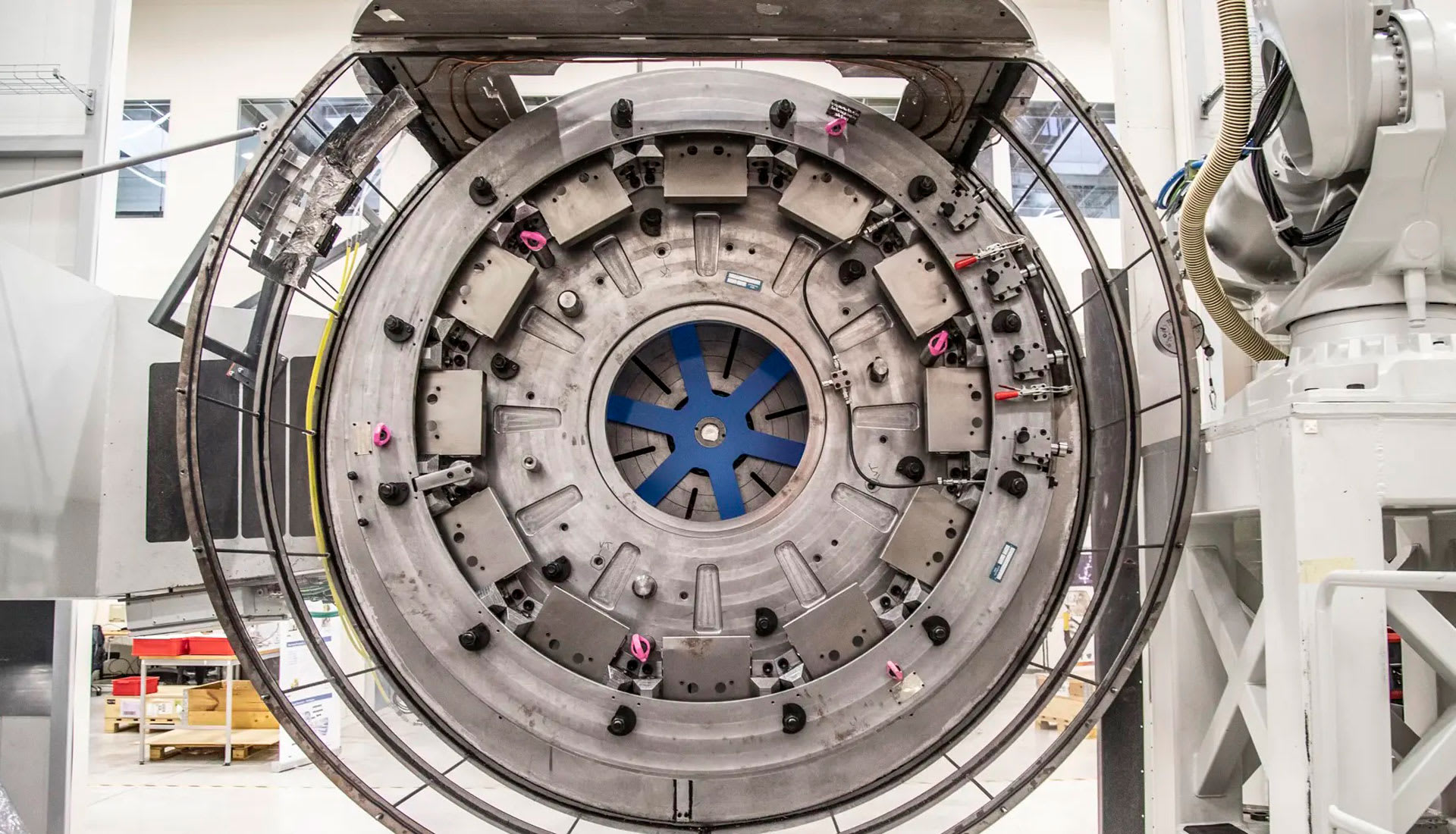
GKN Aerospace announced the expansion of its Newington, Connecticut facility, bringing a new production line dedicated to additive fabrication of the Fan Case Mount Ring (FCMR), a critical component of the Pratt & Whitney GTF engine powering the Airbus’ A220 and Embraer’s E195-E2 jet. The expansion will create new jobs and further strengthens GKN Aerospace’s presence in the U.S.
The FCMR program recently became the largest flight-critical additive component to achieve Federal Aviation Administration (FAA) certification and is on track for 100 percent serial production by the end of 2025. The component’s core structure, the additively fabricated ‘hot size ring’, is already being delivered from GKN Aerospace’s Trollhättan facility in Sweden, with final machining completed in Newington. The expansion will support production ramp-up as well as helping to meet wider market demand.
GKN Aerospace’s proprietary additive fabrication process reduces material consumption, shortens production lead times, and is projected to achieve over 70 percent material savings. Critically, it will also help to strengthen global supply chains, by offering and alternative production method.
"This expansion in Connecticut marks a major milestone for GKN Aerospace and our Fan Case Mount Ring program. The combination of strong local support, the highly skilled workforce and the availability of an aerospace network and infrastructure here allows us to bring our latest additive fabrication technology into industrial-scale production, creating jobs and supporting our long-term relationship with Pratt & Whitney," said Joakim Andersson, President of GKN's Engines Division. "We are proving that additive fabrication is not only technically transformative but also delivers real-world benefits in sustainability, lead-time and predictability for our customers."
The expansion of the Connecticut facility follows other additively fabricated FCMR production updates shared by GKN earlier this year.
With their additively manufactured FCMR now in serial production, and key additive insertion activities for GE Aerospace now also underway, current results demonstrate around 40 percent material waste reduction per part compared to traditional manufacturing methods. In the future, GKN Aerospace expects to achieve more than 70 percent material savings, while reducing end-to-end lead times from nine months to as little as four weeks.
In the past 12 months, GKN Aerospace has achieved several key additive certification and technology milestones. These include FAA approval for its first additively fabricated critical structural component and successful manufacturing of its largest ever all-additive component: a large-scale, titanium engine case for the CFMI RISE technology demonstrator. Produced using fully automated direct energy deposition, the structure met casting-quality standards and demonstrated the full design and build potential of large-scale additive fabrication.
"Today we already produce around 30 FCMR units per month at our Trollhättan facility. Expanding our cutting-edge technology, developed in Sweden, to the U.S. will support the full volume of FCMR production in one place. As well as ramping up our production for the FCMR, it will also enable us to expand our additive fabrication offering to other customers in the USA," said Sébastien Aknouche, Senior Vice President of Material Solutions, GKN Aerospace.
This expansion will accelerate from 2026 due to the modular additive fabrication production concept, which enables the rapid deployment of the technology in other sites globally.
More From SAE Media Group
Aerospace Manufacturing and Machining INSIDER
New Reverse Bleed System for LEAP-1A Engines is Ready to Fly
Aerospace & Defense Tech Briefs
Government, Industry Invest $450M to Advance U.K. Civil Aerospace Research, Technology, Manufacturing



Aerospace INSIDER
How Aerospace Manufacturers are Adjusting to Ongoing Tariff Changes

Aerospace Manufacturing and Machining INSIDER
Navy Uses Stratasys F-900 to 3D Print F/A-18 Jet’s Button Plug

Aerospace INSIDER
FAA to Replace Aging Network of Ground-Based Radars
Aerospace Manufacturing and Machining INSIDER
How Airbus is Using w-DED to 3D Print Larger Titanium Airplane Parts
Aerospace & Defense Tech Briefs
Updated High-Pressure Turbine Kit for A320neo Engine
Aerospace & Defense Tech Briefs
Industry Invited to Participate in AeroTech Aerospace and Defense Technical Program
Aerospace & Defense Tech Briefs
Air Force Begins 3D Printing Nonstructural Aircraft Parts
Aerospace & Defense Tech Briefs
Lockheed Martin and Arconic Collaborate on 3D Printing and Advanced Aerospace Materials
Aerospace Manufacturing and Machining INSIDER
Airbus Announces Expansion of Aircraft Manufacturing in the U.S.
Aerospace INSIDER
Are Boeing 737 Rudder Control Systems at Risk of Malfunctioning?

Aerospace & Defense Tech Briefs
FAA, SAE International Focus on Engine Fire Protection System Standards for Aerospace
Aerospace INSIDER
Boeing Adopts New Airplane Manufacturing Quality and Safety Metrics

Aerospace Manufacturing and Machining INSIDER
Meeting the Demands of Defense Production and Sustainment Through Additive Manufacturing

Aerospace & Defense Tech Briefs
3D Printing Aerodynamic Improvements

Aerospace & Defense Tech Briefs
SAE International Issues First Technical Standards for Aerospace Additive Manufacturing
Aerospace INSIDER
Delta Air Lines, JetZero to Design Commercial Blended Wing Body Airliner


Aerospace INSIDER
Archer Achieves First Untethered Flight with Midnight eVTOL
Top Stories
NewsRF & Microwave Electronics
 Microvision Aquires Luminar, Plans Relationship Restoration, Multi-industry Push
INSIDERAerospace
 A Next Generation Helmet System for Navy Pilots
INSIDERDesign
 New Raytheon and Lockheed Martin Agreements Expand Missile Defense Production
INSIDERMaterials
 How Airbus is Using w-DED to 3D Print Larger Titanium Airplane Parts
NewsPower
 Ford Announces 48-Volt Architecture for Future Electric Truck
ArticlesAR/AI

Webcasts
Electronics & Computers
 Cooling a New Generation of Aerospace and Defense Embedded...
Automotive
 Battery Abuse Testing: Pushing to Failure
Power
 A FREE Two-Day Event Dedicated to Connected Mobility
Unmanned Systems
 Quiet, Please: NVH Improvement Opportunities in the Early Design Cycle
Automotive
 Advantages of Smart Power Distribution Unit Design for Automotive &...
Energy
 Sesame Solar's Nanogrid Tech Promises Major Gains in Drone Endurance