




Measuring Propellant Stress Relaxation Modulus Using Dynamic Mechanical Analyzer
New testing technique requires less material, gives more accurate results.
Structural analysis of solid rocket motors is challenging for several reasons, but the most important of these is the complex behavior of the propellant. The mechanical response of a solid propellant is time and temperature dependent. The complexity of the mathematical analysis of the propellant depends on the loading conditions, but for some loading situations, the linear viscoelasticity assumption is reasonable. In particular, linear viscoelasticity is perhaps the most appropriate material behavior description for use in the simulations of stresses related to storage conditions. Typically, simulations use a viscoelastic model in the form of a Prony series and a Williams–Landel–Ferry (WLF) equation. The parameters in these models are derived from stress relaxation experiments, making the stress relaxation experiment a key viscoelastic test, analogous to the tensile test for linear elastic materials.
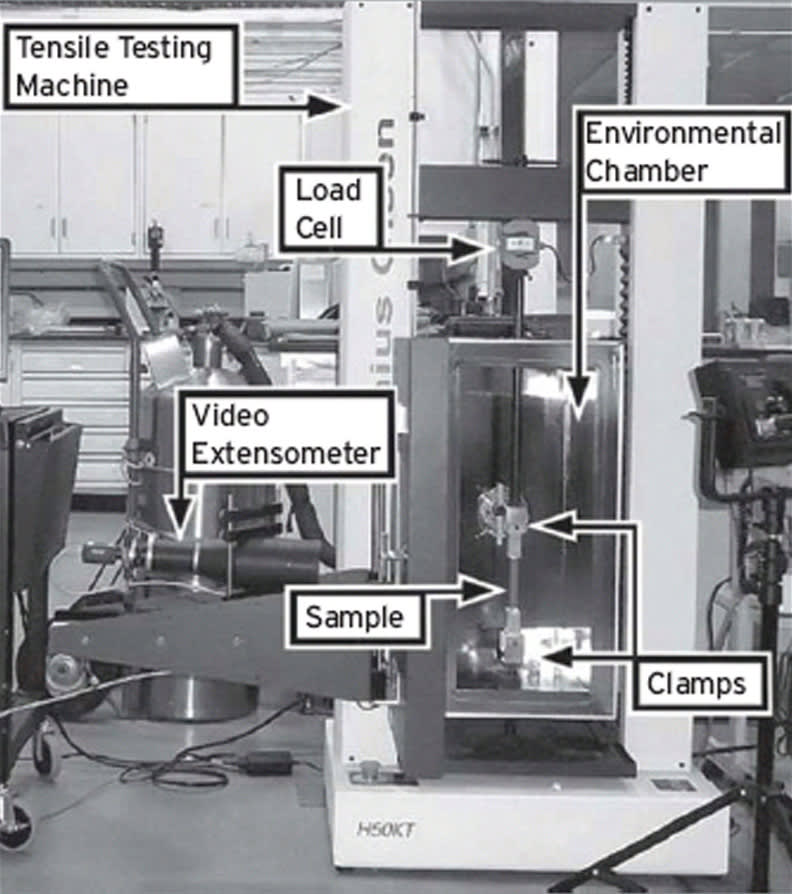
A typical set of stress relaxation tests is performed at several discrete temperatures that cover a range of temperatures anticipated by the fielded motor. At each of the selected temperatures, the specimen is deformed with approximately a single step in strain, which is then held constant for the duration of the test. While held at this constant strain, the stress decays over time due to relaxation of the rubbery elastomer. During this portion of the test, the stresses are measured, and the ratio of stress to applied strain is determined. This ratio is termed the stress relaxation modulus ER. Using time–temperature superposition, the set of curves at the various temperatures can be shifted horizontally relative to each other to form a master curve. The translation of the curves takes a specific mathematical form, viz., the WLF equation. From this master curve, the Prony series at any given temperature can be calculated, and the calculation can be incorporated into finite element analyses along with the WLF equation, making linear viscoelastic analysis of rocket motors possible.
The Prony series is a common method of approximating the behavior of a viscoelastic material. Various algebraic representations are available, but one of the simplest forms is given by: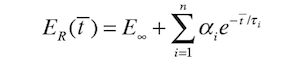
Here, ⊺ refers to reduced time, meaning the test time divided by the horizontal shift factor aT. The variable ER is the relaxation modulus, E∞ is the long-term relaxation modulus, and the n exponential terms each have a coefficient αi and an exponential constant τi. The relaxation modulus is therefore represented as a sum of a series of exponential terms, each with its own time constant, so that the entire spectrum of relaxation times and temperatures is well represented.
To determine the unknown parameters E∞, αi, and τi (i=1, 2,…, n), the horizontal shift function is first determined using the WLF equation. This is necessary to obtain the reduced time ⊺ then, numerical methods are employed to derive the Prony series parameters. Typically, E∞ is estimated from the data, and then the time constants τi are chosen arbitrarily, but each a decade apart in time. Next, a least-squares fit of the master curve data to the above equation determines the unknown values for the coefficients αi. These parameters are then incorporated into a finite element program for subsequent analysis of solid rocket motor grains.
The horizontal shift factor aT is determined by the Williams–Landel–Ferry equation:
Here, the horizontal shift factor aT is determined from the shifting of the individual stress relaxation curves relative to a reference curve (in this case, the curve for 20°C), T is the test temperature, Tref is the temperature of the reference curve, and C1 and C2 are parameters determined from a least-squares fit of the horizontal shift data.
Stress relaxation tests of propellant are currently performed on standard tensile testing machines, and the specimens are subjected to uniaxial stress conditions. Because the propellant is very compliant, the applied strain has to be large; otherwise, the loads would be too small to measure accurately, unless an atypical load cell were used (i.e., an atypical load cell that is not very compatible with commercial tensile testing hardware). Typically, the applied strains will be in the 1–10% range. At these strains, damage is likely occurring due to dewetting of the particulate matter. Therefore, specimens are only used at a single temperature. Because of these considerations, generating a typical master curve requires 18–30 specimens (assuming three to five specimens per temperature and six temperatures).
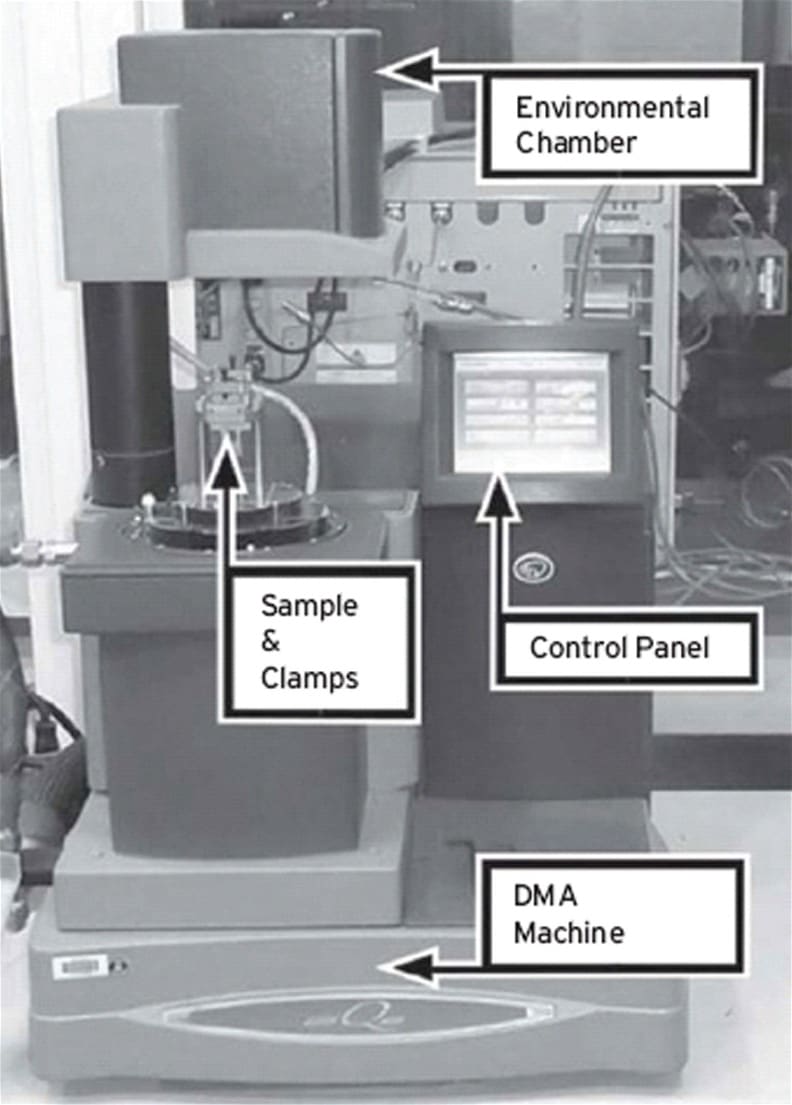
Specimens were also tested in a dynamic mechanical analyzer, using a dual cantilever beam mode. While the results were similar, the dynamic mechanical analyzer required less material, resulted in reduced variability, and was not sensitive to the applied strain. The quantity of material required was on the order of grams, so that results were obtained with small amounts of propellant, as compared to the conventional uniaxial tension test that requires material quantities on the order of kilograms.
This work was done by Timothy C. Miller, C. S. Wojnar, and J. A. Louke for the Air Force Research Laboratory. AFRL-0253
This Brief includes a Technical Support Package (TSP).
Measuring Propellant Stress Relaxation Modulus Using Dynamic Mechanical Analyzer
(reference AFRL-0253) is currently available for download from the TSP library.
Don't have an account?
More From SAE Media Group
Aerospace & Defense Tech Briefs
Zwick Roell Provides Flexible Materials Testing over a Wide Temperature Range
Aerospace & Defense Tech Briefs
Industry Invited to Participate in AeroTech Aerospace and Defense Technical Program
Aerospace & Defense Tech Briefs
Multi-Scale Analysis of Deformation and Failure in Polycrystalline Titanium Alloys Under High Strain Rates
Aerospace & Defense Tech Briefs
Peridynamic Modeling: An Alternative Approach to Analyzing Material Failure
Aerospace & Defense Tech Briefs
SAE International Issues, Revises Technical Reports for Aerospace Engineering
Aerospace & Defense Tech Briefs
Fluorosilicones

Medical Design Briefs
Impact-Modified Acrylic Copolymers: Evaluating Chemical Resistance
Tech Briefs
Extrans Permeation Measurement System
Medical Manufacturing and Machining
Integrating Vision and Force Measurement into Medical Quality Control
Aerospace & Defense Tech Briefs
Thermal Simulation and Testing of Expanded Metal Foils for Lightning Protection
Aerospace & Defense Tech Briefs
Combustion Characteristics of Hydrocarbon Droplets Induced by Photoignition of Aluminum Nanoparticles
Off-Highway Engineering
Putting Lightweighting to the Test
Tech Briefs
Cord Tension Measurement Device
Aerospace & Defense Tech Briefs
Ruggedizing Coaxial and Fiber Optic Cable Assemblies from Mechanical Strain
Tech Briefs
Nano/Micro Mechanical Environmental Test Cell
Aerospace & Defense Tech Briefs
Redesign of composite parts for structural integrity
Aerospace & Defense Tech Briefs
SAE International Extends Call for Abstracts, Seeks Submissions for AeroTech Conference
NASA Spinoff
Analytic Tool Simplifies Metal Fracture Assessments

Motion Design INSIDER
Autonomous Structures Can Be Programmed to Jump Days in Advance


Aerospace & Defense Tech Briefs
Ensure Aerospace Composite Quality with Force Measurement, Material Testing

Aerospace & Defense Tech Briefs
Streamlining Advanced Composites Testing


Tech Briefs
Rocket Nozzle Side-Load Analysis Software
Aerospace & Defense Tech Briefs
Advances in Adhesive Joining of Structural Components Focus of New Book from SAE International
Overview
The document presents a study on measuring the stress relaxation modulus of solid rocket propellants using a Dynamic Mechanical Analyzer (DMA). Conducted by Timothy C. Miller and colleagues at the Air Force Research Laboratory, the research addresses the complexities involved in the structural analysis of solid rocket motors, particularly due to the time and temperature-dependent behavior of solid propellants.
The study emphasizes the importance of stress relaxation tests, which are crucial for understanding the viscoelastic properties of propellants. Traditional methods of measuring stress relaxation often require larger strains, leading to nonlinear behavior and damage to the specimens. In contrast, the DMA approach allows for smaller deformations, ensuring that tests remain within the linear viscoelastic range. This method not only improves the accuracy of measurements but also reduces the number of specimens needed for testing, resulting in significant cost and time savings.
The document outlines the process of conducting stress relaxation tests at various temperatures, where specimens are subjected to a constant strain and the resulting stress decay is measured over time. The stress relaxation modulus (E_R) is derived from these measurements, and the data can be represented using a Prony series and the Williams–Landel–Ferry (WLF) equation. This enables the creation of a master curve that encapsulates the material's behavior across different temperatures.
One of the key advantages of the DMA method is the ability to use a single specimen for multiple temperature tests, as opposed to conventional methods that require multiple specimens due to damage from larger strains. This not only conserves materials but also facilitates research efforts involving aging programs and propellant development, allowing for smaller batch sizes and safer handling of expensive ingredients.
The study also highlights the implications of improved stress relaxation measurements on service life predictions for rocket motors. By enhancing the accuracy of input data for Monte Carlo simulations, manufacturers can better predict the remaining service life of motor fleets, ultimately leading to safer and more reliable rocket motor designs.
In summary, this research provides a significant advancement in the understanding and measurement of solid propellant behavior, offering a more efficient and accurate approach to assessing the viscoelastic properties critical for the performance and safety of solid rocket motors.
Top Stories
INSIDERManufacturing & Prototyping
 How Airbus is Using w-DED to 3D Print Larger Titanium Airplane Parts
INSIDERManned Systems
 FAA to Replace Aging Network of Ground-Based Radars
NewsTransportation
 CES 2026: Bosch is Ready to Bring AI to Your (Likely ICE-powered) Vehicle
NewsSoftware
 Accelerating Down the Road to Autonomy
EditorialDesign
 DarkSky One Wants to Make the World a Darker Place
INSIDERMaterials
 Can This Self-Healing Composite Make Airplane and Spacecraft Components Last...
Webcasts
Defense
 How Sift's Unified Observability Platform Accelerates Drone Innovation
Automotive
 E/E Architecture Redefined: Building Smarter, Safer, and Scalable...
Power
 Hydrogen Engines Are Heating Up for Heavy Duty
Electronics & Computers
 Advantages of Smart Power Distribution Unit Design for Automotive...
Unmanned Systems
 Quiet, Please: NVH Improvement Opportunities in the Early Design...
