




Researchers Test Minuteman III Intercontinental Ballistic Missile
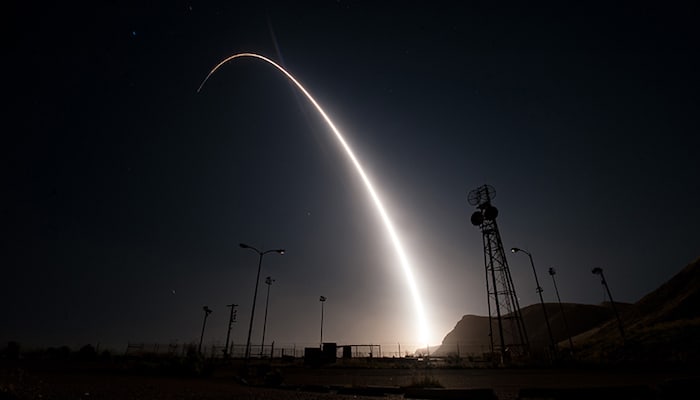
As an unarmed Minuteman III intercontinental ballistic missile (ICBM) rocketed into the night sky, a team of Lawrence Livermore National Laboratory (LLNL) researchers listened intently to radio chatter and watched flight data stream in from a control room at the Ronald Reagan Ballistic Missile Defense Test Site. It was the first of two flight tests conducted recently to verify that the system could deliver a payload to target.
The LLNL team was on hand to grade the exercise, using a one-of-a-kind diagnostic suite they developed and fielded to take real-time measurements of the approximately 4,200-mile flight. Within the hour, they delivered diaognostic results to the Department of Defense. LLNL Flight Test Program Director Steve Jensen said the LLNL fielded diagnostics performed extremely well.
"We consider tests like this an invaluable part of our confidence basis," Jensen said. "It gives us critical information on how the systems respond in real environments."
The tests took place April 26 and May 2, with the ICBMs traveling from their Vandenberg Air Force Base launch site in California to the waters off the Kwajalein Atoll in the Marshall Islands, near the Ronald Reagan Ballistic Missile Defense Test Site.
In addition to scoring tests like this, LLNL researchers are responsible for the W87 thermonuclear warhead that would be the payload for the Minuteman III ICBM, if ever used in a real-world scenario. These flight tests carried a mock payload, but Jensen noted that the data gathered will help his LLNL colleagues validate computer models that are critical to certifying the safety, reliability and effectiveness of the U.S. nuclear deterrent in a post-testing world. This assessment takes place on an annual basis as part of the Stockpile Stewardship Program, culminating in a letter from laboratory directors to the president regarding the current assessed condition of the nuclear stockpile.
"This is the closest we'll get to fielding a warhead in a test," Jensen said. "LLNL, Sandia and the Air Force all have a significant interest in these tests."
The tests were collaborative efforts between the Air Force and the National Nuclear Security Administration, with Lawrence Livermore and Sandia National laboratories, Pantex, Y12 and the Kansas City National Security Campus all playing key roles.
More From SAE Media Group
Defense INSIDER
Lab-Designed Instrumentation Flies Aboard Unarmed Missile


Defense INSIDER
Sandia-Led Team Helps Extend Life of B61 Nuclear Deterrent
Aerospace INSIDER
F-35 Proves Nuke Drop Performance in Stockpile Flight Testing
Defense INSIDER
Warhead Life-Extension Program Passes Key Milestone
Defense INSIDER
Sandia Works on Nuclear Weapon Life Extension Program
Defense INSIDER
Patriot Missile Hits Target in Test of Upgraded ICBS Radar

Defense INSIDER
Kauai Test Facility Launches Its Largest Missile
Defense INSIDER
How to Dismantle a Nuclear Bomb
Aerospace & Defense Tech Briefs
Missile Defense Battle Manager
Defense INSIDER
Hypersonic Glide Vehicle Successfully Tested
Defense INSIDER
Drop of Mock Nuclear Weapon Is First of New Flight Tests


Defense INSIDER
Nuclear Bomb Proves Compatible With F-15E Strike Eagle
Aerospace & Defense Tech Briefs
Missile Protection System
Defense INSIDER
Sandia Labs Takes Modern Approach to Evaluating Nuclear Weapons
Aerospace INSIDER
Air Force Expands Missile Signature Characterization Capabilities
Aerospace & Defense Tech Briefs
Laser Guided Rocket System
Aerospace Manufacturing and Machining INSIDER
Counter UAS Systems Tested Against Swarms of 50 Drones in Latest Yuma Exercise
Defense INSIDER
Novel Instrument Enhances Ability to Measure Nuclear Materials
Aerospace INSIDER
Anduril Completes First Semi-Autonomous Flight of CCA Prototype
Aerospace INSIDER
The B-21 Raider Starts Flight Testing

Defense INSIDER
Friendly Electromagnetic Pulse Improves Survival for Electronics
Aerospace & Defense Tech Briefs
Next Generation Air and Missile Defense Radar
Top Stories
NewsRF & Microwave Electronics
 Microvision Aquires Luminar, Plans Relationship Restoration, Multi-industry Push
INSIDERAerospace
 A Next Generation Helmet System for Navy Pilots
INSIDERDesign
 New Raytheon and Lockheed Martin Agreements Expand Missile Defense Production
INSIDERMaterials
 How Airbus is Using w-DED to 3D Print Larger Titanium Airplane Parts
NewsPower
 Ford Announces 48-Volt Architecture for Future Electric Truck
ArticlesAR/AI

Webcasts
Electronics & Computers
 Cooling a New Generation of Aerospace and Defense Embedded...
Automotive
 Battery Abuse Testing: Pushing to Failure
Power
 A FREE Two-Day Event Dedicated to Connected Mobility
Unmanned Systems
 Quiet, Please: NVH Improvement Opportunities in the Early Design Cycle
Automotive
 Advantages of Smart Power Distribution Unit Design for Automotive &...
Energy
 Sesame Solar's Nanogrid Tech Promises Major Gains in Drone Endurance