




High-Speed, Autonomous Surface Patrol Capability Demonstrated
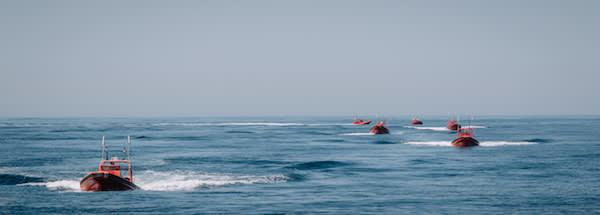
After a year of internal research and development, the Johns Hopkins University Applied Physics Laboratory in Laurel, Maryland, recently conducted a large, at-sea demonstration of swarming unmanned surface vessels (USV). The experiment — done in collaboration with the Surface Targets Branch of the Naval Air Warfare Center Weapons Division, Port Hueneme, California — was designed to advance the state of the art of collaborative, autonomous USV behaviors to higher speeds and a larger numbers of vessels.
The successful demonstration involved six surface target boats operating together at high speeds, using hardware and software that APL developed and integrated with the reliable boat control system created by the Surface Targets Branch.
“To our knowledge, this represents the first time that six autonomous vessels have ‘swarmed’ at tactically relevant speeds,” said Jim Horris, APL program manager for Autonomy Test and Evaluation. “And the joint team implemented a full safety protocol without the need for additional safety boats.”
The demonstration scenario was an unmanned patrol of a restricted maritime area such as a range or marine preserve. The boats traveled at speeds up to 35 knots to execute fully autonomous behaviors such as cooperative persistent search, target detection and tracking, rendezvous, pursuit and escort.
The surface vessel control system, employed throughout the fleet of high-speed surface targets worldwide and refined over the last 15 years by the Surface Targets Branch, provided a distinct advantage during integration and testing. The operator control station software developed by APL and coupled with the Navy system allowed safe, broad command and control capabilities as well as “on-the-fly” mission planning.
In addition to achieving this milestone capability, the demonstration provided great insight into the challenges of swarming at high speeds, as well as changes needed by the testing community to establish the operational “trust” necessary for adoption of autonomous systems. APL is exploring next steps with the Navy and other Department of Defense stakeholders to incorporate the technology into operations and related development programs.
More From SAE Media Group

Aerospace & Defense Tech Briefs
Enabling Off-the-Shelf Autonomous Naval Warfare
Aerospace & Defense Tech Briefs
Navy to Evaluate Three Large Displacement Unmanned Underwater Vehicle Prototypes
Aerospace & Defense Tech Briefs
DoD to Deploy Thousands of Low Cost Autonomous Systems Under Replicator Program
Aerospace & Defense Tech Briefs
Mk 18 Unmanned Underwater Vehicle Systems

Defense INSIDER
UAV Can Launch Aerial Missions from Underwater
Tech Briefs
Flimmer: The Flying, Swimming Drone
Defense INSIDER
Are Navy Ships Ready for 5G?
Aerospace & Defense Tech Briefs
Register Now: Counter UAS Technology 2021
Tech Briefs
How NRL Thermal Spray Enhances Ship Readiness
Aerospace & Defense Tech Briefs
Evaluation of Future Unmanned Underwater Vehicle Capabilities in an Automated Computer-Aided Wargame

Aerospace Manufacturing and Machining INSIDER
Meeting the Demands of Defense Production and Sustainment Through Additive Manufacturing
Aerospace & Defense Tech Briefs
Tomahawk to Develop Common Control System for U.K. Human Machine Teaming Project


Aerospace & Defense Tech Briefs
Interoperability Standards Pave the Way for Modular Robotic Manipulators
Aerospace & Defense Tech Briefs
Unmanned Aerial Vehicles

Aerospace & Defense Tech Briefs
Playing Defense — Uncertain Regulations Stall the Implementation of Counter-UAS Technology in The U.S.
Aerospace & Defense Tech Briefs
Electric-Powered Warship
Top Stories
NewsSensors/Data Acquisition
 Microvision Aquires Luminar, Plans Relationship Restoration, Multi-industry Push
INSIDERRF & Microwave Electronics
 A Next Generation Helmet System for Navy Pilots
INSIDERWeapons Systems
 New Raytheon and Lockheed Martin Agreements Expand Missile Defense Production
NewsAutomotive
 Ford Announces 48-Volt Architecture for Future Electric Truck
INSIDERAerospace
 Active Strake System Cuts Cruise Drag, Boosts Flight Efficiency
ArticlesTransportation

Webcasts
Aerospace
 Cooling a New Generation of Aerospace and Defense Embedded...
Energy
 Battery Abuse Testing: Pushing to Failure
Power
 A FREE Two-Day Event Dedicated to Connected Mobility
Automotive
 Quiet, Please: NVH Improvement Opportunities in the Early Design Cycle
Electronics & Computers
 Advantages of Smart Power Distribution Unit Design for Automotive &...
Unmanned Systems
 Sesame Solar's Nanogrid Tech Promises Major Gains in Drone Endurance