




UAV Can Launch Aerial Missions from Underwater
Researchers at the Johns Hopkins University Applied Physics Laboratory in Laurel, Maryland, have developed an innovative unmanned aerial vehicle (UAV) that can stay on station beneath the water until needed, then launch into the air to perform a variety of missions. The Corrosion Resistant Aerial Covert Unmanned Nautical System — or CRACUNS — is a submersible UAV that can be launched from a fixed position underwater, or from an unmanned underwater vehicle (UUV). A team from APL’s Force Projection Sector worked with fabrication experts in the Research and Exploratory Development Department to create a new type of unmanned vehicle that can operate effectively in two very different arenas: air and water.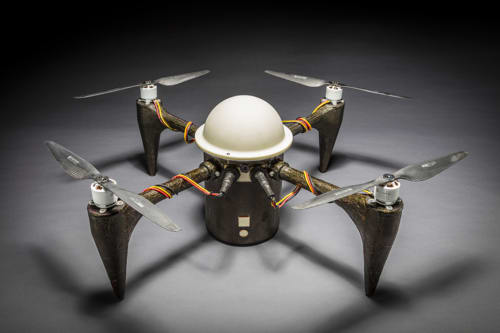
“Engineers at APL have long worked on both Navy submarine systems and autonomous UAVs,” said Jason Stipes of APL’s Sea Control Mission Area, project manager for CRACUNS. “In response to evolving sponsor challenges, we were inspired to develop a vehicle that could operate both underwater and in the air.” The resulting CRACUNS prototype system was developed and tested using internal research and development funding.
CRACUNS enables new capabilities not possible with existing UAV or UUV platforms. Its ability to operate in the harsh littoral (shore) environment, as well as its payload flexibility, enables a wide array of potential missions.
The most innovative feature of CRACUNS is that it can remain at – and launch from – a significant depth without needing structural metal parts or machined surfaces. To make that possible, the team needed to overcome two big challenges. First, the APL team leveraged advances in additive manufacturing and novel fabrication techniques available at the Laboratory’s extensive fabrication facilities. The team fabricated a lightweight, submersible, composite airframe able to withstand the water pressure experienced while submerged.
The second significant challenge was to ensure CRACUNS could not just survive, but operate effectively in a corrosive saltwater environment. To do that, the APL team sealed the most sensitive components in a dry pressure vessel. For the motors that are exposed to salt water, APL applied commercially available protective coatings. The team tested the performance of the motors by submerging them in salt water. Two months later, they showed no sign of corrosion and continued to operate while submerged.
“CRACUNS successfully demonstrated a new way of thinking about the fabrication and use of unmanned systems,” said APL’s Rich Hooks, an aerospace and mechanical engineer who was responsible for the novel additive manufacturing techniques used on CRACUNS.
One other advantage CRACUNS has is its low cost, which makes it expendable, allowing for the use of large numbers of vehicles for high-risk scenarios.
More From SAE Media Group
Tech Briefs
Flimmer: The Flying, Swimming Drone
Aerospace Manufacturing and Machining INSIDER
Meeting the Demands of Defense Production and Sustainment Through Additive Manufacturing
Aerospace & Defense Tech Briefs
3D Printing Parts for Ships, Submarines and Underwater Vehicles
Aerospace & Defense Tech Briefs
Playing Defense — Uncertain Regulations Stall the Implementation of Counter-UAS Technology in The U.S.
Defense INSIDER
Northrop Grumman Assembles First Manta Ray UUV Prototype
Aerospace & Defense Tech Briefs
DoD to Deploy Thousands of Low Cost Autonomous Systems Under Replicator Program
Aerospace & Defense Tech Briefs
Interoperability Standards Pave the Way for Modular Robotic Manipulators
Tech Briefs
Drones Change Shape Mid-Flight
Aerospace & Defense Tech Briefs
Designing Future Autonomous Underwater Vehicles

Aerospace & Defense Tech Briefs
AI-Trained Vehicles Can Adjust to Extreme Turbulence on the Fly
Aerospace & Defense Tech Briefs
Robotic Rotational Molding Creates New Opportunities for Military and Aerospace Applications

Aerospace & Defense Tech Briefs
Unmanned Aerial Vehicles
Aerospace INSIDER
Air Force Researchers Design, Build and Fly Drone in 24 Hours
Robotics & Automation INSIDER
MIT Engineers Help Multirobot Systems Stay In the Safety Zone
Tech Briefs
2025 Award Finalists
Tech Briefs
Experimental Hybrid Drone Transforms in Flight
Defense INSIDER
3D Printing Parts for Ships, Submarines and Underwater Vehicles


Tech Briefs
Insect-Sized Agile Drones
Tech Briefs
Charging Port for Autonomous Drone Swarms
Aerospace & Defense Tech Briefs
Lockheed Martin Will Merge Machine Learning with 3D Printing
Aerospace & Defense Tech Briefs
AUVSI XPONENTIAL 2021 in Atlanta
Top Stories
NewsSensors/Data Acquisition
 Microvision Aquires Luminar, Plans Relationship Restoration, Multi-industry Push
INSIDERRF & Microwave Electronics
 A Next Generation Helmet System for Navy Pilots
INSIDERWeapons Systems
 New Raytheon and Lockheed Martin Agreements Expand Missile Defense Production
NewsAutomotive
 Ford Announces 48-Volt Architecture for Future Electric Truck
INSIDERAerospace
 Active Strake System Cuts Cruise Drag, Boosts Flight Efficiency
ArticlesTransportation

Webcasts
Aerospace
 Cooling a New Generation of Aerospace and Defense Embedded...
Energy
 Battery Abuse Testing: Pushing to Failure
Power
 A FREE Two-Day Event Dedicated to Connected Mobility
Automotive
 Quiet, Please: NVH Improvement Opportunities in the Early Design Cycle
Electronics & Computers
 Advantages of Smart Power Distribution Unit Design for Automotive &...
Unmanned Systems
 Sesame Solar's Nanogrid Tech Promises Major Gains in Drone Endurance