




SIPHER: Scalable Implementation of Primitives for Homomorphic Encryption
Improving the efficiency and scalability of Fully Homomorphic Encryption (FHE).
Prior to the Proceed program, the main challenges preventing practical demonstrations and use of Fully Homomorphic Encryption (FHE) were efficiency and scalability. At the start of the Program, the state-of-the-art FHE implementations were both inefficient and not scalable. Work in Scalable Implementation of Primitives for Homomorphic EncRyption (SIPHER) has brought FHE into the realm of practice, bringing several orders of magnitude runtime improvement, and resulting in FHE implementations that can be executed on single and multicore computers (including iPhones). Furthermore, implementation of an FHE hardware accelerator on a Virtex 7 Field Programmable Gate Array (FPGA) can speed up core FHE functions by over three orders of magnitude.
Previous FHE schemes were inefficient because the underlying algorithms and their implementations took too long to run at an appropriate level of assured security. Similarly, these FHE schemes were not scalable because memory requirements for encrypting practical-length messages with a reasonable level of security exceed the abilities of highly parallel computation devices like FPGAs. These issues are driven by several factors:
- The very large keys required for an assured level of security and large expansion of unencrypted plaintext messages to encrypted ciphertext.
- The large computation depth needed for Bootstrapping/Recryption circuits (an efficiency bottleneck of FHE schemes).
- The lack of scalable and highly optimized implementations of basic modulus ring operations, which are building blocks used across many lattice FHE schemes.
These activities culminated in many orders of magnitude improvement for these bottlenecks. This revolutionary improvement was achieved by significantly advancing the state of the art in a number of independent focus areas:
- Multiple foundational improvements in the underlying FHE scheme for more efficient and scalable implementations of FHE operations. These improvements include a new approach to FHE Recryption, and the use of modulus and ring reduction to limit ciphertext expansion.
- Parallelizable, efficient algorithm design for scalable implementations of basic computational primitives at the core of lattice FHE schemes improving runtime of all FHE operations.
- Advanced code development approach for efficient and flexible embedded and FPGA implementations.
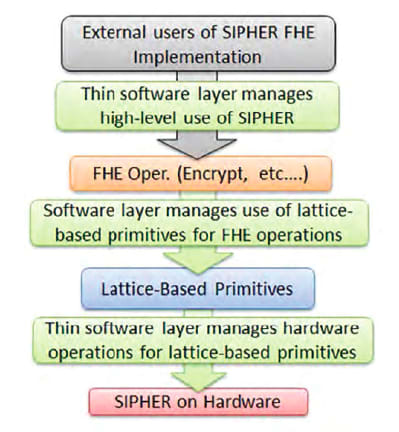
The accompanying Figure shows the layered SIPHER approach. Software interfaces are provided for optimized basic FHE operations. This lets users construct general applications computing on encrypted data. Core lattice-based primitives form the heart of the FHE implementations. This modular approach allows users to:
- construct and experimentally modify multiple implementations of FHE operations and
- easily deploy code on FPGA hardware to run the primitives on cost-effective, massively parallel hardware, providing 3 orders of magnitude improvement in basic FHE operation runtimes.
This work was done by David Cousins, Kurt Rohloff, Christopher Peikert, and Daniel Sumorok of Raytheon BBN Technologies for the Air Force Research Laboratory. AFRL-0244
This Brief includes a Technical Support Package (TSP).
SIPHER: SCALABLE IMPLEMENTATION OF PRIMITIVES FOR HOMOMORPHIC ENCRYPTION
(reference AFRL-0244) is currently available for download from the TSP library.
Don't have an account?
More From SAE Media Group

Off-Highway Engineering
AI Moves into Military Boards and Subsystems

Medical Design Briefs
Benefits of Using Rigorously Tested Routines From Numerical Libraries
Aerospace Manufacturing and Machining INSIDER
Army Launches CMOSS Prototyping Competition for Computer Chassis and Cards
Aerospace & Defense Tech Briefs
5 Startups Developing AI for Defense Application
Aerospace & Defense Tech Briefs
Hands-on Cybersecurity Studies: Multi-Perspective Analysis of the WannaCry Ransomware
Aerospace & Defense Tech Briefs
Managing Security in FPGA-Based Embedded Systems
Automotive Engineering
Closing Gap to Leverage Enhanced Computational Power for SDV Advancement
Aerospace & Defense Tech Briefs
Inside Story: The Role of the SFFs in Rugged HPEC Computing
Defense INSIDER
Algorithms for Autonomous Marine Vehicles
Aerospace & Defense Tech Briefs
Rugged Server and Display System
Aerospace & Defense Tech Briefs
US Army Tests Avionics in Effort to Upgrade Black Hawk Helicopters from Analog to Digital Glass Cockpit

Off-Highway Engineering
Making Machines Software-Defined No Simple Task

Defense INSIDER
A Quantum Leap for Defense Computing Applications
Aerospace & Defense Tech Briefs
Localization and Mapping of Unknown Locations with Unmanned Ground Vehicles
Aerospace & Defense Tech Briefs
Chrono: A Parallel Physics Library for Rigid-Body, Flexible-Body, and Fluid Dynamics
Air Force Research Laboratory Technology Horizons
Advanced Hardware-in-the-Loop Sensor Simulation
Automotive Engineering
NXP S32 CoreRide Platform Simplifies Development of Software-Defined Vehicles
Aerospace & Defense Tech Briefs
A Hardware-Centric Approach to Countering Side-Channel Threats
Aerospace & Defense Tech Briefs
New Products

Aerospace & Defense Tech Briefs
Thailand Army Vehicle Computer System Upgrades
Aerospace & Defense Tech Briefs
Electronic Flight Bag Users Forum Focuses on Regulatory, AID, Security, Connectivity, Other Pressing Issues
Aerospace & Defense Tech Briefs
In-Network Processing on Low-Cost IoT Nodes for Maritime Surveillance

Aerospace & Defense Tech Briefs
Adamant: A Soon-to-be Open Source, Mission-Critical Flight Software Framework Written in Ada
Defense INSIDER
MIT Report Finds US Lead in Advanced Computing is Almost Gone
Overview
The document discusses threshold cryptographic schemes, focusing on their properties, security, and protocols. A threshold cryptographic scheme allows a group of trustees to perform privileged operations collectively, requiring a minimum number of honest parties (denoted as h) to ensure security and correctness, even if some parties (up to t, where t < h) act adversarially. This setup is crucial for maintaining robustness in cryptographic protocols, particularly in environments where secure erasures cannot be guaranteed.
The paper emphasizes the importance of information-theoretic security, which provides statistical security against adaptive corruptions. This means that the protocols are designed to withstand attacks where adversaries can adapt their strategies based on the information they gather during the execution of the protocol. The authors highlight that their protocols are structured to ensure that commands issued by the environment are always directed towards at least h honest parties in the same round, reinforcing the integrity of the operations performed.
Additionally, the document touches on the learning with errors (LWE) problem, which is a foundational concept in modern cryptography. The LWE problem involves distinguishing between certain distributions that are perturbed by noise, and it has significant implications for the security of cryptographic systems. The authors explore the implications of this problem in the context of their proposed protocols and the overall security framework.
The document also references the Short Integer Solution (SIS) problem, which is closely related to LWE and is used in constructing secure cryptographic primitives. The authors argue that their approach to threshold cryptography, combined with the principles of LWE and SIS, leads to robust and secure protocols that can be applied in various cryptographic applications.
In summary, the document provides a comprehensive overview of threshold cryptographic schemes, their security properties, and the underlying mathematical problems that support their robustness. It emphasizes the need for protocols that can withstand adversarial actions while ensuring that a sufficient number of honest parties are involved in the decision-making process, thereby maintaining the integrity and security of cryptographic operations.
Top Stories
INSIDERDefense
 New Raytheon and Lockheed Martin Agreements Expand Missile Defense Production
NewsAutomotive
 Ford Announces 48-Volt Architecture for Future Electric Truck
INSIDERManufacturing & Prototyping
 Active Strake System Cuts Cruise Drag, Boosts Flight Efficiency
ArticlesTransportation
 Accelerating Down the Road to Autonomy
INSIDERMaterials
 How Airbus is Using w-DED to 3D Print Larger Titanium Airplane Parts
Road ReadyTransportation

Webcasts
Electronics & Computers
 Cooling a New Generation of Aerospace and Defense Embedded...
Power
 Battery Abuse Testing: Pushing to Failure
Connectivity
 A FREE Two-Day Event Dedicated to Connected Mobility
Automotive
 Quiet, Please: NVH Improvement Opportunities in the Early Design Cycle
Transportation
 Advantages of Smart Power Distribution Unit Design for Automotive &...
Aerospace
 Sesame Solar's Nanogrid Tech Promises Major Gains in Drone Endurance