




The Effect of Substrate Emissivity on the Spectral Emission of a Hot-Gas Overlayer
Analytic model demonstrates the impact of emitted background radiation on the molecular gas spectrum.
Recently, in operando optical investigations of high temperature solid oxide electrochemical cells (SOECs) have gained significant traction with several research groups motivated by a need to directly correlate electrochemical performances of SOECs with their associated and complex electrode processes. These techniques (including Raman spectroscopy, ambient x-ray photoelectron spectroscopy, near-infrared thermal imaging, and Fourier transform infrared emission spectroscopy) have demonstrated a significant advantage over traditional, indirect experimental methods by providing direct, non-invasive information in real time along with high temporal, spatial, and/or molecular resolution.
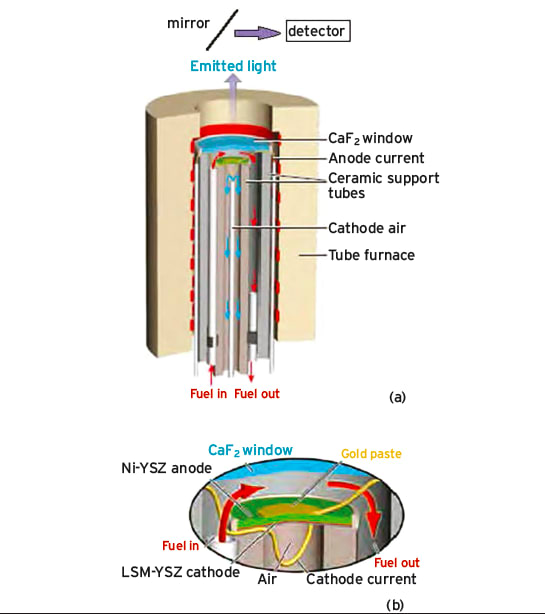
Fourier transform infrared emission spectroscopy, recently implemented for in operando testing of solid oxide fuel cell (SOFC) anodes by Pomfret and coworkers, has become a novel means to directly measure the radiative emission of hot gases within the volume over an anode surface, including CH4, CO2, CO, and H2O (see Figure). In these measurements, a FTIR spectrometer was adapted by removing an infrared glow source from the optical path and aligning in its place the anode surface, located within a furnace cavity. Ideally, the detector will only see the infrared emission of the hot anode surface and any gases in the anode head space, though in reality broad-band, nonmolecular (and frequency dependent) emission sources (e.g. furnace walls) contribute to the majority of the signal reaching the detector. These must be subtracted from each spectrum collected during an experiment to leave behind the difference that shows only molecular contributions.
However, recent emission experiments have indicated that for the FTIR spectra a simple background subtraction may not account for all background contributions. These measurements have been made on a variety of fuels including 100% CH4 and mixtures of CH4/Ar and simulated biogas (50% CH4 and 50% CO2, balance Ar) at various operational temperatures which represent different SOFC operating conditions.
In operando IR emission spectra collected during operation with both fuels described above show that CO2 emission is significantly attenuated relative to other gas constituents. On the other hand, ex situ IR absorption measurements from the same experiments have demonstrated that CO2 absorption is optically thick and very intense relative to other gas constituents in the spectrum.
Additionally, attempts to calibrate the emission intensity of CO2 with concentration in a high-temperature environment indicated a nonlinear response, while FT-IR absorption measurements of the same gases directed into a flow cell showed a linear response as expected.
Interestingly, in the emission experiments, as the concentration of CO2 increased, the normally weak CO2 combination bands at 3600 cm-1 and 3700 cm-1 grew in intensity while the asymmetric stretch at 2350 cm-1 remained relatively unchanged. We expect that the gas composition over the anode headspace is comparable to the exhaust composition, despite the rather large apparent concentration differences inferred from the emission and absorption spectra. To better understand these differences, a model has been implemented to describe how the frequency-dependent substrate emission could affect the emission of a hot gas. This report describes a model where the background radiation is coupled to molecular emission, and cannot be subtracted linearly. Furthermore, the geometry of the test apparatus greatly influences any background radiation through the radiative form factor and reflections from the anode surface.
This work was done by Harold D. Ladouceur, John D. Kirtley, Syed N. Qadri, Jeffrey C. Owrutsky, and Daniel A. Steinhurst for the Naval Research Laboratory. NRL-0067
This Brief includes a Technical Support Package (TSP).
The Effect of Substrate Emissivity on the Spectral Emission of a Hot-Gas Overlayer
(reference NRL-0067) is currently available for download from the TSP library.
Don't have an account?
More From SAE Media Group
Aerospace & Defense Tech Briefs
Next-Generation Spectrometers for Rapid Analysis of Complex Mixtures

Tech Briefs
Correlation Spectrometer
Aerospace & Defense Tech Briefs
Towards Greater Sensitivity: A Brief FTIR and Infrared-Based Cavity Ring Down Spectroscopy Comparative Study



Off-Highway Engineering
Allison’s Now Open for Hydrogen Testing
Tech Briefs
Wide-Area Chemical Sensor
Off-Highway Engineering
Advances in Virtual Powertrain Development
Off-Highway Engineering
After Successful Trials, Cellcentric Moves to Build NextGen Fuel Cell for Anyone
Automotive Engineering
Hydrogen Storage Tank Options: Not Everything Need Look like a Sausage
Off-Highway Engineering
Transmission Talk: Eaton Discusses Its Portfolio of Commercial Gearboxes

Photonics Tech Briefs
Demystifying Spectroscopy
Photonics & Imaging Technology
Compact MEMS-Based NIR Spectroscopy for Mobile Applications
Aerospace & Defense Tech Briefs
3D Meta-Optics for High-Energy Lasers
Tech Briefs
Fuel Cell Boosts Electric-Powered Vehicles
Aerospace & Defense Tech Briefs
Imaging Detonations of Explosives
Tech Briefs
Cryogenic Selective Surfaces

Photonics Tech Briefs
Detecting Hydrazine via Optical Detection of Ammonia
Photonics & Imaging Technology
Advanced Infrared Camera Maps Methane "Hot Spots"
Automotive Engineering
EVs Expand the Testing Envelope
Photonics & Imaging Technology
Researchers Generate Terahertz Laser with Laughing Gas
Tech Briefs
Taking Out the Trash, NASA-Style

Tech Briefs
Composite Panel with Integrated Thermal Control
Tech Briefs
Portable Acousto-Optic Spectrometers
Overview
The document titled "The Effect of Substrate Emissivity on the Spectral Emission of a Hot-Gas Overlayer" is a research report published by the Naval Research Laboratory. It investigates how the emissivity of substrates influences the spectral emission characteristics of hot gas overlays, which is crucial for various applications in thermal management and remote sensing.
The report begins with an executive summary that outlines the primary objectives and findings of the study. It emphasizes the importance of understanding radiative transfer in hot gas environments, particularly in the context of aerospace and defense applications where accurate thermal signatures are essential.
The introduction provides background information on the principles of emissivity and its relevance to thermal radiation. Emissivity is defined as the efficiency with which a surface emits thermal radiation compared to a perfect black body. The study highlights that variations in substrate materials and their emissive properties can significantly affect the thermal radiation emitted by hot gases.
The core of the document includes a detailed discussion of the radiative transfer equation, which is fundamental to modeling the spectral emission of hot gases. The authors present model calculations that demonstrate how different substrate emissivities alter the spectral emission profiles. These calculations are critical for predicting the thermal behavior of materials in high-temperature environments.
The report also examines the effects of surrounding surfaces on the emission characteristics of hot gas overlays. It discusses how the interaction between the gas and the substrate can lead to variations in emitted radiation, which can impact sensor readings and thermal management strategies.
In the conclusions section, the authors summarize their findings, emphasizing the need for accurate emissivity measurements in practical applications. They suggest that understanding the relationship between substrate emissivity and spectral emission can lead to improved designs in thermal systems and enhanced performance in remote sensing technologies.
The document is structured with clear sections, including references for further reading, and is approved for public release, indicating its relevance to both the scientific community and industry stakeholders. Overall, this report contributes valuable insights into the interplay between substrate properties and thermal radiation, which is vital for advancing technologies in various fields.
Top Stories
INSIDERManufacturing & Prototyping
 How Airbus is Using w-DED to 3D Print Larger Titanium Airplane Parts
INSIDERManned Systems
 FAA to Replace Aging Network of Ground-Based Radars
NewsTransportation
 CES 2026: Bosch is Ready to Bring AI to Your (Likely ICE-powered) Vehicle
NewsSoftware
 Accelerating Down the Road to Autonomy
EditorialDesign
 DarkSky One Wants to Make the World a Darker Place
INSIDERMaterials
 Can This Self-Healing Composite Make Airplane and Spacecraft Components Last...
Webcasts
Defense
 How Sift's Unified Observability Platform Accelerates Drone Innovation
Automotive
 E/E Architecture Redefined: Building Smarter, Safer, and Scalable...
Power
 Hydrogen Engines Are Heating Up for Heavy Duty
Electronics & Computers
 Advantages of Smart Power Distribution Unit Design for Automotive...
Unmanned Systems
 Quiet, Please: NVH Improvement Opportunities in the Early Design...
