




Graphene Composite Could Keep Wings Ice-Free
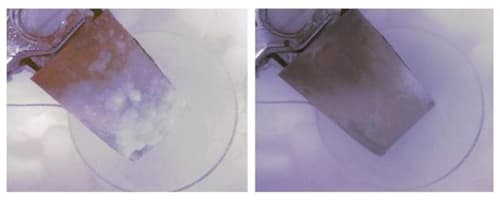
A thin coating of graphene nanoribbons in epoxy developed at Rice University has proven effective at melting ice on a helicopter blade. The lab melted centimeter-thick ice from a static helicopter rotor blade in a -4° F environment. When a small voltage was applied, the coating delivered electrothermal heat – called Joule heating – to the surface, which melted the ice.
The nanoribbons produced commercially by unzipping nanotubes are highly conductive. Rather than trying to produce large sheets of expensive graphene, the lab determined years ago that nanoribbons in composites would interconnect and conduct electricity across the material with much lower loadings than traditionally needed. Previous experiments showed how the nanoribbons in films could be used to de-ice radar domes and even glass, since the films can be transparent to the eye.
More From SAE Media Group
Tech Briefs
Thin Heat Shield for Superfast Aircraft
Aerospace & Defense Tech Briefs
Advanced CT Inspection and Data Analysis

Aerospace & Defense Tech Briefs
Fiber-Reinforced Thermoplastic Composites
Aerospace INSIDER
Dual-Function Aircraft De-Icer Also Prevents Freezing

Aerospace & Defense Tech Briefs
Evaluation of the Effects of Hydrogen Peroxide on Common Aircraft Electrical Materials

Aerospace Manufacturing and Machining INSIDER
Researchers Push Limits in High-Temp, Polymer Additive Manufacturing
Aerospace & Defense Tech Briefs
Thermal Conductivities of Some Polymers and Composites
Tech Briefs
Nano-Infused Ceramic Can Report its own Health
Tech Briefs
Compact, Lightweight, CMC-Based Acoustic Liner

Aerospace & Defense Tech Briefs
Thermoplastic Composites to Play Enhanced Role in Next-Generation Aerospace Applications
Tech Briefs
Sensor Film for Aerospace
Tech Briefs
Electronics Withstand Extreme Heat
Tech Briefs
Fiber-Metal Laminate Manufacturing Technique
Tech Briefs
Self-Healing, Recyclable, Shape Memory Polymers
Tech Briefs
Method Enables Wings to be De-Iced in Flight
Aerospace & Defense Tech Briefs
Composite Repair Engineering Case Studies for U.S. Army Aerostructures
Aerospace INSIDER
Making Airplane Parts Without the Massive Infrastructure
Aerospace & Defense Tech Briefs
Cold Spray Technology
Tech Briefs
Technique Creates Adaptive Materials
Tech Briefs
Products of Tomorrow

Aerospace & Defense Tech Briefs
Sensing Applied Load and Damage Effects in Composites with Nondestructive Techniques
Aerospace & Defense Tech Briefs
Robotic Paint Removal System
Top Stories
INSIDERManufacturing & Prototyping
 How Airbus is Using w-DED to 3D Print Larger Titanium Airplane Parts
INSIDERManned Systems
 FAA to Replace Aging Network of Ground-Based Radars
NewsTransportation
 CES 2026: Bosch is Ready to Bring AI to Your (Likely ICE-powered) Vehicle
NewsSoftware
 Accelerating Down the Road to Autonomy
EditorialDesign
 DarkSky One Wants to Make the World a Darker Place
INSIDERMaterials
 Can This Self-Healing Composite Make Airplane and Spacecraft Components Last...
Webcasts
Defense
 How Sift's Unified Observability Platform Accelerates Drone Innovation
Automotive
 E/E Architecture Redefined: Building Smarter, Safer, and Scalable...
Power
 Hydrogen Engines Are Heating Up for Heavy Duty
Electronics & Computers
 Advantages of Smart Power Distribution Unit Design for Automotive...
Unmanned Systems
 Quiet, Please: NVH Improvement Opportunities in the Early Design...
