




Researchers Urge Changes to Design of Commercial Aircraft Engines
Virginia Tech researchers are urging changes in how commercial aircraft engines are designed in the wake of a possible new threat to passenger aircraft safety: drones, or unmanned aerial vehicles, being sucked into turbofan engines at high speeds. Such an impact would be devastating to the engine as its blades are ripped to shreds after “ingesting” the hard-shell center of a drone’s electronics housing.
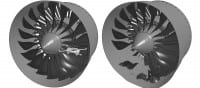
U.S. Federal Aviation Regulations require commercial aircraft to adhere to design criteria that help ensure the aircraft’s survival after a midair collision with smaller “soft” airborne objects, i.e. birds. However, little investigation has been conducted on the ingestion of drones into larger engines.
The researchers urge that more education on safe drone flight use is vital. The team is exploring various methods that could be used to prevent more critical collisions of drones and aircraft. The team notes that engine failure rates and timing can change with different commercial aircraft and different relative impact velocity between the drone and the plane.
More From SAE Media Group

NASA Spinoff
From Shark Searches to Space Tours
Aerospace & Defense Tech Briefs
Rising Star Awards: Women in Engineering Aerospace Winner - Heather Cummings
Tech Briefs
Novel Control Method in Tailless Aircraft
Motion Design INSIDER
Tailless Jet Flies Free with Novel Control Technique
Motion Design INSIDER
AI-Powered Vision System Helps Drones Navigate Safely
Aerospace INSIDER
NASA System Would Enable Unmanned Aircraft to Fly in US Airspace

Aerospace INSIDER
Crashing Into Safe Autonomous Flight
Aerospace INSIDER
Reliable Robotics to Provide Aircraft Automation Study for US Air Force
Aerospace & Defense Tech Briefs
Small UAV Satcom System

Aerospace & Defense Tech Briefs
Assessment of Noncommercial Icing Prediction Capabilities for Army Applications
Aerospace INSIDER
Wing Configuration Could Reduce Fuel Consumption
Aerospace & Defense Tech Briefs
Uncrewed Solar Aircraft Passes Key Ground Tests

Aerospace INSIDER
NASA’s Quiet Supersonic Demonstrator Jet Completes First Flight
Aerospace INSIDER
Archer Aviation Completes Midnight eVTOL Transition Flight Milestone
Aerospace INSIDER
Drones More Damaging to Aircraft than Birds
Aerospace & Defense Tech Briefs
Hybrid Electric Aircraft Demonstrator
Aerospace & Defense Tech Briefs
Mission Control System
Aerospace & Defense Tech Briefs
Airbus to Fly Prototype eVTOL This Year

Aerospace & Defense Tech Briefs
MQ-25 Vehicle Management Computer Upgrade
Aerospace & Defense Tech Briefs
MUSHER Demonstrates Manned-Unmanned Aircraft Teaming Applications
Aerospace INSIDER
EASA Ready to Adopt Final Regulations for eVTOL Operations
NASA Spinoff
Flying (Not Quite) Blind
Aerospace INSIDER
Platform Converts Standard Aircraft to UAV, and Back
Top Stories
INSIDERManufacturing & Prototyping
 How Airbus is Using w-DED to 3D Print Larger Titanium Airplane Parts
INSIDERManned Systems
 FAA to Replace Aging Network of Ground-Based Radars
NewsTransportation
 CES 2026: Bosch is Ready to Bring AI to Your (Likely ICE-powered) Vehicle
NewsSoftware
 Accelerating Down the Road to Autonomy
EditorialDesign
 DarkSky One Wants to Make the World a Darker Place
INSIDERMaterials
 Can This Self-Healing Composite Make Airplane and Spacecraft Components Last...
Webcasts
Defense
 How Sift's Unified Observability Platform Accelerates Drone Innovation
Automotive
 E/E Architecture Redefined: Building Smarter, Safer, and Scalable...
Power
 Hydrogen Engines Are Heating Up for Heavy Duty
Electronics & Computers
 Advantages of Smart Power Distribution Unit Design for Automotive...
Unmanned Systems
 Quiet, Please: NVH Improvement Opportunities in the Early Design...
