




Boeing Reveals Innovative Method of Building 777 Fuselages
Boeing announced on the opening day of the Farnborough Air Show that it is in the final phases of testing and production readiness of a new method for building 777 fuselages “as part of its ongoing technology investment strategy.”
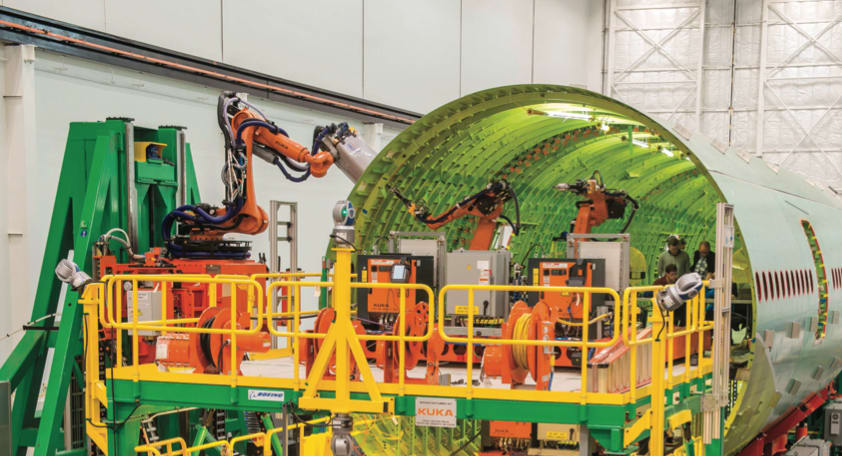
With this new technology, fuselage sections will be built using automated, guided robots that will fasten the panels of the fuselage together, drilling and filling the more than approximately 60,000 fasteners that are today installed by hand.
FAUB offers numerous benefits including an improvement in employee safety. The nature of the drilling and filling work makes it suitable for an automated solution. According to Boeing, more than half of all injuries on the 777 program have occurred during the phase of production that is now being automated. In addition, the automated system is expected to reduce build times and improve first-time quality of the build process. For a video of how the process works, go to www.techbriefs.com/tv/boeing.
“This is the first time such technology will be used by Boeing to manufacture wide-body commercial airplanes,” said Elizabeth Lund, Vice President and General Manager, 777 program and Everett site, Boeing Commercial Airplanes. “We're excited to continue improving the production process here and we're positioning ourselves to begin building 777X airplanes in the future.”
The 777 program has already begun testing FAUB at a facility in Anacortes, WA. Production readiness preparations are underway and the system will be installed in Everett in a new portion of the main factory that is under construction now. The technology is expected to be implemented in the next few years.
The robotic system, designed for Boeing by KUKA Systems, is the latest in a series of strategic advanced manufacturing moves on the 777 program, which have already included new systems for painting wings and other drilling operations.
More From SAE Media Group
Aerospace & Defense Tech Briefs
Boeing Reveals at Farnborough Innovative Method of Building 777 Fuselages
Aerospace & Defense Tech Briefs
Boeing Completes Assembly of the First 777X
Aerospace & Defense Tech Briefs
Industry Invited to Participate in AeroTech Aerospace and Defense Technical Program
Aerospace & Defense Tech Briefs
Rear Fuselage Packer
Aerospace & Defense Tech Briefs
Flight Testing Microvanes and Riblets
Aerospace & Defense Tech Briefs
Automated drilling machine takes the burr out of fuselage joint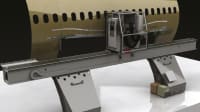
Aerospace & Defense Tech Briefs
Excalibur Flight Test and Modification
Aerospace & Defense Tech Briefs
Lockheed Martin and Arconic Collaborate on 3D Printing and Advanced Aerospace Materials
Aerospace Manufacturing and Machining INSIDER
Northrop Grumman and Airbus Partner on “Wing of Tomorrow” Program
Aerospace & Defense Tech Briefs
Unmanned Aerial Vehicle
Aerospace & Defense Tech Briefs
Boeing advances automation with smart and portable orbital drilling tools for 787
Aerospace & Defense Tech Briefs
Quality Management Experts Provide Guidance on AS9100 Standard, Equipment Calibration
Aerospace INSIDER
WATCH: Air Force Research Lab's First Flight of XQ-67A Drone
Aerospace INSIDER
Boeing to End 767 Production, Reduce Workforce Amid Ongoing Union Strike
Aerospace INSIDER
Archer Delivers First Midnight eVTOL to US Air Force
Aerospace & Defense Tech Briefs
SAE International Extends Call for Abstracts, Seeks Submissions for AeroTech Conference
Aerospace & Defense Tech Briefs
Business Jets Bounce Back

Aerospace & Defense Tech Briefs
Avionics Upgrade for U.S. Forest Service: Sherpa Aircraft
Aerospace & Defense Tech Briefs
Boeing T-7A Completes First Flight


Aerospace & Defense Tech Briefs
New Boeing Facility Will Improve V-22 Quality, Safety
Aerospace INSIDER
Turkey's KAAN Combat Aircraft Completes First Flight
Aerospace INSIDER
Sweden Taps GKN, Saab to Design Concepts for Future Fighter Jet

Aerospace INSIDER
Key Production Milestones Achieved For F-35 Fighter
Top Stories
INSIDERManufacturing & Prototyping
 How Airbus is Using w-DED to 3D Print Larger Titanium Airplane Parts
INSIDERManned Systems
 FAA to Replace Aging Network of Ground-Based Radars
NewsTransportation
 CES 2026: Bosch is Ready to Bring AI to Your (Likely ICE-powered) Vehicle
NewsSoftware
 Accelerating Down the Road to Autonomy
EditorialDesign
 DarkSky One Wants to Make the World a Darker Place
INSIDERMaterials
 Can This Self-Healing Composite Make Airplane and Spacecraft Components Last...
Webcasts
Defense
 How Sift's Unified Observability Platform Accelerates Drone Innovation
Automotive
 E/E Architecture Redefined: Building Smarter, Safer, and Scalable...
Power
 Hydrogen Engines Are Heating Up for Heavy Duty
Electronics & Computers
 Advantages of Smart Power Distribution Unit Design for Automotive...
Unmanned Systems
 Quiet, Please: NVH Improvement Opportunities in the Early Design...
