




Unmanned Demonstrator Flight Control Systems
North Atlantic Industries
Bohemia, NY
631-567-1100
www.naii.com
North Atlantic Industries (NAI) has been chosen by Lockheed Martin Skunk Works® to provide navigation system solutions for the Aerial Reconfigurable Embedded System (ARES) vertical takeoff and landing (VTOL) demonstrator. Vehicle management computer (VMC) and actuator interface unit (AIU) requirements were met utilizing NAI’s commercial-off-the-shelf (COTS) SIU6 chassis.
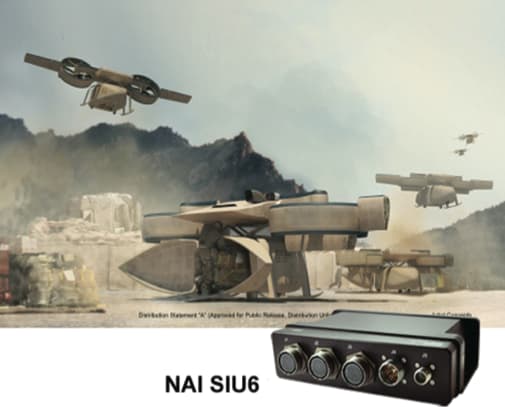 Built on NAI’s Custom-On-Standard Architecture™ (COSA™) platform, the SIU6 chassis is populated with highly configurable PowerPC-based single board computer (SBC) and multi-function I/O 6U VME boards (64EP3 & 64C3). This provides a flexible system solution that allows Lockheed Martin to quickly mix and match functionality based on the ARES application demands.
As part of the ARES navigation system, the SIU6 sensor interface unit enables Lockheed Martin to populate each board with function specific modules. This unique modular architecture offers a selection of up to 10 different or same functions from a broad assortment of low-power, high density modules. Functions include: programmable discretes, analog I/O (A/D, D/A & RTD), communications (RS-232/422/485 & ARINC-429), LVDT measurement, RVDT simulation and LVDT/RVDT AC Excitation. The SWaP-C efficient design increases packaging density, saves enclosure slots and reduces power consumption. In addition, the SIU6 incorporates automatic background Built-in-Test (BIT) testing that is always enabled and continually checks the health of each channel.
Utilizing the 64EP3 6U VME single board computer with configurable multi-function I/O, combined with the U3 PowerPC Processor, ARES’ VMC is triple redundant and controls actuators and various I/O for advanced autonomous flight control. The VMC also communicates with the AIU, which has redundancy by using two AIUs in the system.
The Defense Advanced Research Projects Agency’s (DARPA) ARES program is currently in its third and final phase. “Transporting and resupplying troops in rugged, austere terrain has become a major challenge, especially as the U.S. military shifts to using smaller and more distributed combat units,” said Kevin Renshaw, Lockheed Martin Skunk Works senior principal engineer for ARES. “ARES seeks to demonstrate several key technologies to achieve an operational VTOL system with a more compact footprint than those of conventional helicopters and couple this with higher cruise speeds.”
For Free Info Click Here
More From SAE Media Group
Aerospace & Defense Tech Briefs
Defining an Open System Architecture Standard for Defense Systems
Aerospace & Defense Tech Briefs
Optimal UAS Assignments and Trajectories for Persistent Surveillance and Data Collection from a Wireless Sensor Network
Aerospace & Defense Tech Briefs
Foreign Counter-Unmanned Aerial Systems: Developments in the International Arms Markets
Aerospace & Defense Tech Briefs
Vertical Takeoff and Landing Drone
Aerospace & Defense Tech Briefs
Unmanned Aerial Vehicle
Aerospace & Defense Tech Briefs
Autonomous Air Defense Production
Aerospace & Defense Tech Briefs
Designing Transportable, High-Performance AI Systems for the Rugged Edge

Aerospace & Defense Tech Briefs
Autonomous Collaborative Platform
Aerospace & Defense Tech Briefs
MUSHER Demonstrates Manned-Unmanned Aircraft Teaming Applications
Aerospace & Defense Tech Briefs
Hybrid-Powered Unmanned Helicopter
Aerospace & Defense Tech Briefs
Precision Attack Drone
Aerospace & Defense Tech Briefs
Anti-Drone Jammer
Aerospace & Defense Tech Briefs
MOSA Enclosure Design for Military Systems
Aerospace & Defense Tech Briefs
Nano-UAV Systems
Aerospace & Defense Tech Briefs
Unmanned Aerial Systems Electromagnetic Induction Sensor Development
Aerospace & Defense Tech Briefs
Effectiveness of Inter-Vehicle Communications and On-Board Processing for Close Unmanned Autonomous Vehicle Flight Formations
Aerospace & Defense Tech Briefs
Interoperability Standards Pave the Way for Modular Robotic Manipulators
Aerospace & Defense Tech Briefs
Military Aircraft Systems Technology
Aerospace & Defense Tech Briefs
Enabling Off-the-Shelf Autonomous Naval Warfare
Aerospace & Defense Tech Briefs
Mission Control System
Aerospace & Defense Tech Briefs
Drone Control System
Aerospace & Defense Tech Briefs
How to Test a Cognitive EW System
Off-Highway Engineering
AI Moves into Military Boards and Subsystems
Autonomous Vehicle Engineering
Kontron’s Embedded Boards Help Drive Autonomy Forward
Aerospace & Defense Tech Briefs
A New Approach to Counter-UAS Technology
Aerospace & Defense Tech Briefs
Next Generation Airborne Navigation System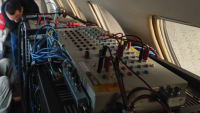
Aerospace & Defense Tech Briefs
Counter-Drone Technology
Aerospace & Defense Tech Briefs
Unmanned Hover Plane
Aerospace & Defense Tech Briefs
Autonomous and Resilient Management of All-Source Sensors for Navigation Assurance
Top Stories
INSIDERManufacturing & Prototyping
 How Airbus is Using w-DED to 3D Print Larger Titanium Airplane Parts
INSIDERManned Systems
 FAA to Replace Aging Network of Ground-Based Radars
NewsTransportation
 CES 2026: Bosch is Ready to Bring AI to Your (Likely ICE-powered) Vehicle
NewsSoftware
 Accelerating Down the Road to Autonomy
EditorialDesign
 DarkSky One Wants to Make the World a Darker Place
INSIDERMaterials
 Can This Self-Healing Composite Make Airplane and Spacecraft Components Last...
Webcasts
Defense
 How Sift's Unified Observability Platform Accelerates Drone Innovation
Automotive
 E/E Architecture Redefined: Building Smarter, Safer, and Scalable...
Power
 Hydrogen Engines Are Heating Up for Heavy Duty
Electronics & Computers
 Advantages of Smart Power Distribution Unit Design for Automotive...
Unmanned Systems
 Quiet, Please: NVH Improvement Opportunities in the Early Design...
