




Power Management for the Electric Taxiing System Incorporating the More Electric Architecture
The electric taxiing system does not require the use of jet engines or the auxiliary power unit.
With airlines increasingly directing their attention to operating costs and environmental initiatives, the More Electric Architecture for Aircraft and Propulsion (MEAAP) is emerging as a viable solution for improved performance and ecofriendly aircraft operations. An electric taxiing system was developed that does not require the use of jet engines or the auxiliary power unit (APU) during taxiing, either from the departure gate to takeoff, or from landing to the arrival gate.
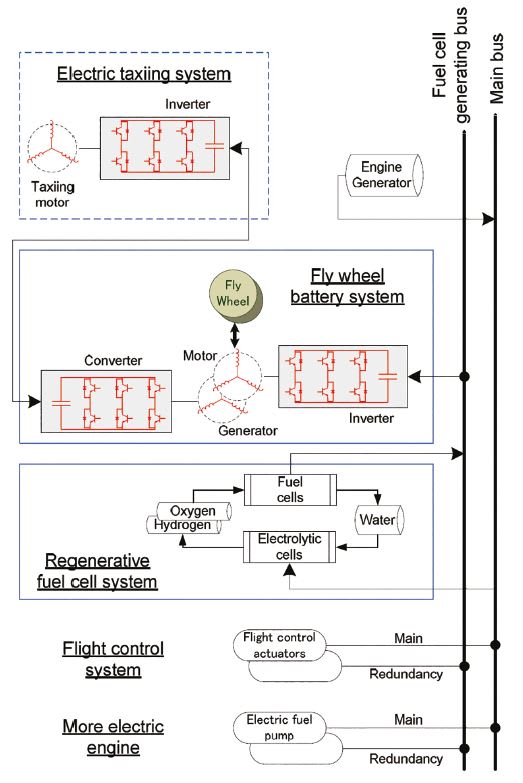
The MEAAP concept offers the promise of greater power management efficiency compared to conventional aircraft systems. Researchers have developed several cornerstone technologies, including high-voltage drivers, fault tolerance systems, and electrical-mechanical engineering technologies, all with the goal of building more efficient electric systems for aerospace applications.
This work targets practical applications of energy management technology, focusing primarily on electric power systems that take over the roles of conventional aircraft systems. This system must address two issues: safety and reliability, and power source and storage. The autonomous taxiing approach must incorporate an electrically driven wheel system. A more eco-friendly approach requires the replacement of devices that run on jet fuel. Instead of an engine or APU generator, a smaller primary power source based on a fuel cell or other battery system can be used. Comprised of a common electric motor and inverter, the electric taxiing system drives the front gear or main gear wheels. Each of the aircraft's electric-powered wheels is controlled by state-of-the-art power electronics and controllers. This system gives pilots total control of aircraft speed, direction, and braking while on the loading apron and taxiway.
This electric system requires a wholly new electric power source. Before taxiing, the aircraft avionics system must be activated, while the environmental control system (ECS), including air conditioning, must work continuously. The ECS must draw its power from another power source, since we cannot draw on conventional engines or APU power. To shift from the engine and APU to a substitute power source at the airport, aircraft systems must be designed to reduce power requirements, since the substitute power sources will have lower energy and power densities than gas turbine generators.
After leaving the loading apron, the aircraft operates on a taxiway. Smooth runway performance in real-world systems will likely require an electrical taxiing system capable of speeds of 30 to 40 km/h. A single-aisle aircraft requires a 6-kW power source to run at 4 km/h. Based on the taxiing speed goal, approximately 60 kW power will be required when running at maximum speed (40 km/h).
As it moves on the taxiway, the aircraft will repeatedly stop and go while lining up and waiting for takeoff. To meet the significant peak power requirements for heavy aircraft, a temporary power energy storage system can augment the primary power source. In addition to accommodating high-density acceleration and bump climbing during the typical taxiway traffic cycle, the power energy storage system can provide energy to the electrically driven wheels with the higher power levels required for relatively short durations.
When the power required to propel the aircraft is less than the power produced by the primary power source, the excess energy can be stored in the power energy storage system for later use, thereby achieving eco friendly power/energy control. General electrical specifications for aircraft systems do not permit regeneration to the electrical system. Regenerative current causes distortion on the power buses. A power energy storage system capable of absorbing high regenerated power during regenerative braking will boost system efficiency. Assuming regenerative power is equivalent to the power required for acceleration, regenerative energy storage must be capable of providing 80 kW over 10 seconds. Several available storage devices can meet these regenerative power needs, including lithium-ion batteries, supercapacitors, and flywheel batteries.
To overcome the issues posed by conventional fuel cell systems, a regenerative fuel cell (RFC) system is one solution for FC fuel supply and onboard storage. An RFC system requires mere water as fuel, since the RFC, which incorporates a water electrolyzer, is an autonomous system that produces oxygen and hydrogen. The RFC consists of proton exchange membrane fuel cells (FC), electrolyte cells (EC) linked to the main power bus, and fuel storage tanks. Some of the main bus power is supplied to the EC to produce hydrogen and oxygen from water for FC operations. The power generated from the main engine generators during climb, cruise, and descent is transmitted to the EC for hydrogen and oxygen refueling, as well as for supplying electricity for all aircraft systems. Hydrogen- and oxygen- fueled FC power is used for electric power generation when needed.
Once the aircraft arrives at the gate, the power supply from an internal source shuts down. Aircraft electricity is provided from the external power supply — the Ground Power Unit (GPU).
The GPU provides the power needed to generate hydrogen and oxygen in the RFC system to prepare for the subsequent flight and operations.
This work was done by Hitoshi Oyori of IHI Aerospace Co. Ltd. and Noriko Morioka of IHI Corporation. The full technical paper on this technology is available for purchase through SAE International at http://papers.sae.org/2013-01-2106 .
More From SAE Media Group
Aerospace & Defense Tech Briefs
Hybrid-electric distributed propulsion explored
Aerospace & Defense Tech Briefs
Engineering an Aircraft Hydrogen Powertrain
Battery Technology
Advancing Battery Technology: THE 2021 BATTERY SHOW Preview
Aerospace & Defense Tech Briefs
Electronics Take Charge
Off-Highway Engineering
Hyundai CE Debuts Hydrogen and Electric Excavators at Bauma 2022
Off-Highway Engineering
GM Hydrotec Boss Readies Fuel Cells for Commercial Deployment
Off-Highway Engineering
Freudenberg to Deliver Batteries, Fuel-Cell Stacks
Off-Highway Engineering
Volvo CE Not Letting up on Electric
Aerospace & Defense Tech Briefs
Rolls-Royce and Superdielectrics Explore Supercapacitor Technology
Automotive Engineering
Hydrogen Industry Vet Says Fuel Cells Still a ‘Go’
Automotive Engineering
Hydrogen Storage in a Box!
Automotive Engineering
BMW Reapproaches Hydrogen
Off-Highway Engineering
Bauma the Big One in 2025
Aerospace & Defense Tech Briefs
Air Mobility Innovations Take Center Stage at Aerospace Systems and Technology Conference
Off-Highway Engineering
Fuel-Cell Power for Monster Mining Trucks in GM, Komatsu Deal
Off-Highway Engineering
Narrower Focus, Bigger Payoff for Commercial EVs
Aerospace & Defense Tech Briefs
Designing a Power Generation System for a More-Electric Aircraft
Aerospace & Defense Tech Briefs
Modeling and Simulation of an Unmanned Ground Vehicle Power System
Off-Highway Engineering
Nikola Producing Battery-Electric Trucks, Fuel-Cell EVs Coming
Off-Highway Engineering
Fuel Cell Production Spurs Supplier Opportunities
Off-Highway Engineering
Volvo Charts Its Path Towards Zero Emissions
Aerospace & Defense Tech Briefs
Bringing Turbine Power to Small Aircraft
Off-Highway Engineering
Hydrogen’s Humming in Power Generation
Off-Highway Engineering
Partnering to Produce Fuel-Cell-Electric Trucks
Off-Highway Engineering
Mahle’s Hydrogen Focus Spans Fuel Cells, ICEs
Aerospace & Defense Tech Briefs
SAE International Issues, Revises Technical Reports for Aerospace Engineering

Tech Briefs
Ruthenium-Doped Thermoelectric Materials
Off-Highway Engineering
Truckin’ on Hydrogen
Top Stories
INSIDERManufacturing & Prototyping
 How Airbus is Using w-DED to 3D Print Larger Titanium Airplane Parts
INSIDERManned Systems
 FAA to Replace Aging Network of Ground-Based Radars
NewsTransportation
 CES 2026: Bosch is Ready to Bring AI to Your (Likely ICE-powered) Vehicle
NewsSoftware
 Accelerating Down the Road to Autonomy
EditorialDesign
 DarkSky One Wants to Make the World a Darker Place
INSIDERMaterials
 Can This Self-Healing Composite Make Airplane and Spacecraft Components Last...
Webcasts
Defense
 How Sift's Unified Observability Platform Accelerates Drone Innovation
Automotive
 E/E Architecture Redefined: Building Smarter, Safer, and Scalable...
Power
 Hydrogen Engines Are Heating Up for Heavy Duty
Electronics & Computers
 Advantages of Smart Power Distribution Unit Design for Automotive...
Unmanned Systems
 Quiet, Please: NVH Improvement Opportunities in the Early Design...
