




Scientists Create Effective Thermal Camouflage And Invisibility Device
Engineers and scientists have been trying to discover the ultimate “cloaking” device, not just to make things disappear magically, but for its applications in defense technology. A team from the National University of Singapore (NUS) Department of Electrical & Computer Engineering, led by Assistant Professor Qiu Chengwei, has successfully created a thermal illusion device to control thermal camouflage and invisibility using thermotic materials. Thermotics is a branch of science dealing with heat and thermodynamics.
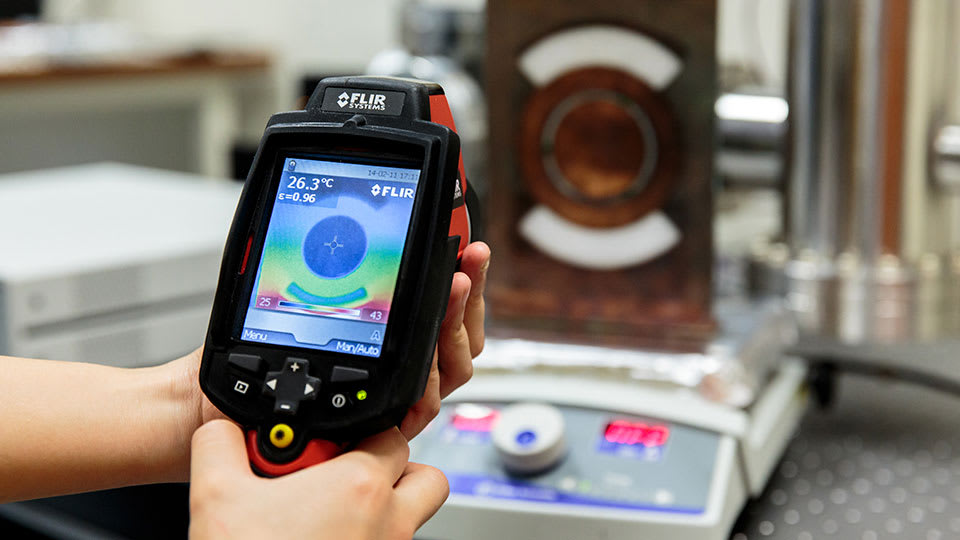
Every natural object exhibits thermal signatures. However, if these signals are blocked or masked, the objects will become undetectable. If you recall the Predator movie (starring Arnold Schwarzenegger), the creature is invisible and is also effectively camouflaged to blend in with its surroundings, making it difficult for it to be tracked down. But this hi-tech creature has an advantage over its hunters, as it detects them using thermal imaging. A "predator" like the one in the movie is, to some extent, actually realizable, using Dr Qiu’s invention. His device could block thermal signatures (leading to invisibility) and provide illusionary camouflage at the same time.
Said Dr Qiu: "This is the first time that such a cloak has been proven to work effectively, based on thermotics. Our success means that now we have a cloaking technology that is cost-effective and easily scalable and applicable to even bigger objects, such as soldiers on night missions. We have managed to control the thermal illusions' shapes, material properties, distributions, and locations using bulk natural materials without sophisticated fabrication. This drastically overcomes practical and challenging limitations of metamaterials, which are not found in nature, and hence would require complicated and complex design to imbue them with special properties. Our new technology has also overcome limitations like narrow bandwidth and polarisation-dependence."
The team has carefully investigated their device in both time-dependent and temperature-dependent conditions and found it to demonstrate excellent thermodynamic performance. The technology is ready to be rolled out for military applications.
Their research has also introduced a new dimension to the emerging field of "phononics", which is the controlling and manipulating of heat flow with phonons (particles which transmit heat within solid materials). A spin-off application of their research, said Dr Qiu, would be in the heat management of highly packed electronic circuits, interconnectors and batteries.
More From SAE Media Group
Defense INSIDER
Engineers Design Novel Multi-Field Invisible Sensor
Electronics & Sensors INSIDER
Blocking Electromagnetic Radiation with the Flip of a Switch
Photonics & Imaging Technology
Chiral Photonic Device Combines Light Manipulation with Memory
Defense INSIDER
Using Squeezed Light to Develop Sensors That Defy Defense Limits

Tech Briefs
Method Miniaturizes Light-Based Chips
Aerospace & Defense Tech Briefs
Shape-Shifting Origami Could Help Antenna Systems Adapt On-the-Fly
Aerospace INSIDER
A New Quantum Materials Research System
Aerospace & Defense Tech Briefs
Design Guidelines for Military and Aerospace PCBs
Aerospace & Defense Tech Briefs
Active Heat Sink Technology to Improve Thermal Performance of Military Systems
Aerospace & Defense Tech Briefs
Considerations for Thermal Management of Printed Wiring Boards
Aerospace & Defense Tech Briefs
Rolls-Royce and Superdielectrics Explore Supercapacitor Technology
Tech Briefs
Wearable Liquid Unit Harvests Energy


Aerospace & Defense Tech Briefs
Future Advances in Electronic Materials and Processes - Flexible Hybrid Electronics
Tech Briefs
Dr. Haiyan Wang Discusses Fuel Cell Work
Electronics & Sensors INSIDER
Careful Heating Unlocks Unprecedented Sensitivity to Pressure in Semiconductor Materials

Electronics & Sensors INSIDER
New Cooling Technique Could Make Computer Chips More Powerful
Embedded Technology INSIDER
Thermal Invisibility Cloak Actively Redirects Heat
Motion Design INSIDER
Computer-Guided Drawing Machine Fabricates Paper Metamaterials
Electronics & Sensors INSIDER
New Technique Pinpoints Nanoscale ‘Hot Spots’ in Electronics
Defense INSIDER
Satellite Communications for the Army’s NGC2 Pilot



Top Stories
INSIDERManufacturing & Prototyping
 How Airbus is Using w-DED to 3D Print Larger Titanium Airplane Parts
NewsAutomotive
 Microvision Aquires Luminar, Plans Relationship Restoration, Multi-industry Push
INSIDERAerospace
 A Next Generation Helmet System for Navy Pilots
INSIDERDesign
 New Raytheon and Lockheed Martin Agreements Expand Missile Defense Production
ArticlesAR/AI
 CES 2026: Bosch is Ready to Bring AI to Your (Likely ICE-powered) Vehicle
Road ReadyDesign

Webcasts
Semiconductors & ICs
 Advantages of Smart Power Distribution Unit Design for Automotive...
Unmanned Systems
 Quiet, Please: NVH Improvement Opportunities in the Early Design...
Electronics & Computers
 Cooling a New Generation of Aerospace and Defense Embedded...
Power
 Battery Abuse Testing: Pushing to Failure
AR/AI
 A FREE Two-Day Event Dedicated to Connected Mobility
